































Essential Limiting Reactant Worksheet | Grades 9-12 Science

Paste this activity's link or code into your existing LMS (Google Classroom, Canvas, Teams, Schoology, Moodle, etc.).
Students can open and work on the activity right away, with no student login required.
You'll still be able to track student progress and results from your teacher account.
This stoichiometry worksheet targets common limiting reactant misconceptions across four progressive parts. Students critique flawed student claims, calculate moles from mass, evaluate particle models, and interpret lab data to determine theoretical yields. By identifying and correcting conceptual errors, high school chemistry learners solidify their understanding of mole ratios and chemical reaction limits.
At a Glance
- Grade: Grades 9–12 · Subject: Science
- Standard: Chemistry Stoichiometry — Use mole ratios and limiting reactants to calculate theoretical product yields
- Skill Focus: Limiting Reactant Misconceptions & Error Analysis
- Format: 4 pages · 20 problems · Answer key included · PDF
- Best For: High school stoichiometry error correction
- Time: 45–60 minutes
What's Inside
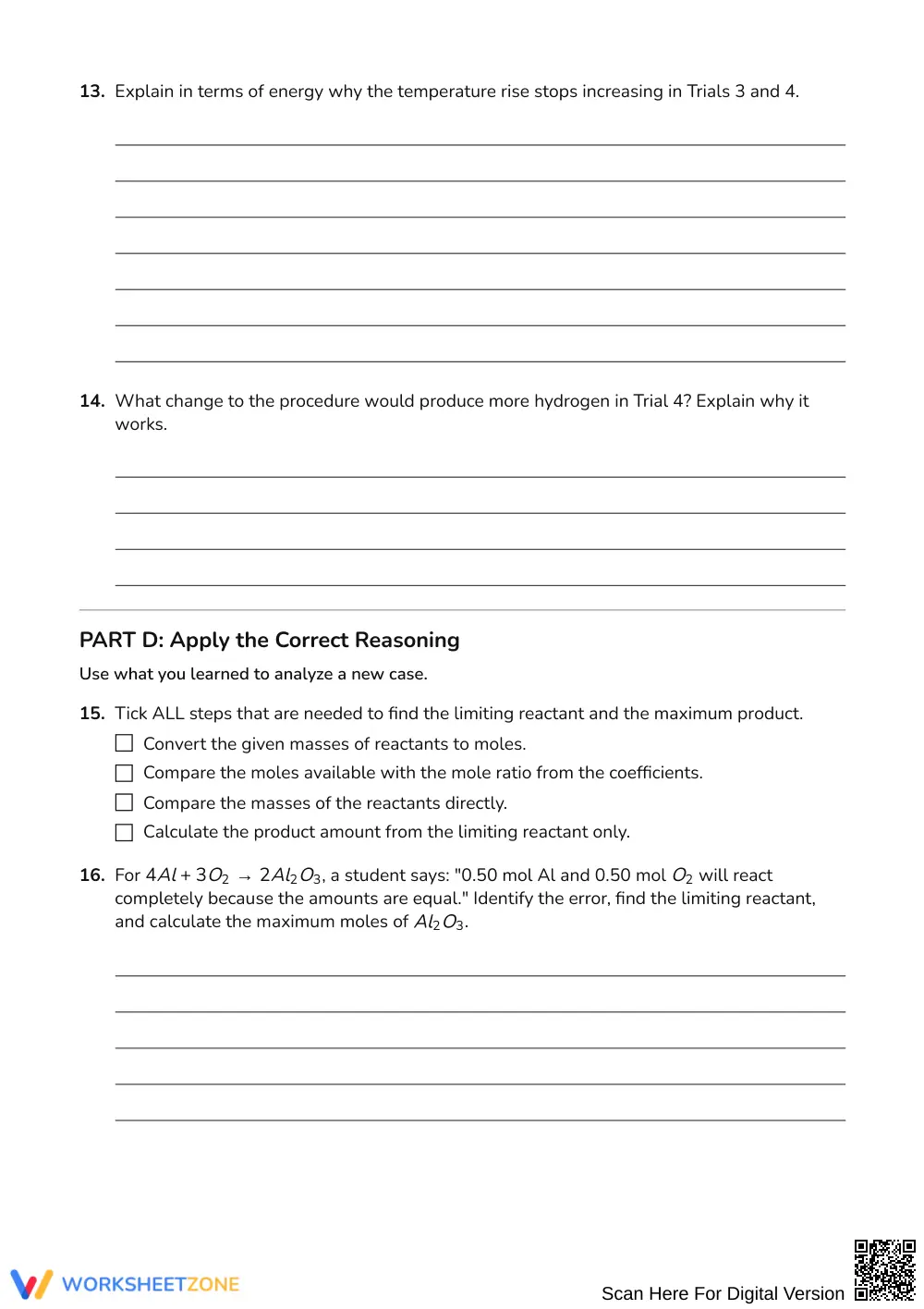
This 4-page printable resource delivers 20 targeted tasks organized into four misconception-busting sections. It includes multi-step mass-to-mole calculations, particle diagram interpretations with an everyday sandwich analogy, empirical lab data analysis comparing gas production and thermal energy across magnesium trials, and a comprehensive 4-page answer key featuring worked solutions and written justifications.
Skill Progression
- Guided Practice (Part A): Students examine a flawed mass-comparison claim, compute molar quantities for hydrogen and oxygen, and rewrite the scientific justification using a 2:1 mole ratio (Tasks 1–5).
- Supported Practice (Parts B & C): Learners analyze particle diagrams using a sandwich analogy before evaluating an empirical four-trial lab dataset tracking hydrogen volume and temperature change (Tasks 6–18).
- Independent Practice (Part D): Students independently select valid procedural steps and solve an unassisted stoichiometry scenario involving aluminum oxide formation (Tasks 19–20).
This structured sequence follows an intentional gradual-release model, shifting students from guided error identification to independent theoretical yield calculation.
Standards Alignment
This worksheet aligns with high school chemistry standards governing chemical reactions and stoichiometry. Students mathematically evaluate chemical amounts to predict relative quantities of products and remaining reactants, applying the law of conservation of mass. Standard alignments can be copied directly into lesson plans, IEP goals, or district curriculum mapping tools.
How to Use It
Assign this activity after direct instruction on balanced equations and mole-to-mole ratios. It functions exceptionally well as mid-unit collaborative group work or post-lab analysis. During class, monitor how students approach Part A Task 1; note whether learners fall into the trap of directly comparing gram values rather than converting to moles first. Expect students to complete the 20 problems in 45 to 60 minutes.
Who It's For
This resource is designed for Grades 9–12 general and honors chemistry students mastering quantitative chemical analysis. Built-in analogies provide scaffolded access for struggling learners, while extension prompts challenge advanced students. Pair this worksheet directly with a laboratory demonstration of the magnesium-hydrochloric acid reaction to reinforce empirical observations.
Research synthesized by Fisher & Frey (2014) emphasizes that systematic error analysis and scaffolded peer critique significantly deepen conceptual retention in secondary science education. When students evaluate non-examples and flawed claims, they move beyond rote algorithmic execution toward robust conceptual mastery of chemical stoichiometry. Rather than memorizing mechanical steps for limiting reactant calculations, learners must examine the underlying proportional logic connecting atomic quantities, particulate models, and macroscopic laboratory observations. This 20-problem worksheet directly operationalizes these pedagogical findings by presenting realistic student misconceptions, prompting stoichiometric calculations, and guiding learners through gradual-release problem-solving. By contrasting mass measurements with stoichiometric mole ratios, students correct deep-seated misunderstandings and build verifiable quantitative proficiency. High school science educators can deploy this four-part diagnostic activity to ensure rigorous, durable mastery of limiting reactant principles in chemistry classrooms.


