































Essential Justifying Similarity Worksheet | Grade 8 Math

Paste this activity's link or code into your existing LMS (Google Classroom, Canvas, Teams, Schoology, Moodle, etc.).
Students can open and work on the activity right away, with no student login required.
You'll still be able to track student progress and results from your teacher account.
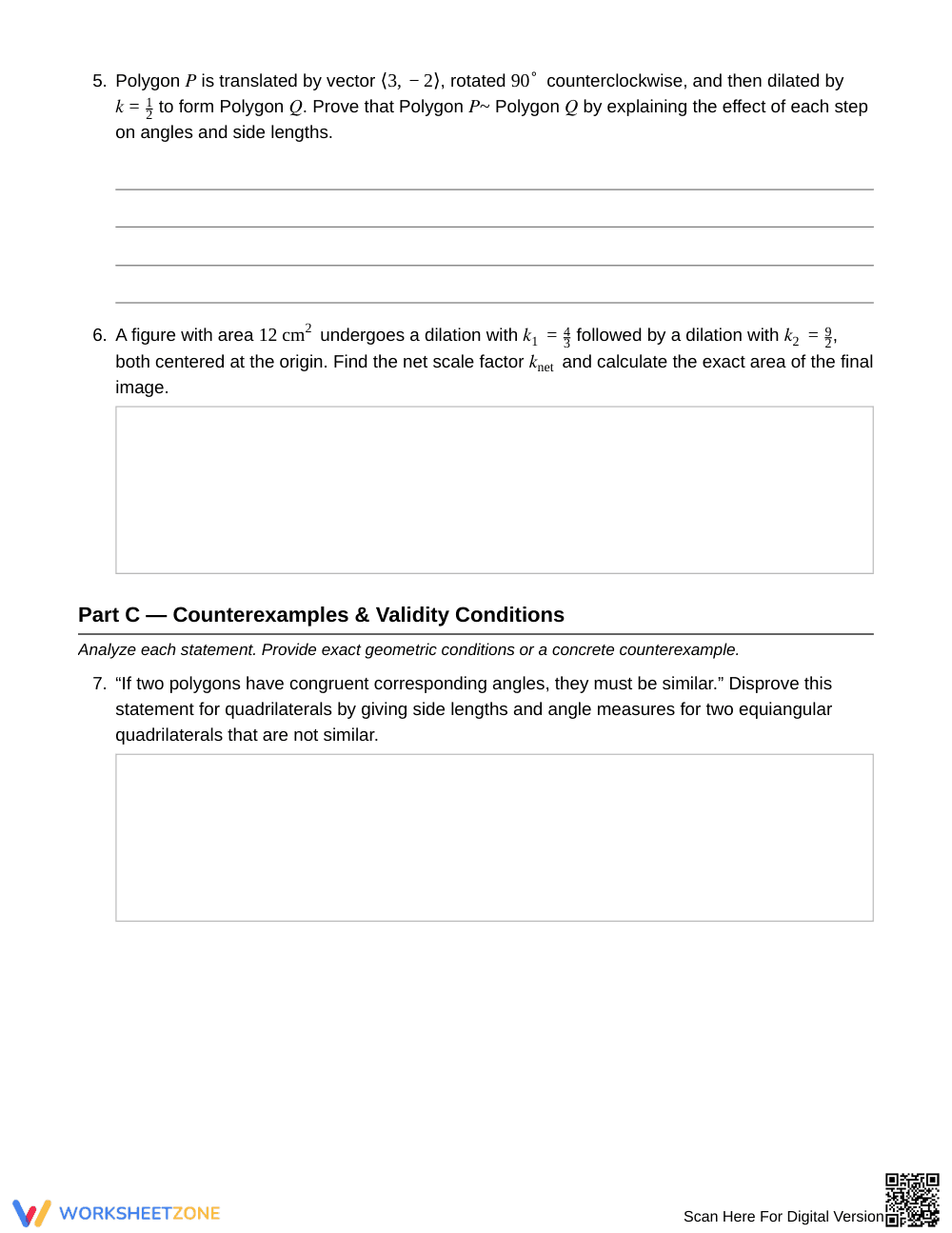
This Grade 8 geometry worksheet helps students justify similarity claims using rigid motions, dilations, and algebraic properties. Learners analyze coordinate rules, verify preservation of angle measure and proportionality, and disprove invalid geometric claims through counterexamples. The 8 problems equip students to construct coherent mathematical arguments.
At a Glance
- Grade: 8 · Subject: Middle School Mathematics
- Standard:
Geometric Similarity— Explain and justify similarity using sequences of rigid transformations and coordinate dilations- Skill Focus: Justify a Similarity Claim Using Transformations
- Format: 4 pages · 8 multi-part problems · Full answer key included · Printable PDF
- Best For: Mid-unit practice, review, or formative assessment
- Time: 45–60 minutes
What's Inside
This 4-page resource includes 8 analytical geometry tasks across three parts, plus a 2-page answer key with step-by-step justifications. A core principles reference block reviews dilation invariants. Students analyze coordinate plane figures, calculate scale factors, write transformation sequences, and formulate geometric counterexamples.
Skill Progression
- Guided practice (Part A, 2 problems): Students critique flawed claims involving negative scale factors and quadrilateral side ratios with structured reference support.
- Supported practice (Part B, 4 problems): Learners write transformation sequences, determine line equations, and compute area scaling factors.
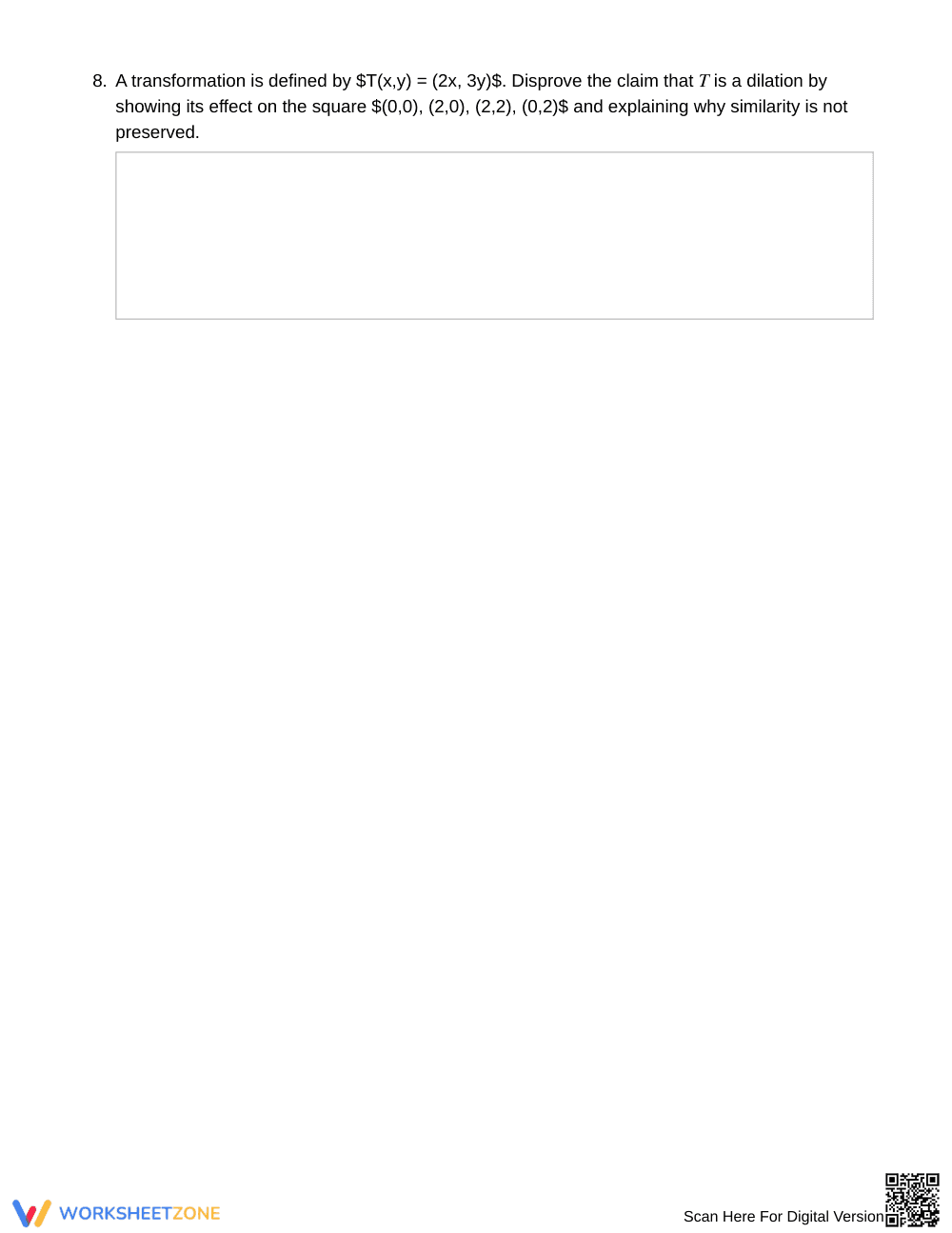
- Independent practice (Part C, 2 problems): Students independently construct counterexamples disproving false assertions about equiangular polygons and non-uniform transformations.
This sequence mirrors the gradual-release model, advancing from peer critique to independent geometric proof.
Standards Alignment
This worksheet aligns with Grade 8 geometry standards requiring students to establish similarity through rotations, reflections, translations, and dilations. Students verify that mappings preserve angle measure and enforce proportional side lengths. These transformation concepts can be referenced directly in lesson plans, IEP goals, or district curriculum maps.
How to Use It
Use this worksheet after direct instruction on dilations or as collaborative partner practice. For formative assessment, check whether students recognize that proportional sides alone do not guarantee quadrilateral similarity. Most students complete these 8 problems in 45 to 60 minutes.
Who It's For
This practice is designed for Grade 8 math students and early high school geometry review. Support striving learners with coordinate grid paper, or challenge advanced students to write general algebraic rules. It pairs effectively with interactive coordinate graphing tools or direct lessons on dilation invariants.
Justifying similarity claims through coordinate transformations demands both conceptual understanding and structured geometric reasoning. According to Fisher & Frey (2014), gradual release of responsibility accelerates student mastery in secondary mathematics by systematically transitioning learners from guided critique to autonomous proof construction. This 4-page Grade 8 resource provides 8 analytical tasks focusing on geometric transformations, prompting students to evaluate scale factors, compose multi-step mapping sequences, and generate precise counterexamples for non-similar figures. By rigorously examining conditions where proportional sides or congruent angles fail to establish similarity, students directly confront and resolve common misconceptions regarding geometric invariants. Complete step-by-step solutions provide classroom teachers with reliable diagnostic benchmarks to assess whether students truly grasp dilations or merely apply algebraic formulas rotely. Consequently, middle school learners build durable mathematical argumentation and proof-writing skills that transfer directly into high school geometric courses.


