































Essential Inverse Operations Worksheet | Grade 6 Math

Paste this activity's link or code into your existing LMS (Google Classroom, Canvas, Teams, Schoology, Moodle, etc.).
Students can open and work on the activity right away, with no student login required.
You'll still be able to track student progress and results from your teacher account.
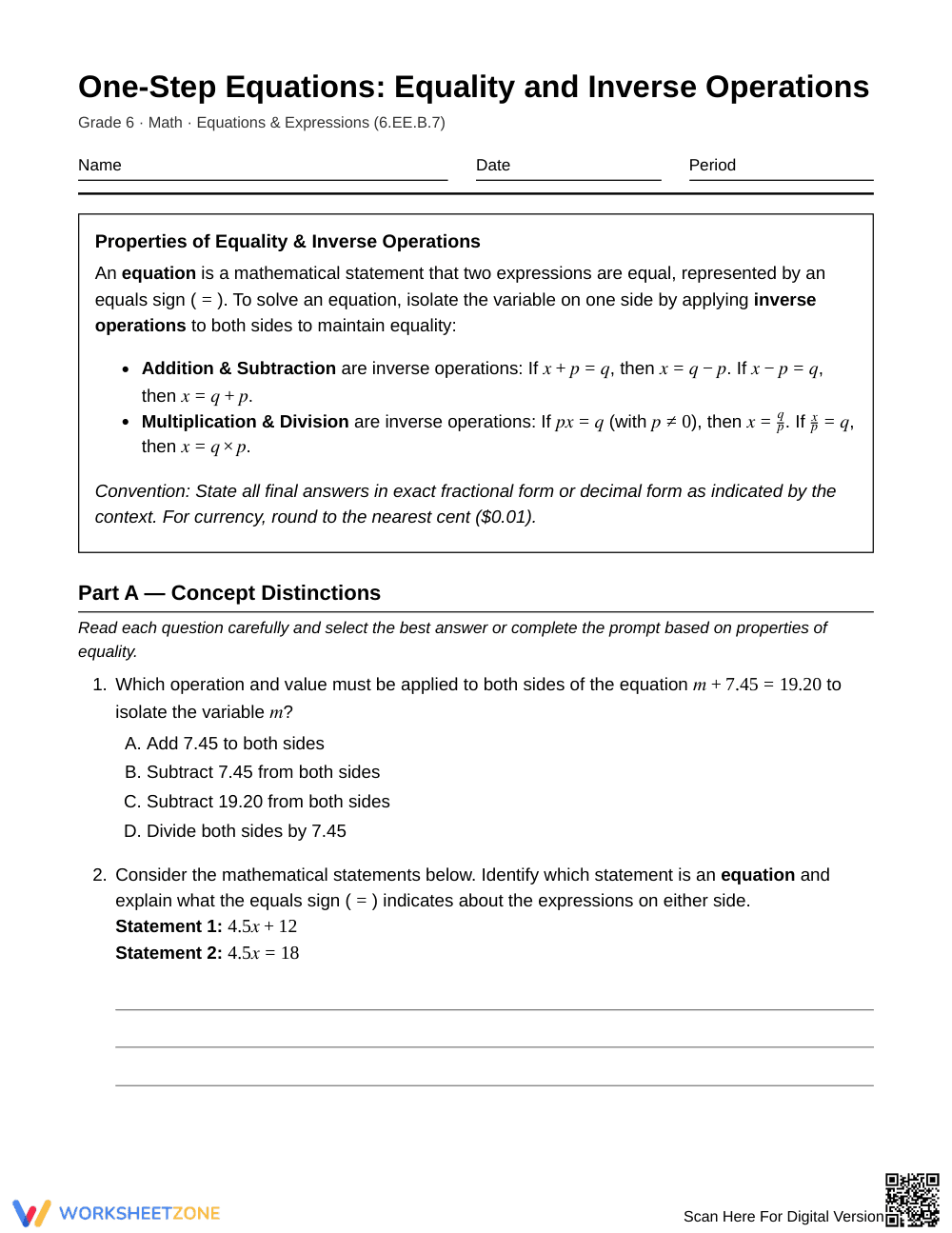
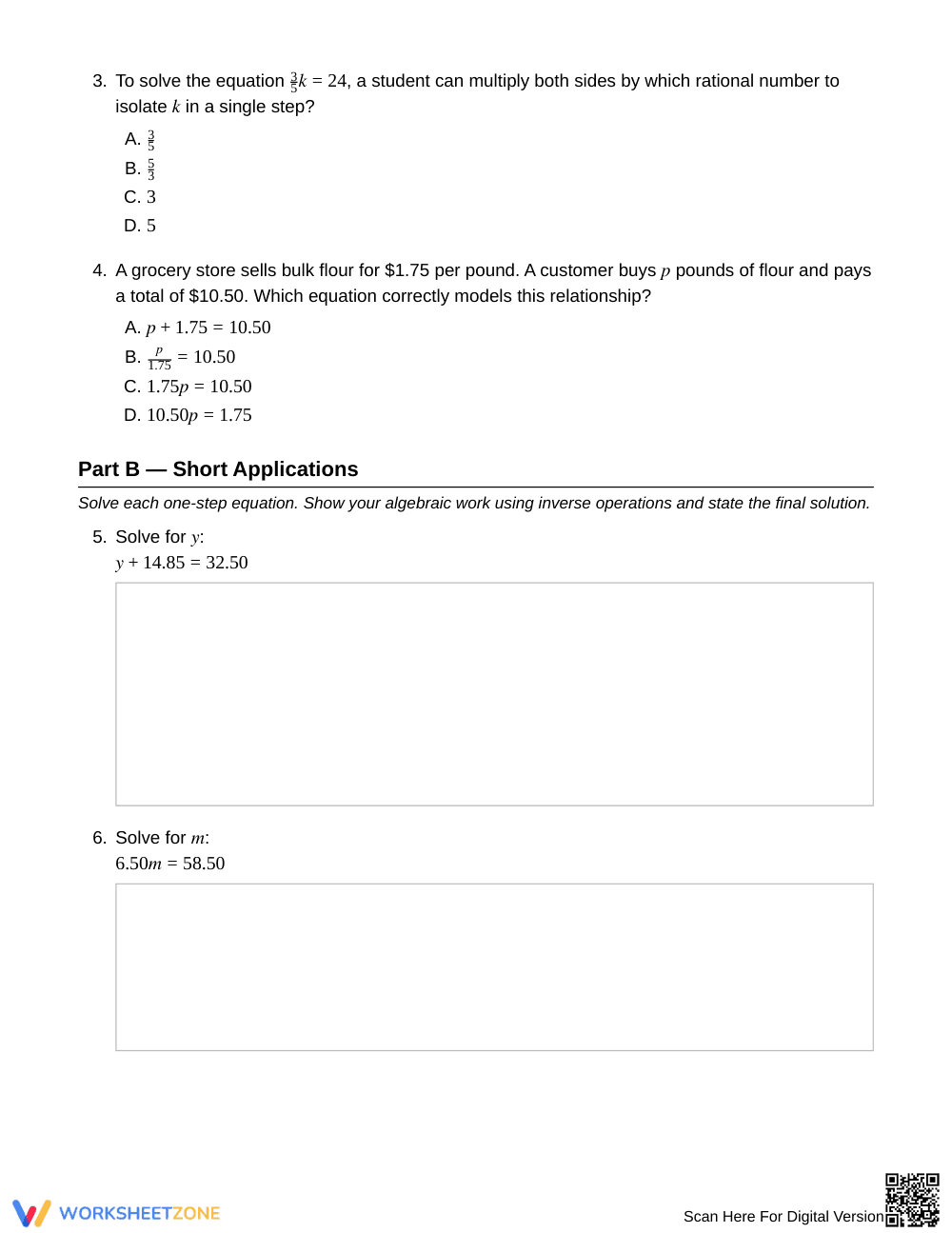
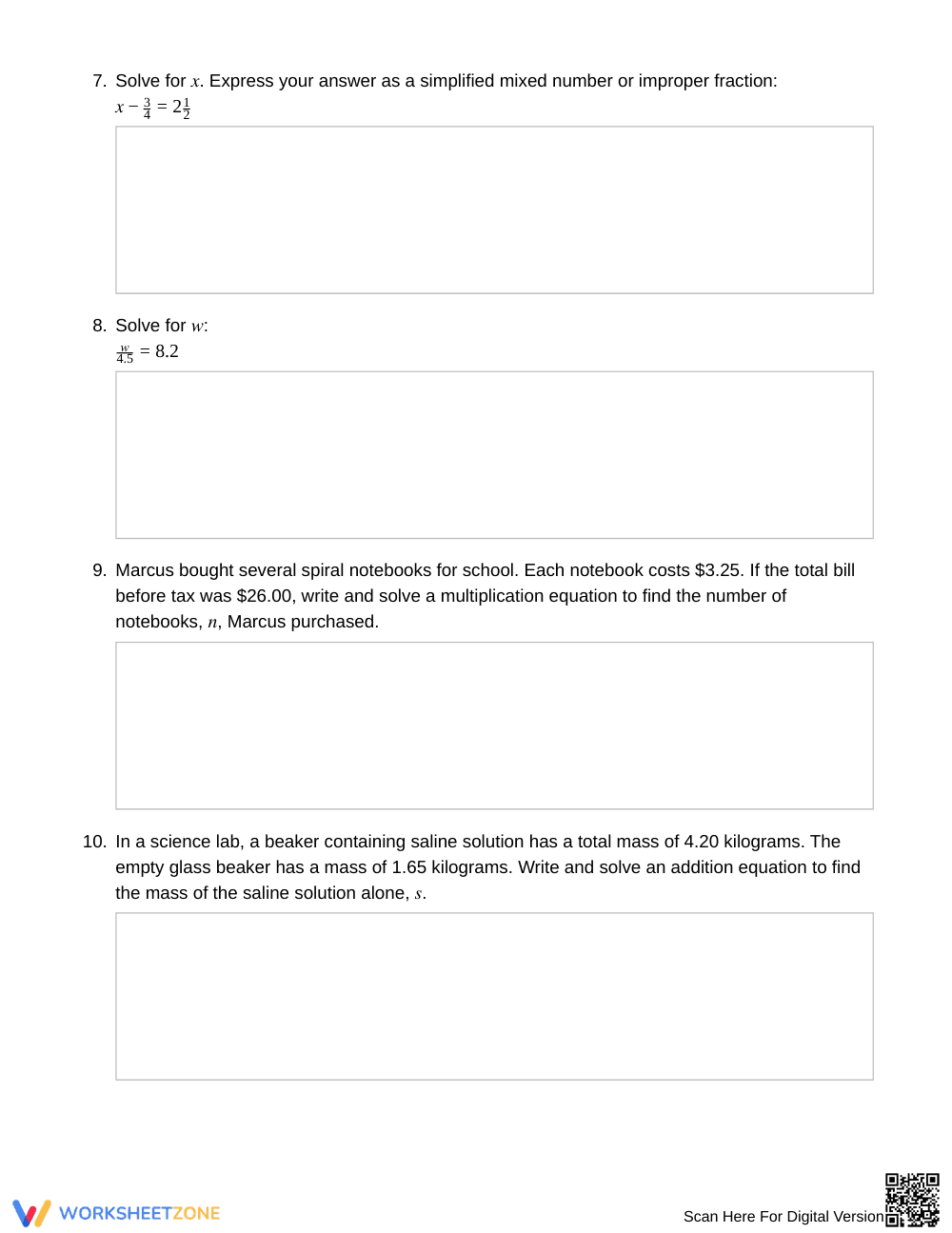
This Grade 6 math worksheet strengthens understanding of equality and inverse operations through 16 structured problems. Students isolate variables, maintain algebraic balance, and solve one-step equations with decimals and fractions. These exercises build essential problem-solving fluency for middle school algebra.
At a Glance
- Grade Level: Grade 6 · Subject: Math
- Standard:
6.EE.B.7— Write and solve one-step linear equations to model and solve real-world problems- Skill Focus: Equality and Inverse Operations
- Format: 5 pages · 16 problems · Complete answer key included · Printable PDF
- Best For: Core classroom practice, small-group remediation, and independent homework
- Time: 35–45 minutes
What's Inside
This 5-page printable resource provides 16 focused tasks and a 3-page answer key with step-by-step solutions. A reference box defines inverse operations for all four arithmetic operations. Problems feature decimals, fractions, mixed numbers, word problems, tables, and error analysis tasks.
Skill Progression
- Guided Practice (Part A — 4 items): Students identify inverse operations, distinguish equations from expressions, and select correct models.
- Supported Practice (Part B — 8 items): Learners solve one-step equations and write algebraic equations from real-world word problems.
- Independent Practice (Part C — 4 items): Students evaluate errors, justify reciprocal multiplication, model data tables, and compare problem scenarios.
This gradual-release structure moves learners smoothly from foundational concepts to independent problem solving.
Standards Alignment
This resource aligns directly with standard `6.EE.B.7` by requiring students to solve real-world and mathematical problems by writing and solving one-step equations. It also supports `6.EE.B.5` by evaluating solution validity. Both standard codes can be copied directly into lesson plans, IEP goals, or district curriculum mapping tools.
How to Use It
Assign this worksheet following direct instruction on inverse operations. During classwork, verify that students apply inverse operations to both sides rather than repeating the operation in the problem. The activity takes 35 to 45 minutes and functions well as partner practice or a formative checkpoint.
Who It's For
This worksheet serves Grade 6 math students, Tier 2 intervention groups, and Grade 5 students needing extension. Pair this activity with an interactive balance scale model or anchor chart illustrating algebraic balance.
According to Fisher & Frey (2014), structured gradual-release frameworks significantly enhance student autonomy and retention when mastering foundational algebraic skills. This Grade 6 worksheet directly supports standard 6.EE.B.7 by developing students' capacity to write and solve one-step linear equations using inverse operations and properties of equality. By beginning with conceptual distinctions, advancing through multi-operation computational tasks, and culminating in error analysis and written mathematical justifications, the 5-page resource scaffolds learners toward complete procedural fluency. Students systematically encounter nonnegative rational numbers in fractional, decimal, and whole-number contexts, reinforcing the core principle that maintaining equivalence across an equals sign is central to all algebraic problem-solving. Educators, instructional coaches, and curriculum specialists can cite this standards-aligned instructional tool as targeted evidence of student progress toward solving real-world mathematical problems and constructing reasoned arguments in middle school algebra units.


