































Essential Integer Powers Worksheet | Grade 8 Math

Paste this activity's link or code into your existing LMS (Google Classroom, Canvas, Teams, Schoology, Moodle, etc.).
Students can open and work on the activity right away, with no student login required.
You'll still be able to track student progress and results from your teacher account.
This Grade 8 math worksheet guides students through integer exponents, zero powers, and negative bases to build foundational algebraic fluency. Learners examine notation patterns, evaluate numerical expressions, and solve applied transfer problems. By addressing common exponent misconceptions directly, students develop conceptual understanding and procedural accuracy across 16 structured tasks.
At a Glance
- Grade: 8 · Subject: Math
- Standard: Apply properties of integer exponents to evaluate and simplify numerical expressions
- Skill Focus: Repeated Multiplication and Integer Powers
- Format: 5 pages · 16 problems · Answer key included · Printable PDF
- Best For: Conceptual math practice, misconception intervention, and chapter review
- Time: 40–50 minutes
What's Inside
This 5-page printable resource pairs a two-page student worksheet with a three-page complete answer key. A reference chart defines positive, zero, and negative exponents alongside powers of ten. The 16 problems feature conceptual comparison tasks, numerical evaluations involving fractions and decimals, and real-world transfer problems.
Skill Progression
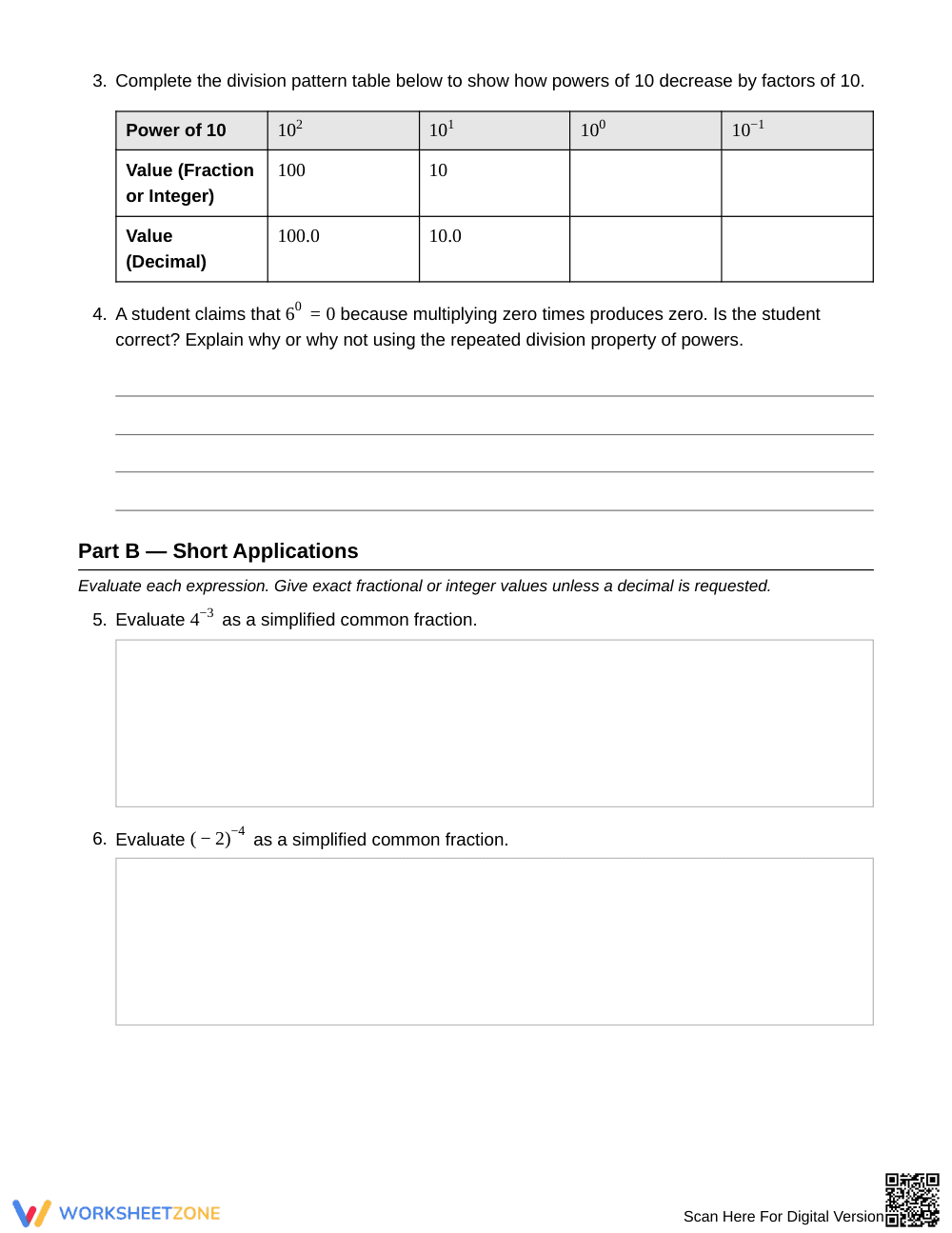
- Guided practice (Part A — 4 tasks): Students analyze core distinctions using the reference box, evaluate negative bases versus negative signs, complete a base-10 division pattern, and explain zero exponents.
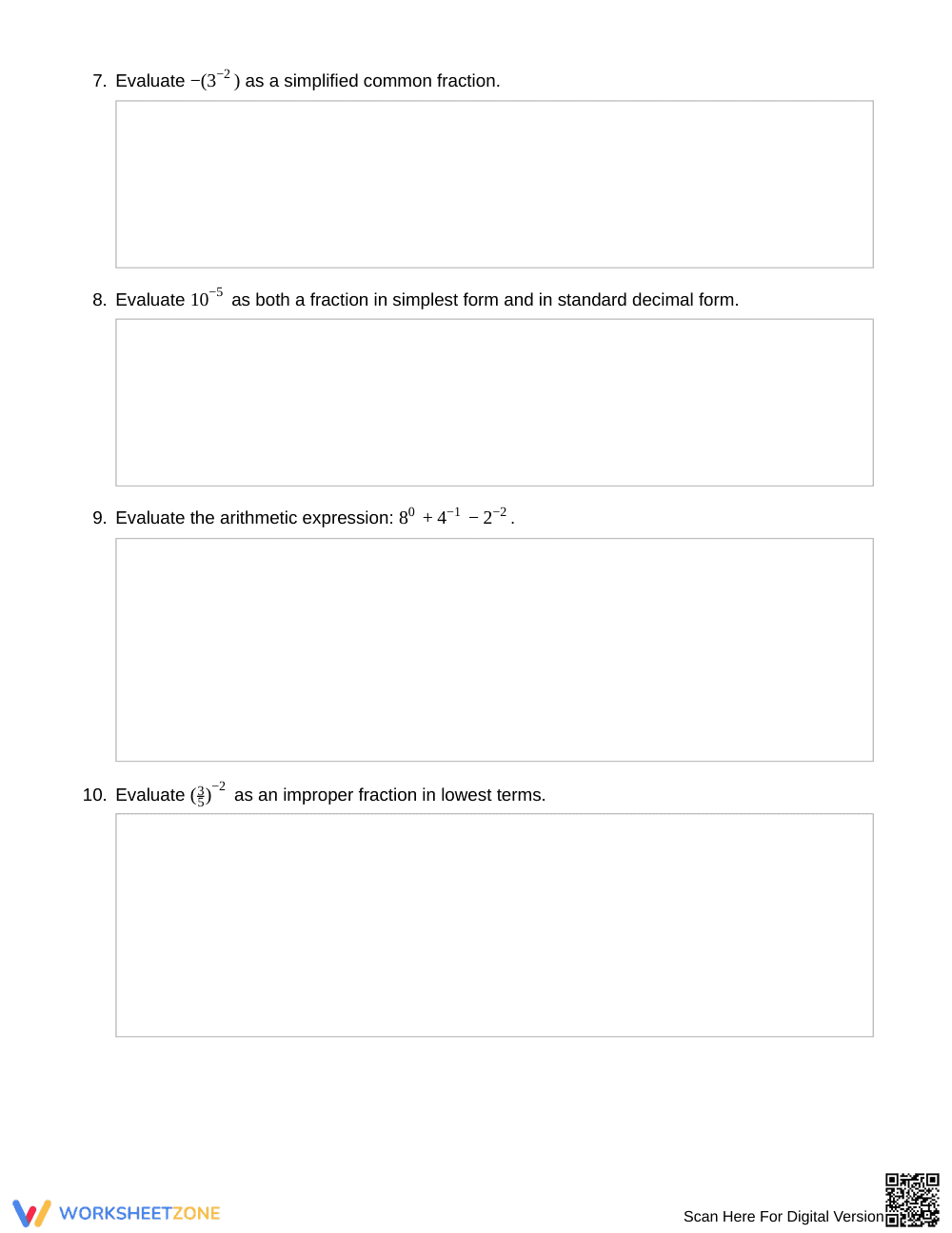
- Supported practice (Part B — 8 tasks): Learners evaluate numeric expressions with zero and negative powers, converting results into simplified fractions, decimals, or single powers with specified bases.
- Independent practice (Part C — 4 tasks): Students complete multi-step applications, including ordering biological specimen lengths in scientific powers of ten, writing a division proof, and modeling exponential decay.
This sequence follows the gradual release of responsibility model, guiding students toward autonomous mastery.
Standards Alignment
This worksheet aligns with middle school mathematics standards: know and apply the properties of integer exponents to generate equivalent numerical expressions. It also supports learning progressions requiring students to explain how negative exponents define place value in scientific notation. Both standard codes can be copied directly into lesson plans, IEP goals, or district curriculum mapping tools.
How to Use It
Assign this worksheet after direct instruction on integer powers. Use Part A for partner discussions to clarify sign rules, followed by Part B as independent practice. Alternatively, assign the entire set as an end-of-unit review. During seatwork, check whether students treat negative exponents as negative values rather than reciprocals (such as writing 4^-3 = -12), directing them back to the division pattern table. Expect completion in 40 to 50 minutes.
Who It's For
This resource is built for Grade 8 math students and Algebra 1 classes needing exponent review. Teachers can scaffold learning by highlighting the reference chart or extend it by assigning the Part C transfer problems. It pairs effectively with an anchor chart on exponent rules or a teacher-led modeling lesson.
Grade 8 mathematics standards require students to master repeated multiplication and integer powers by evaluating numerical expressions with zero and negative exponents. According to Fisher & Frey (2014), structured instructional progressions that guide students from foundational concept analysis to independent application significantly enhance retention and procedural accuracy in secondary mathematics. This 5-page educational resource operationalizes that proven framework through 16 clearly sequence-ordered tasks. Students first analyze the structural mechanics of negative bases and division patterns, progress through targeted computation involving fractional and decimal outputs, and finally synthesize understanding through contextual modeling problems. Complete with an exhaustive 3-page step-by-step solutions guide, the materials allow educators to diagnose persistent notation misconceptions, reinforce the conceptual reasoning behind non-positive powers, and document individual student mastery across key algebraic readiness indicators during regular classroom instruction and targeted intervention sessions.


