































Essential Indicators of Change Worksheet | Grade 7 Science

Paste this activity's link or code into your existing LMS (Google Classroom, Canvas, Teams, Schoology, Moodle, etc.).
Students can open and work on the activity right away, with no student login required.
You'll still be able to track student progress and results from your teacher account.
This Grade 7 science worksheet teaches students to evaluate multiple observable indicators to distinguish between physical and chemical changes. Middle school learners analyze evidence such as temperature shifts, gas production, and precipitate formation to determine whether a new chemical substance formed or matter merely altered state, building scientific argumentation skills.
At a Glance
- Grade: 7 · Subject: Science
- Standard: Middle School Physical Science — Analyze indicators to determine whether matter underwent chemical change
- Skill Focus: Weigh Multiple Indicators of Change
- Format: 5 pages · 10 problems · Answer key included · PDF
- Best For: Skill application and formative assessment
- Time: 35–45 minutes
Across 5 instructional pages, students explore a structured reference chart detailing six indicators of change alongside two fully annotated guided models. The student task set contains 10 rigorous items, including a three-step guided inquiry scenario, five independent real-world application problems, and two explanation critique questions. A comprehensive two-page answer key provides complete justifications for every item.
Skill Progression
- Guided Practice: Students review an "Indicators of Change" reference table and two modeled exemplars before completing Items 1–3, using explicit three-step prompts to identify, interpret, and conclude on an antacid reaction.
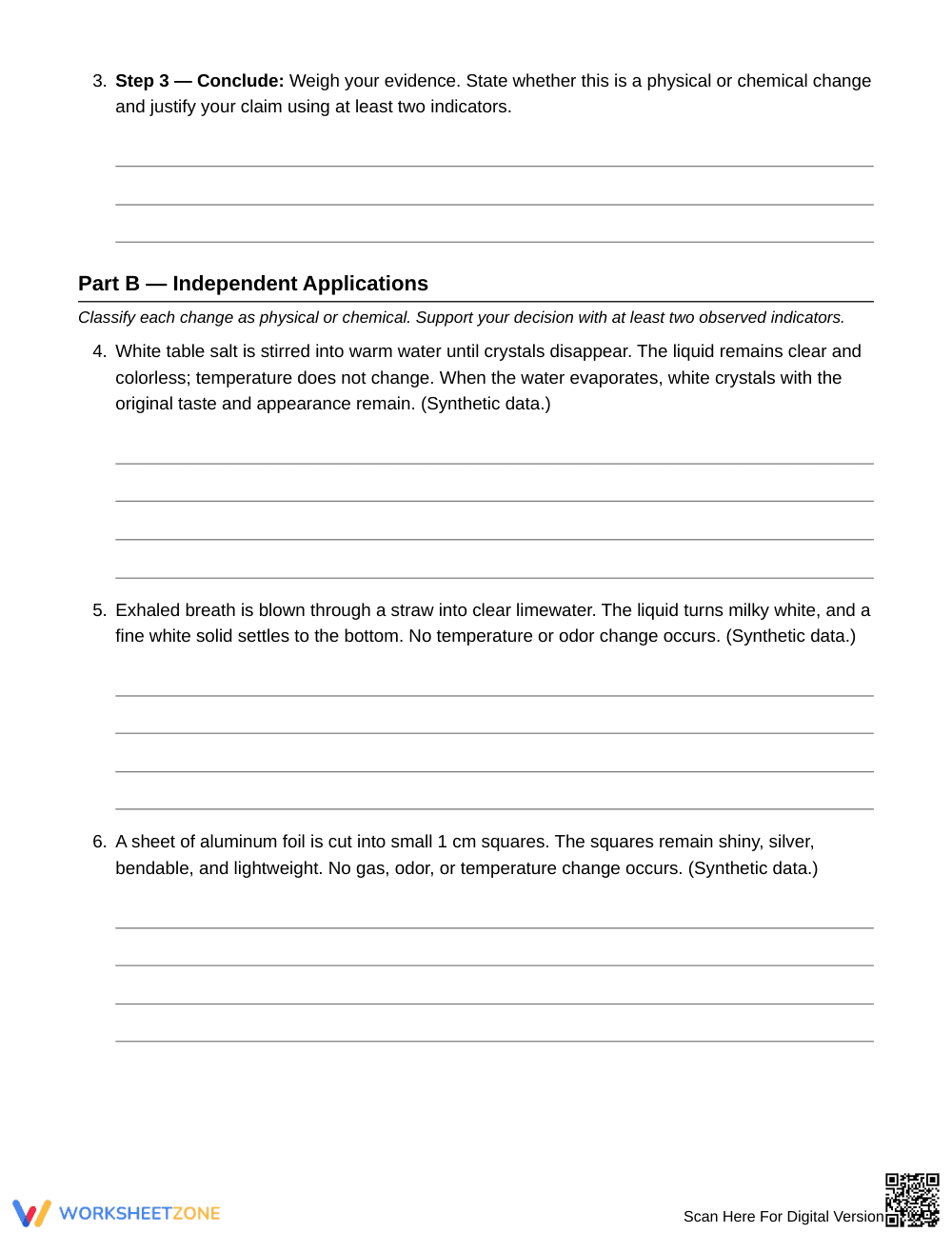
- Supported Practice: Items 4–8 require students to independently classify five distinct laboratory scenarios, requiring at least two pieces of observational evidence per classification to justify their reasoning.
- Independent Practice: Items 9–10 challenge students to critique misconceptions about phase changes and explain why single indicators can mislead scientific conclusions.
This sequence follows a gradual-release model, shifting students from teacher-supported evidence collection to autonomous scientific evaluation.
Standards Alignment
This resource aligns with middle school physical science standards for matter and its interactions, focusing on analyzing evidence to determine whether chemical reactions create new substances. The 10 tasks reinforce constructing scientific explanations from empirical data. Both standard codes can be copied directly into lesson plans, IEP goals, or district curriculum mapping tools.
How to Use It
Implement this worksheet immediately after direct instruction on physical and chemical properties as a collaborative partner activity or independent check for understanding. During the activity, circulate and monitor Step 2 in Part A; verify that students differentiate between heat added externally versus spontaneous exothermic temperature changes. The complete 10-item set takes approximately 35 to 45 minutes to complete in class.
Who It's For
This worksheet is designed for Grade 7 science classrooms, introductory physical science units, and targeted intervention groups. Embedded scaffolds, including decision rules and structured sentence prompts, support English learners and students receiving Tier 2 support. Pair this resource with hands-on lab stations or a physical versus chemical change demonstration lesson to maximize conceptual retention.
Mastering the ability to weigh multiple indicators of physical and chemical change is an essential milestone in middle school physical science education. As established by Fisher & Frey (2014) in their foundational research on guided instructional frameworks, students build lasting conceptual understanding when analytical tasks progress systematically from teacher modeling to autonomous evaluation. Rather than relying on single, isolated clues, 7th-grade science students must learn to synthesize multifaceted evidence—such as temperature shifts, precipitate formation, and unexpected gas release—to determine whether a new chemical substance formed. This 5-page worksheet provides 10 structured items that develop empirical reasoning and scientific argumentation across real-world laboratory scenarios. By challenging learners to critique common misconceptions surrounding phase changes, the resource supports formative assessment goals while aligning with national physical science curriculum benchmarks for matter and its interactions.


