


























Views
Downloads



Essential Incline Systems Worksheet | Grade 12 Physics
Paste this activity's link or code into your existing LMS (Google Classroom, Canvas, Teams, Schoology, Moodle, etc.).
Students can open and work on the activity right away, with no student login required.
You'll still be able to track student progress and results from your teacher account.
Master multi-body mechanics with this comprehensive Grade 12 Physics worksheet. Designed for advanced physics learners, this resource guides students through rigorous coordinate transformations, kinematic constraints, friction bounds, and Newton's Second Law equations across multi-body incline setups. Students derive symbolic relationships and evaluate real-world experimental scenarios to solidify conceptual mechanics mastery.
At a Glance
- Grade: 12 · Subject: Physics
- Standard: Advanced Mechanics — Model multi-body dynamics, coordinate frames, and constraint forces on inclines
- Skill Focus: Analyze an Incline or Connected System
- Format: 5 pages · 10 problems · Answer key included · PDF
- Best For: Advanced mechanics practice and AP exam prep
- Time: 45–60 minutes
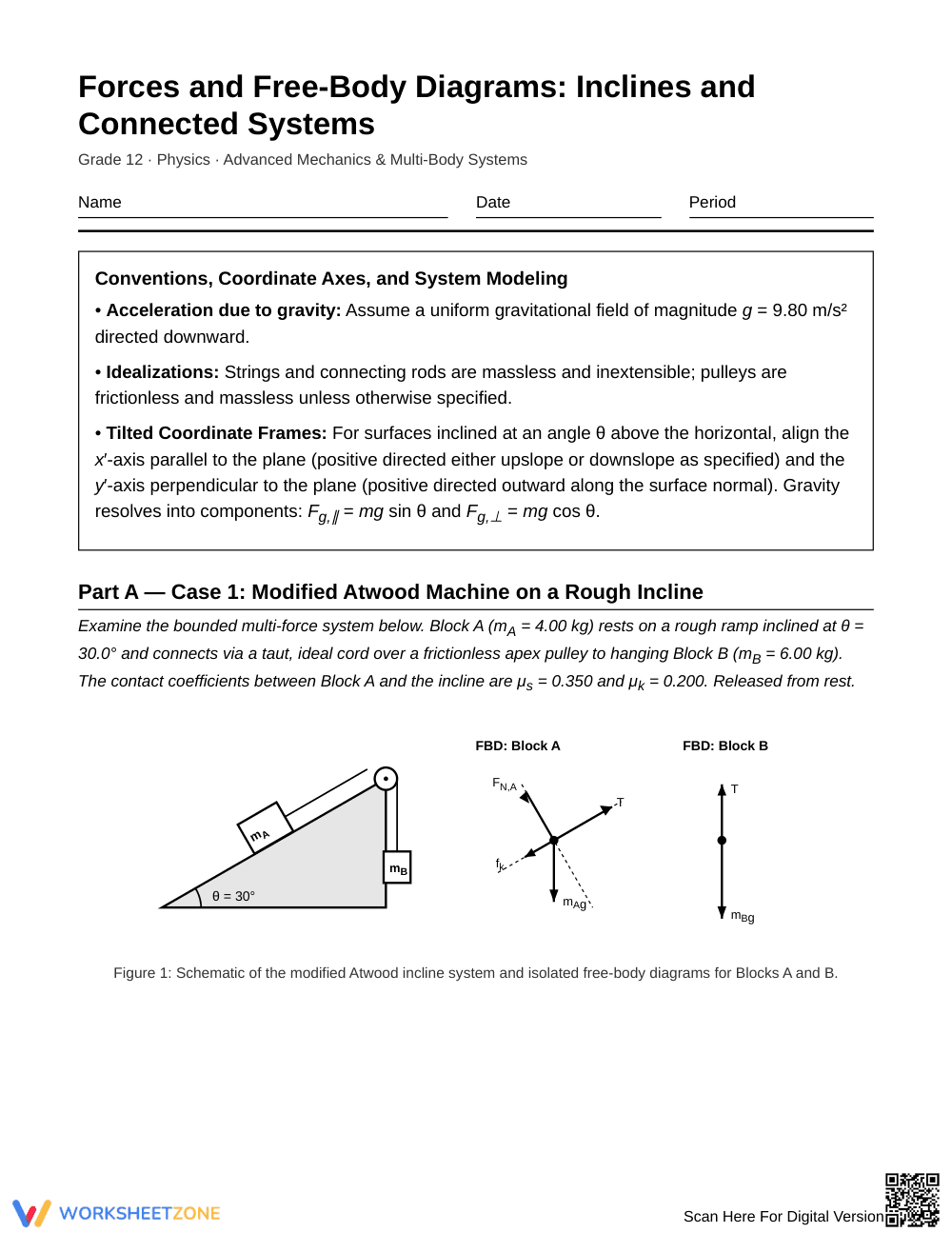
Inside, students encounter two structured multi-body scenarios: a modified Atwood machine on a rough ramp and a coupled two-block sliding assembly connected by a rigid strut. The 5-page worksheet includes isolated free-body diagrams, coordinate convention guidelines, symbolic derivation prompts, and critical conceptual evaluation tasks. A complete 5-page answer key provides step-by-step mathematical solutions and qualitative justifications for every problem.
- Guided Practice (Problems 1–3 & 6): Students define kinematic constraints, construct scalar Newton's Second Law equations in tilted coordinate axes, and deduce internal tension or compression states using isolated free-body diagrams.
- Supported Practice (Problems 4, 7–8): Learners calculate static friction thresholds, derive fully symbolic acceleration expressions, and solve for internal contact forces with quantitative parameter sets.
- Independent Practice (Problems 5, 9–10): Students evaluate physics assertions, determine boundary conditions for equilibrium, recalculate inverted configurations, and critique experimental drag anomalies.
This structured sequence uses the gradual release of responsibility model to move learners from foundational coordinate setups to advanced analytical problem-solving.
This resource aligns with high school physical science standards for forces and interactions, specifically modeling systems governed by Newton's laws of motion under complex constraints. High school physics educators and AP Physics instructors can incorporate these multi-body derivation exercises into unit assessments or curriculum mapping tools.
Administer this 5-page problem set after direct instruction on tilted coordinate systems and multi-body coupled dynamics. For in-class collaborative problem-solving, have student pairs complete Part A during a 45-minute workshop while you formatively assess how groups handle the sign conventions of the kinematic constraint equations. Alternatively, assign Part B as independent homework or an AP Physics C review set.
This resource is built for Grade 12 Physics, Honors Physics, and AP Physics students ready for calculus-ready or rigorous algebra-based mechanics. Provide scaffolding by supplying partially completed free-body diagrams to students needing extra support, and pair the assignment with an incline track laboratory demonstration or interactive digital simulation.
According to Fisher & Frey (2014), structured instructional scaffolds that transition students from guided representational analysis to unassisted analytical evaluation produce substantial gains in conceptual retention and problem-solving transfer in secondary STEM classrooms. This 10-problem multi-body mechanics worksheet applies this evidence-based instructional design by scaffolding coordinate system selection, symbolic Newton's Second Law derivations, and qualitative claim evaluation across coupled incline systems. High school physics students cultivate foundational scientific modeling competencies by isolating interacting bodies, establishing geometric kinematic constraints, and verifying physical limits such as static friction thresholds. Integrating these structured multi-body tasks into advanced mechanics curricula strengthens quantitative reasoning, deepens conceptual understanding of internal versus external forces, and directly prepares learners for college-level physics expectations and rigorous AP mechanics assessments.


