


























Views
Downloads

Essential Geometric Sums Worksheet | Grade 12 Precalculus
Paste this activity's link or code into your existing LMS (Google Classroom, Canvas, Teams, Schoology, Moodle, etc.).
Students can open and work on the activity right away, with no student login required.
You'll still be able to track student progress and results from your teacher account.
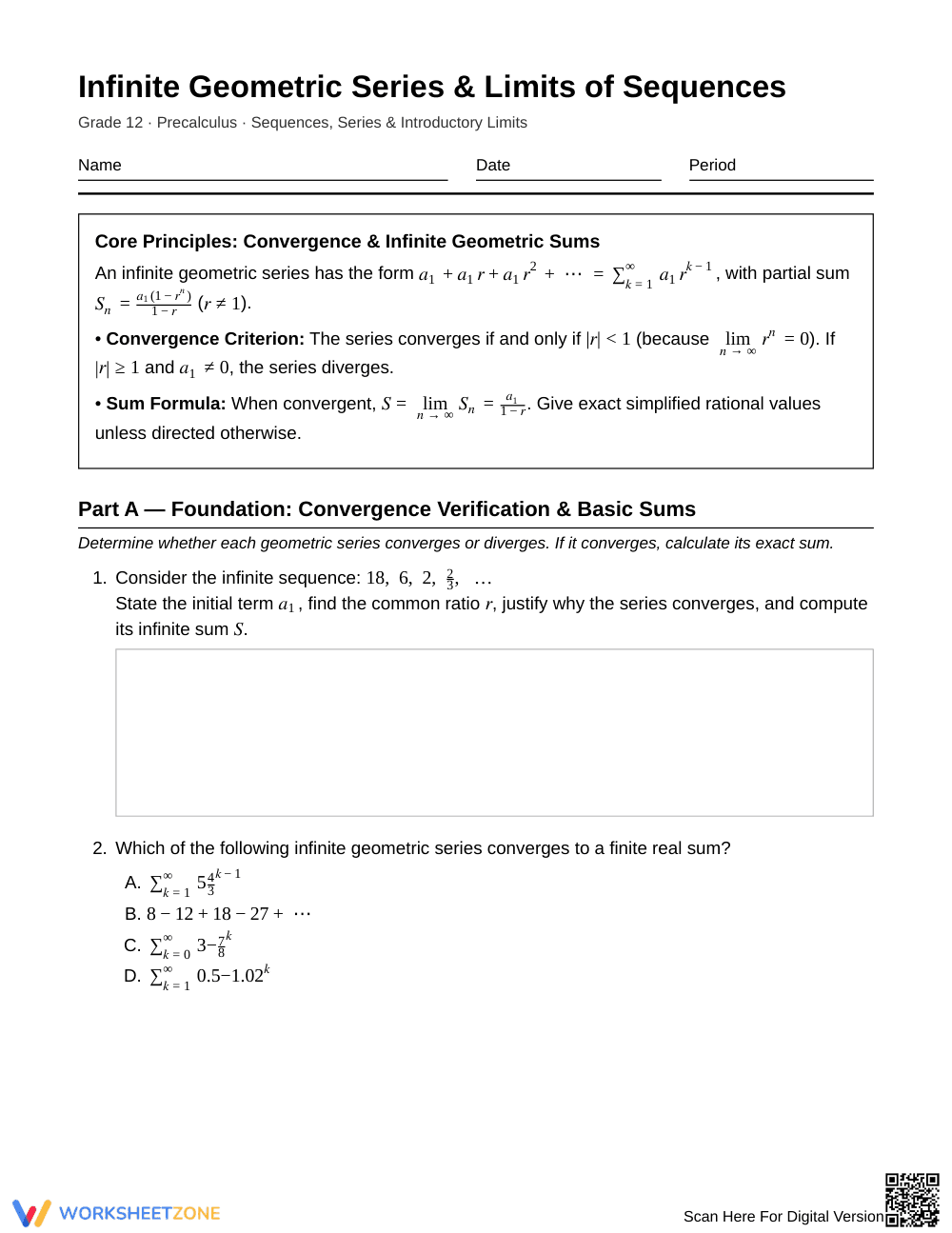
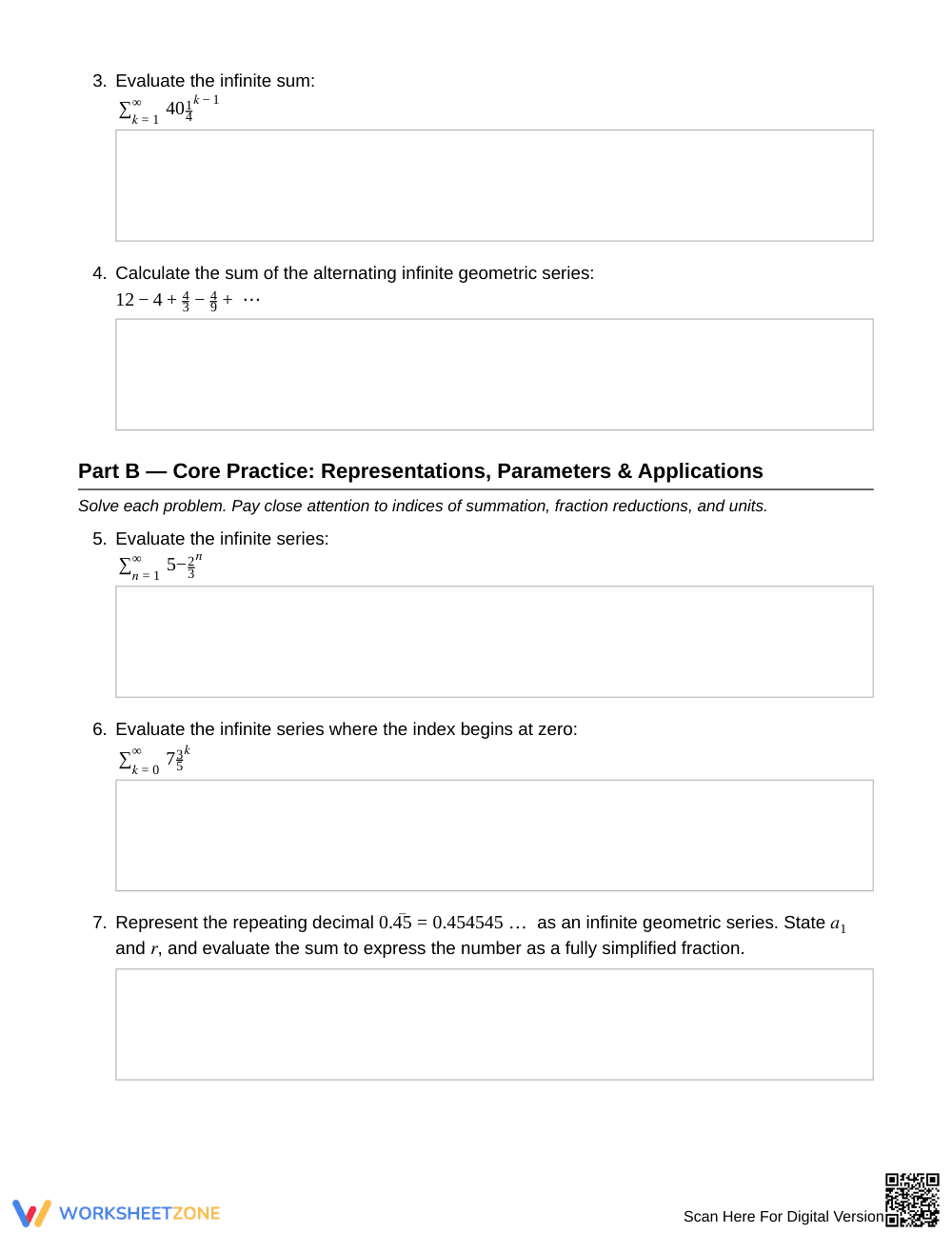
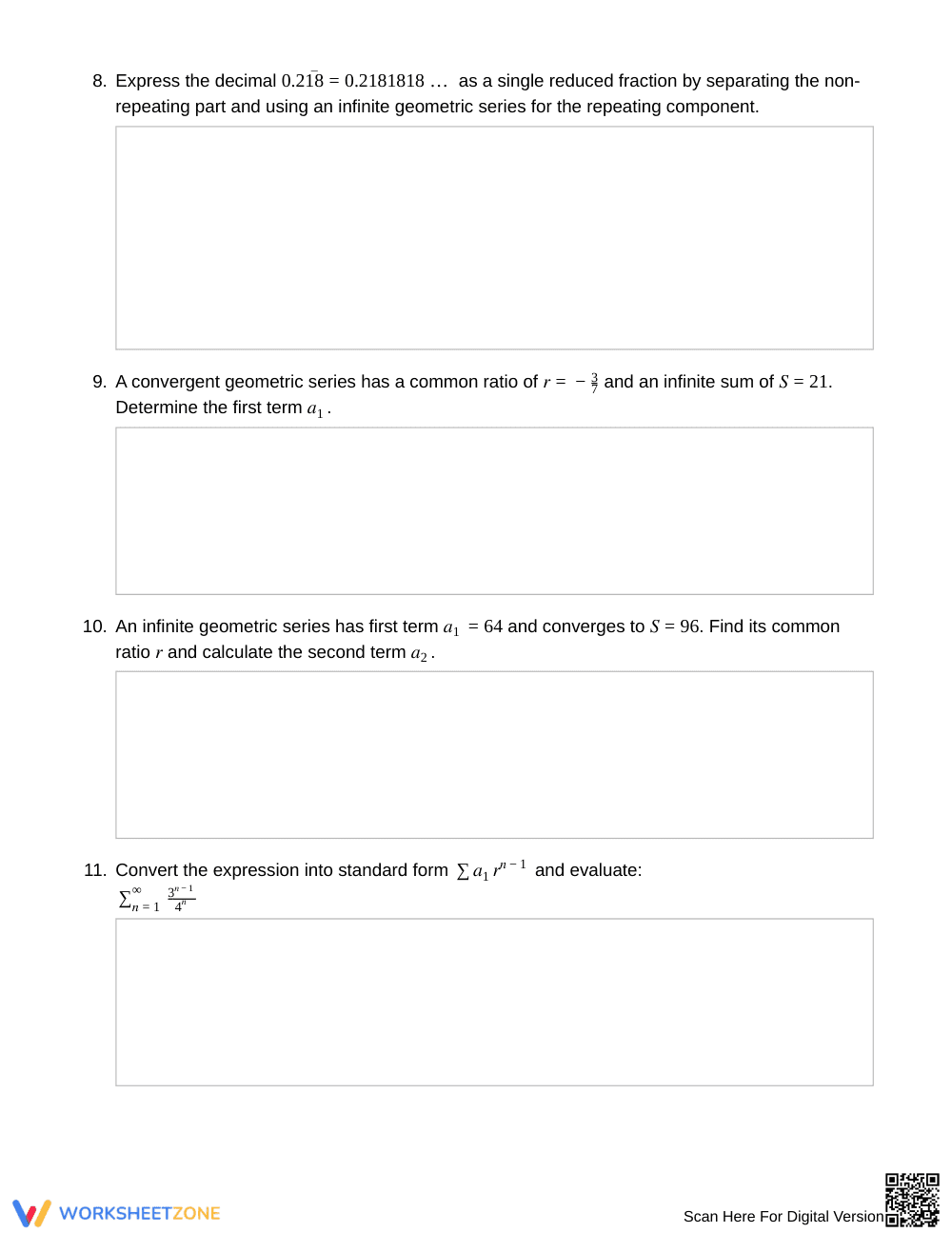
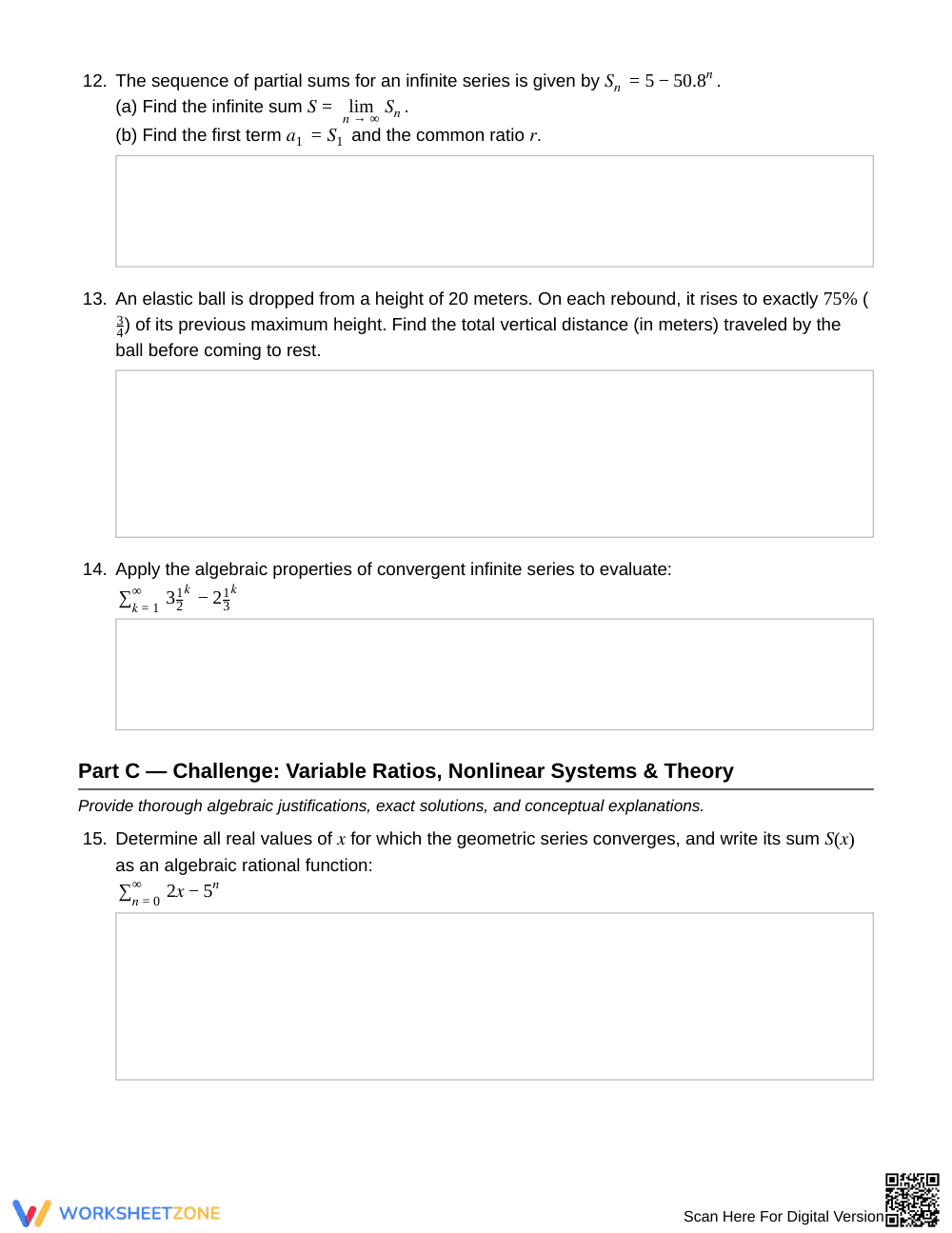
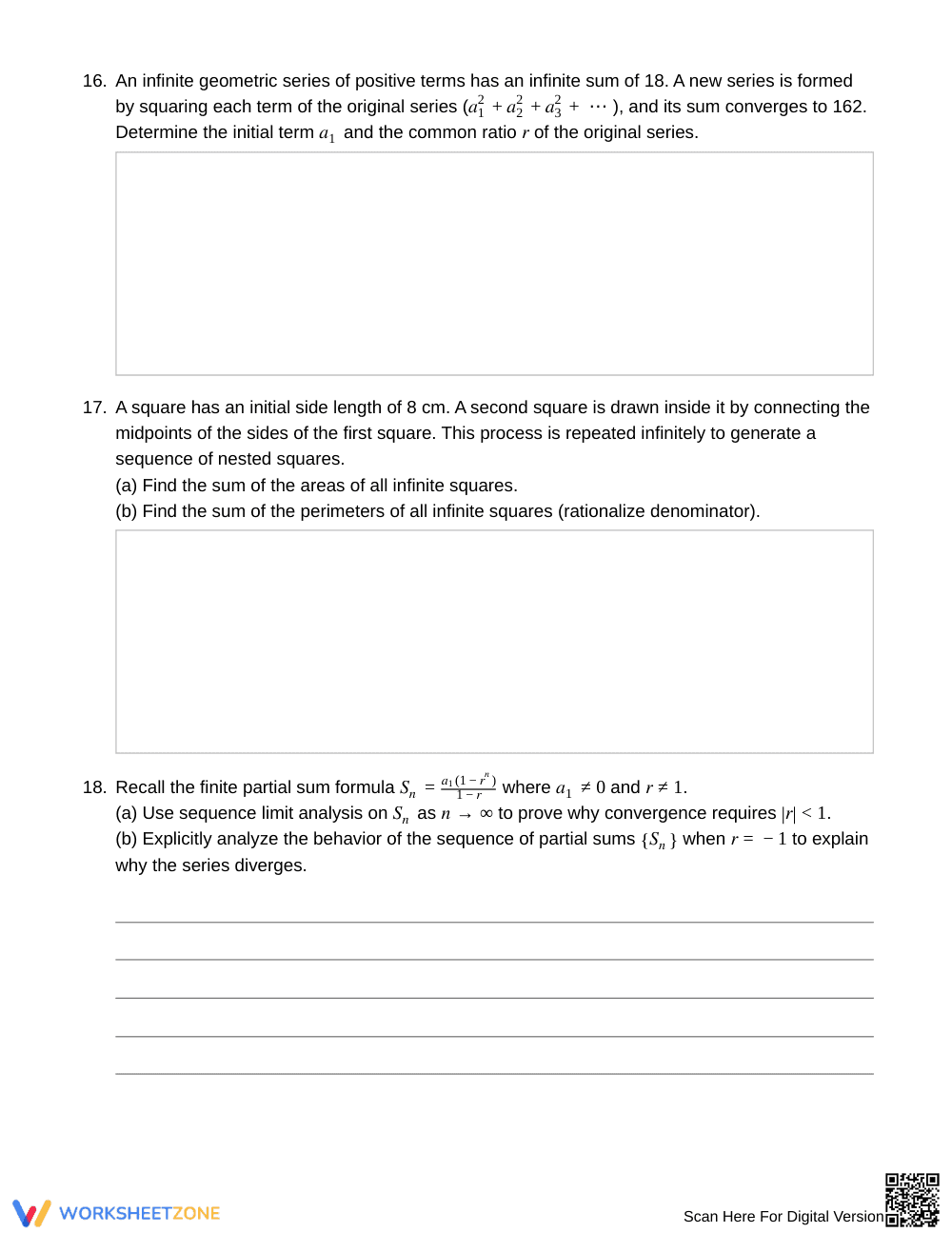
This Precalculus worksheet builds student mastery of infinite geometric series and sequence limits. High school learners verify convergence conditions, calculate exact rational sums, convert repeating decimals into fractions, and solve contextual decay problems across 18 structured, progressively challenging exercises.
At a Glance
- Grade: 12 · Subject: Precalculus
- Standard: Sequences & Series — Calculate exact sums of convergent infinite geometric series and justify convergence
- Skill Focus: Calculate a Convergent Geometric Sum
- Format: 5 pages · 18 problems · Answer key included · PDF
- Best For: Calculus readiness and unit review
- Time: 45–60 minutes
The 5-page worksheet provides 18 analytical tasks with an introductory core principles box defining convergence criteria (|r| < 1) and the sum formula S = a_1 / (1 - r). It spans sigma notation, decimal conversions, physical decay models, and proofs, with a complete 4-page answer key.
Skill Progression
- Guided practice (Problems 1–4): Identify initial terms and common ratios, confirm convergence, and calculate foundational rational sums.
- Supported practice (Problems 5–14): Shift summation indices, convert repeating decimals to fractions, solve for unknown parameters, and model physical rebound heights.
- Independent practice (Problems 15–18): Determine variable convergence intervals, solve nonlinear series systems, analyze nested geometric areas, and write formal limit proofs.
This gradual release sequence transitions students from computational familiarity to rigorous independent proof.
Standards Alignment
This worksheet aligns with advanced high school precalculus topics in sequences, series, and introductory limits. Students evaluate partial sums, establish convergence bounds, and apply geometric series to rational conversions and modeling. Both standard concepts and learning targets can be copied directly into lesson plans, IEP goals, or district curriculum mapping tools.
How to Use It
Assign this resource after introducing the infinite series formula. During practice, check whether students confirm that |r| < 1 before applying formulas. Expected completion time is 45 to 60 minutes, making it ideal for classwork, homework, or calculus readiness review.
Who It's For
Designed for Grade 12 Precalculus and advanced algebra students, this worksheet suits whole-class instruction or leveled differentiation. Pair it with sequence limit anchor charts and direct instruction on partial sums.
According to research on scaffolded learning by Fisher & Frey (2014), structured instructional frameworks that transition systematically from guided verification to independent problem solving significantly improve student retention in advanced high school mathematics. This Grade 12 Precalculus worksheet utilizes that evidence-based instructional progression to build deep conceptual understanding of convergent infinite geometric series and sequence limits. Across 18 rigorous multi-step tasks, students test common ratio convergence criteria, calculate exact rational sums, convert non-terminating repeating decimals, and prove partial sum limits using analytical algebraic properties. By connecting formulaic computations to spatial models—such as nested polygons and vertical rebound distances—the resource reinforces conceptual rigor alongside procedural fluency. This targeted structure thoroughly equips learners for post-secondary calculus while providing educators with precise formative assessment data during direct instruction, small-group intervention, and comprehensive unit exam review.


