


























Views
Downloads



Essential Function Notation Worksheet | Grade 9 Algebra I
Paste this activity's link or code into your existing LMS (Google Classroom, Canvas, Teams, Schoology, Moodle, etc.).
Students can open and work on the activity right away, with no student login required.
You'll still be able to track student progress and results from your teacher account.
This Grade 9 Algebra I worksheet equips students to master function notation by clarifying input and output relationships. Students evaluate expressions, solve for unknown domain values, and interpret functional statements in authentic modeling contexts. This progression helps learners overcome the common misconception that function notation signifies variable multiplication.
At a Glance
- Grade: 9 · Subject: Algebra I
- Standard:
HSF-IF.A.2— Evaluate functions for inputs in their domains and interpret statements using function notation.- Skill Focus: Function Notation and Input Meaning
- Format: 5 pages · 16 problems · Answer key included · PDF
- Best For: Targeted skill practice and concept remediation
- Time: 45–60 minutes
What's Inside
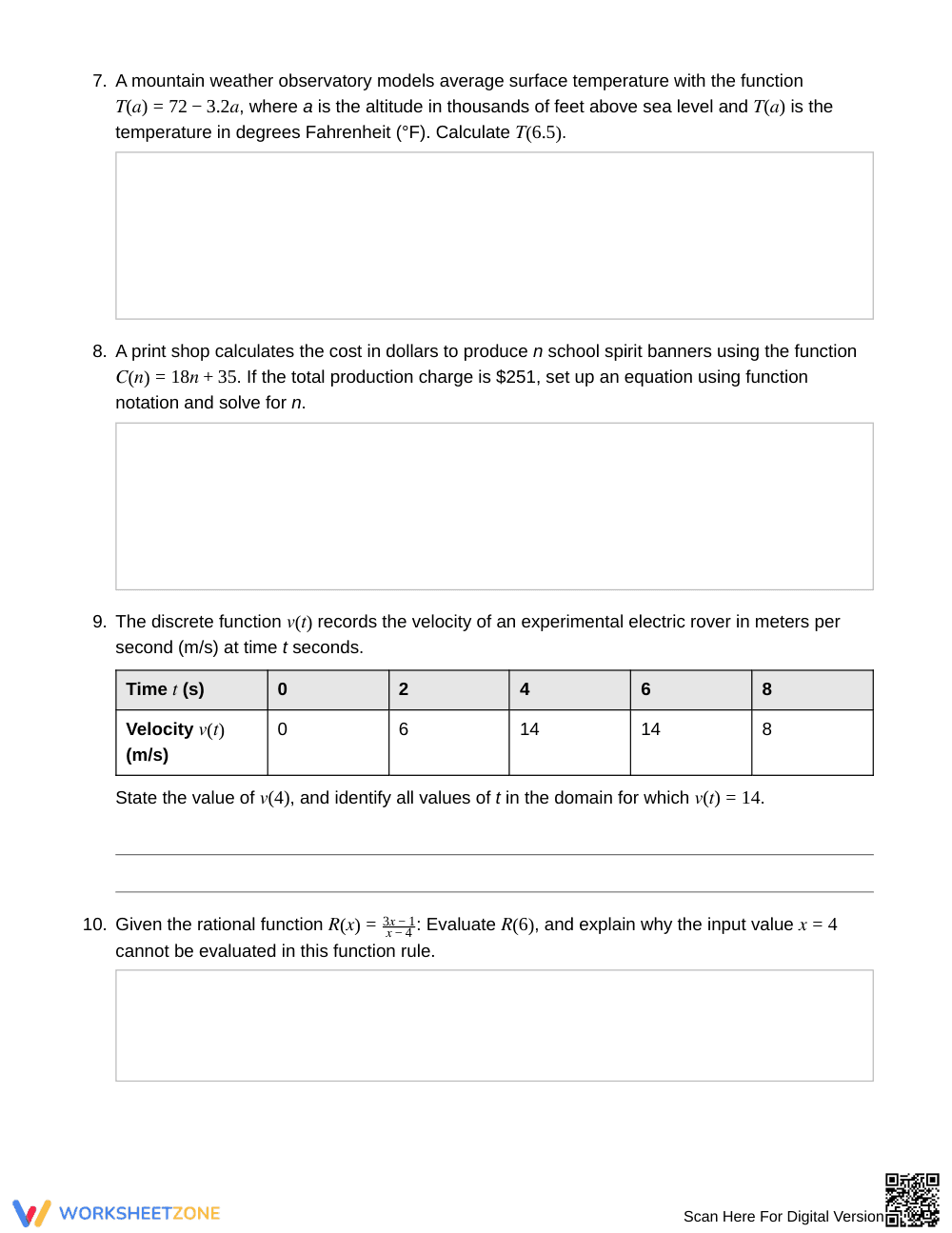
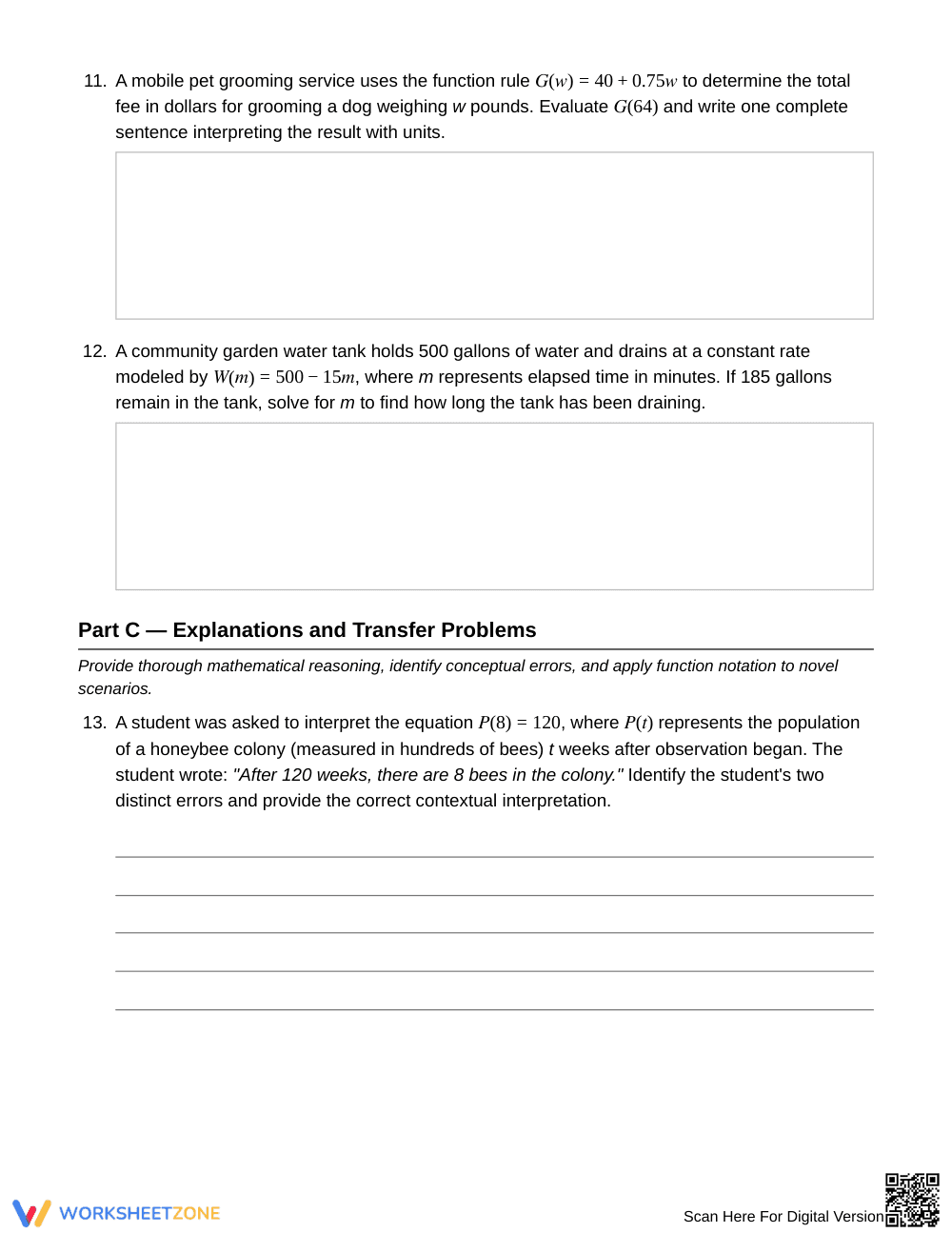
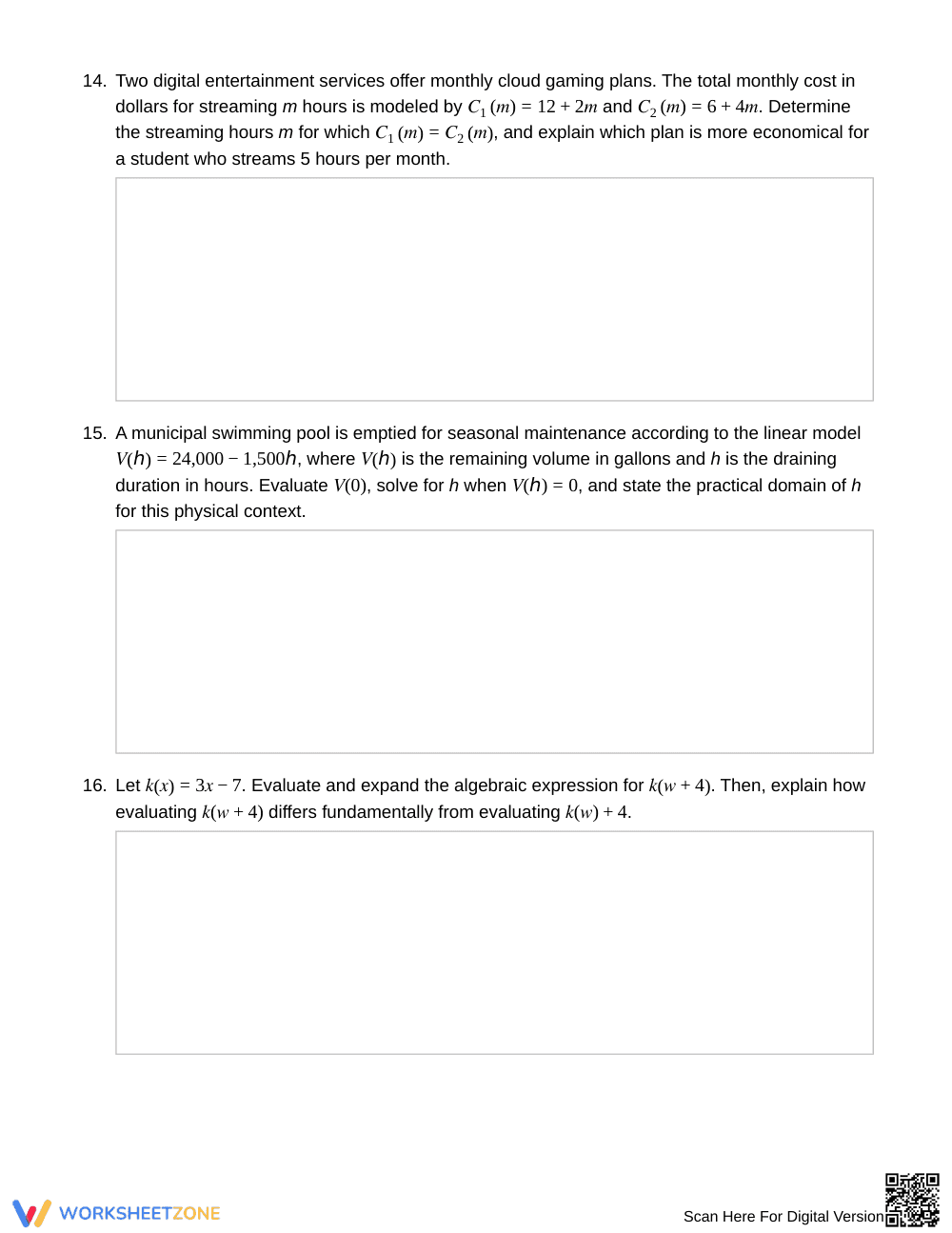
The 5-page worksheet features 16 sequenced problems supported by an introductory reference box and a complete 3-page answer key with step-by-step solutions. Students engage with conceptual multiple-choice questions, tabular data, algebraic functions, and contextual word problems. Designated workspace allows students to show all intermediate calculations and write complete explanatory sentences.
Skill Progression
- Guided practice (Part A, 4 problems): High scaffolding featuring a core concept anchor box, multiple-choice notation definitions, and prompts targeting common algebraic misconceptions.
- Supported practice (Part B, 8 problems): Medium scaffolding pairing algebraic calculations with real-world scenarios, requiring students to evaluate outputs and solve for inputs.
- Independent practice (Part C, 4 problems): Low scaffolding requiring students to correct contextual errors, compare linear models, define domains, and evaluate variable expressions.
This structured progression follows the gradual-release model, moving learners from conceptual understanding to independent application.
Standards Alignment
This worksheet directly aligns with HSF-IF.A.2: Use function notation, evaluate functions for inputs in their domains, and interpret statements that use function notation in terms of a context. It also supports HSF-IF.A.1 by reinforcing domain and range definitions. Both standard codes can be copied directly into lesson plans, IEP goals, or district curriculum mapping tools.
How to Use It
Use this worksheet for independent seatwork following direct instruction on functions, or assign it as an assessment review. During work time, check whether students mistakenly multiply f and x when evaluating f(3) to provide immediate corrective feedback. Most students will complete the 16 tasks in 45 to 60 minutes.
Who It's For
This worksheet is built for Grade 9 Algebra I students in general education, co-taught classes, or math intervention. Differentiate by assigning Parts A and B for core skill mastery, while reserving Part C for students ready for contextual modeling. Pair this resource with direct-instruction notes on function notation fundamentals.
According to findings from the RAND AIRS 2024 report on secondary mathematics instruction, curriculum materials that deliberately scaffold symbolic notation prevent widespread cognitive confusion between variable manipulation and function representation. This Algebra I worksheet targets HSF-IF.A.2 by guiding students to evaluate functions at specific domain values and interpret the contextual significance of functional statements. Research in mathematical pedagogy emphasizes that clarifying the operational role of inputs and outputs through progressive problem sets significantly strengthens algebraic fluency. By confronting persistent student misconceptions—such as misinterpreting notation as standard multiplication or confusing dependent and independent quantities—the structured sequence supports lasting retention and conceptual transfer. Educators seeking standards-aligned resources can reliably integrate these 16 vetted tasks into formative assessment routines, providing ninth-grade mathematicians with the targeted procedural practice and analytical reasoning necessary to achieve long-term mastery in secondary algebra.


