































Essential Free-Body Diagrams Worksheet | Grade 12 Physics

Paste this activity's link or code into your existing LMS (Google Classroom, Canvas, Teams, Schoology, Moodle, etc.).
Students can open and work on the activity right away, with no student login required.
You'll still be able to track student progress and results from your teacher account.
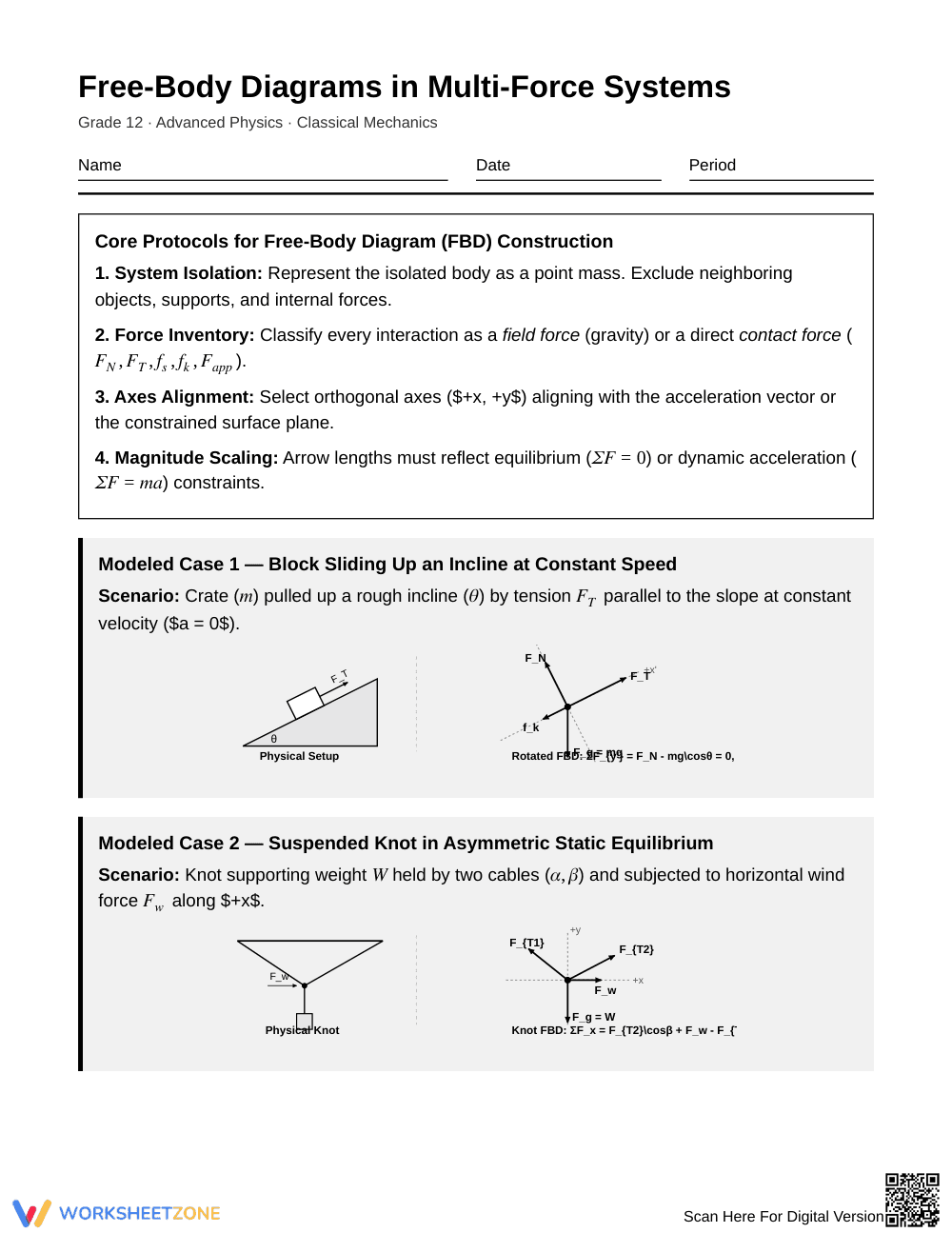
This Grade 12 physics worksheet equips students to construct accurate free-body diagrams and derive governing algebraic equations for complex multi-force mechanics systems. High school learners isolate point masses, verify contact and field interactions, scale force vectors according to dynamic constraints, and resolve forces along chosen orthogonal coordinate axes across ten challenging analytical tasks.
At a Glance
- Grade: 12 · Subject: Physics
- Standard: Advanced Mechanics — Construct free-body diagrams and formulate algebraic force equations for multi-force dynamic systems
- Skill Focus: Construct a Free-Body Diagram
- Format: 5 pages · 10 problems · Answer key included · PDF
- Best For: AP or advanced mechanics problem-solving practice
- Time: 45–60 minutes
What's Inside
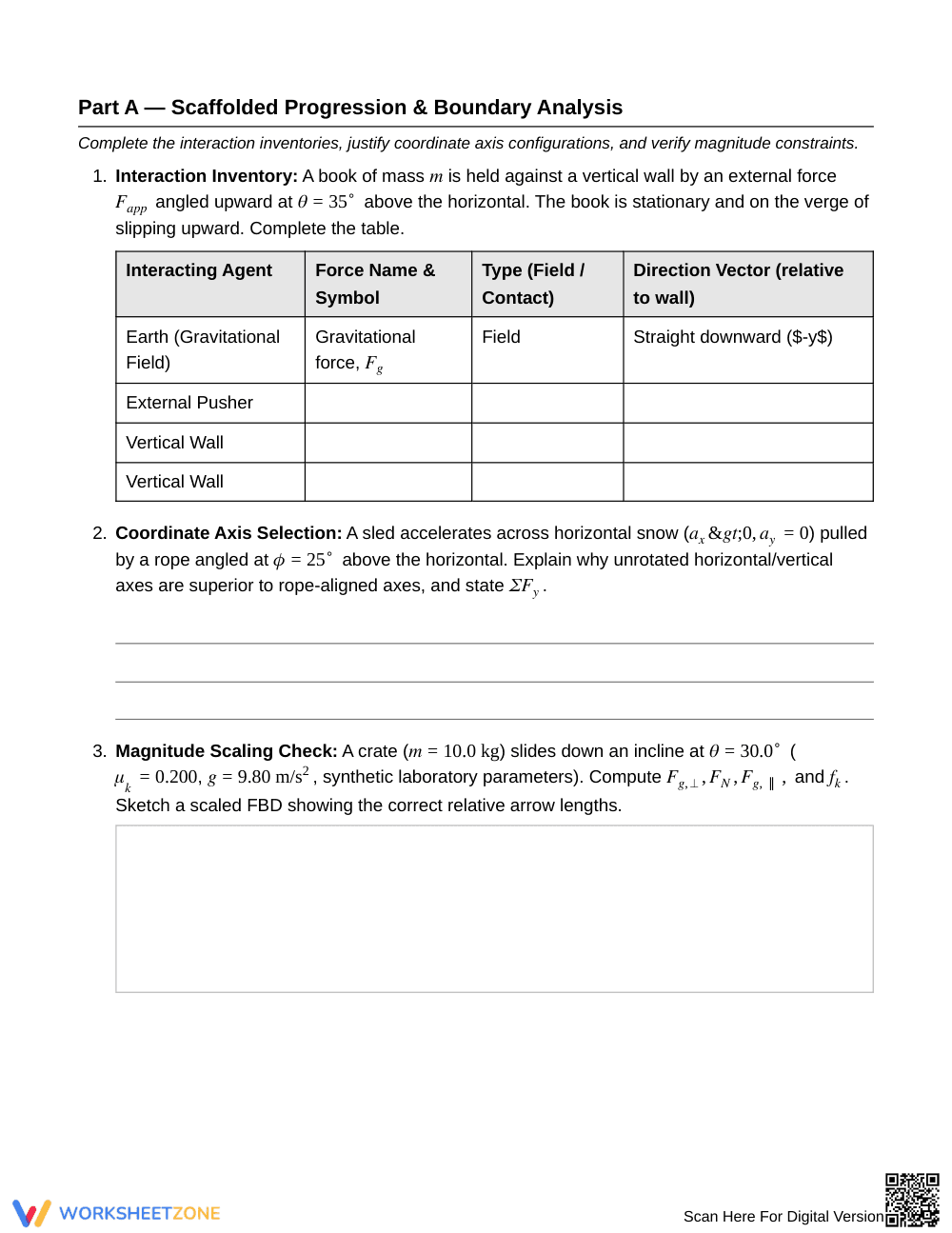
The 5-page student activity features core protocols for free-body diagramming, two worked model problems (an incline with constant velocity and an asymmetric suspended knot), an interaction inventory table, vector scaling exercises, and multi-body coupled scenarios. A comprehensive 3-page answer key provides complete vector diagrams and algebraic derivations for all 10 tasks.
Skill Progression
- Guided practice (Tasks 1–3): Students complete interaction inventories, defend coordinate axis configurations on accelerating sleds, and calculate vector magnitudes to sketch scaled normal and frictional arrows.
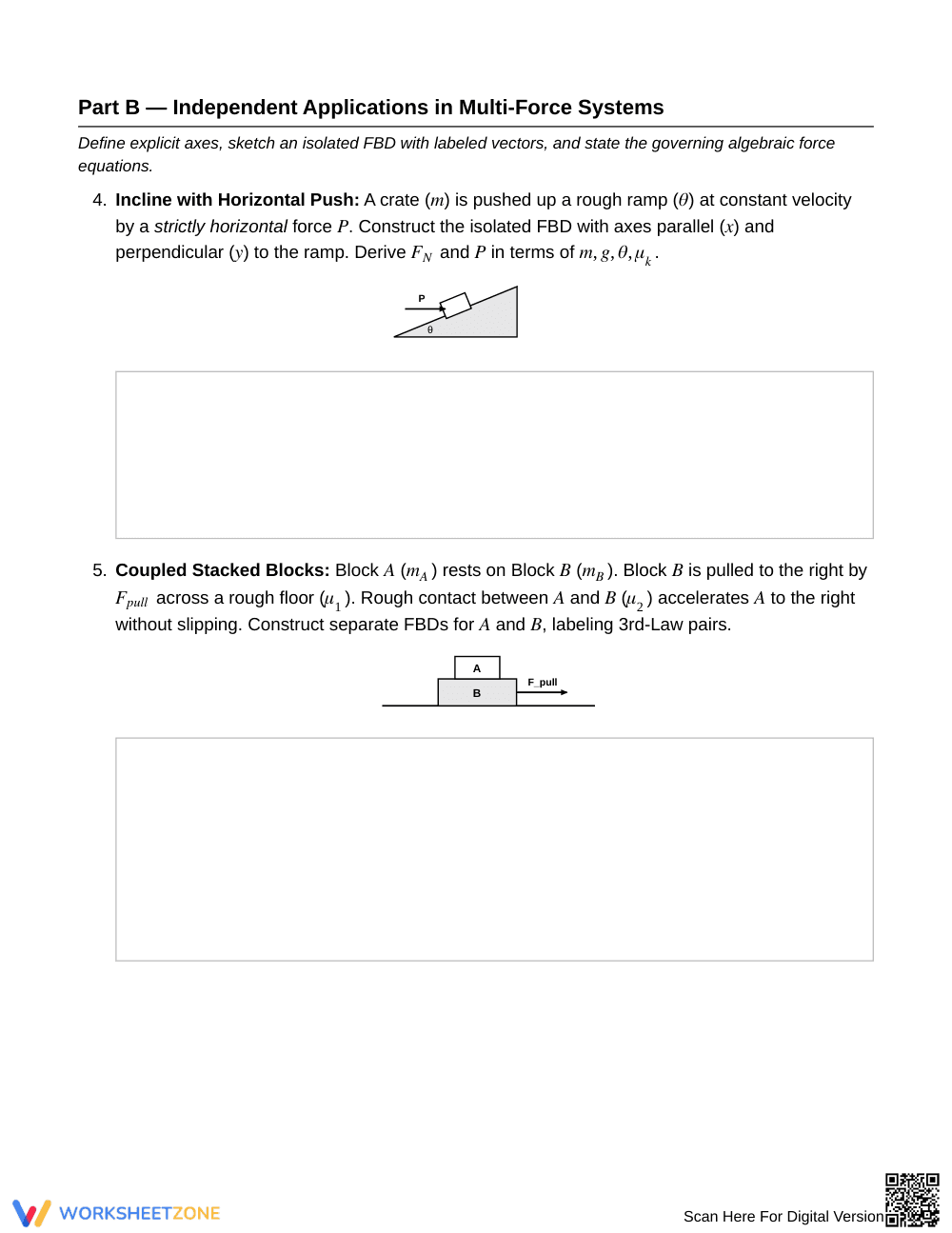
- Supported practice (Tasks 4–6): Learners construct unassisted diagrams for horizontal pushes on inclines, coupled two-block systems showing action-reaction pairs, and angled tension loads.
- Independent practice (Tasks 7–10): Students analyze banked roadway curves at sub-design speeds, solve conical pendulums, and address conceptual third-law misconceptions and friction threshold discontinuities.
This sequence enforces gradual release through an explicit I Do, We Do, You Do structure.
Standards Alignment
This resource aligns with high school physical science standards for forces and interactions, requiring students to analyze vector forces and apply Newton's laws of motion to predict macro-level system behaviors. Supporting objectives target resolving vectors along non-standard axes and distinguishing third-law interaction pairs. Both standard codes can be copied directly into lesson plans, IEP goals, or district curriculum mapping tools.
How to Use It
Deploy this worksheet after direct instruction on Newton's laws and vector resolution. Use it during collaborative workshop sessions where student pairs diagram complex scenarios before deriving algebraic solutions. As a formative assessment check, inspect whether students draw normal forces perpendicular to inclined surfaces rather than strictly upward. The full problem set requires 45 to 60 minutes.
Who It's For
This practice set is engineered for Grade 12 Advanced Placement, honors, and introductory college-level physics students mastering classical mechanics. Differentiate by providing the worked examples as an ongoing reference sheet for emerging learners, and pair this resource directly with an inclined-plane laboratory investigation.
This Grade 12 physics worksheet targets the foundational classical mechanics skill of constructing free-body diagrams for multi-force systems in equilibrium and dynamic acceleration. Students isolate point masses, systematically catalog contact and field forces, establish rotated coordinate axes, and derive governing algebraic equations across 10 rigorous mechanics problems. Research by Fisher & Frey (2014) highlights that intentional gradual-release frameworks—moving systematically from scaffolded interaction inventories to unprompted diagramming of coupled bodies and conical pendulums—significantly deepen conceptual understanding and procedural fluency in STEM domains. High school physics educators can implement this five-page instructional resource during forces units to diagnose spatial reasoning errors, clarify Newton's third-law interaction pairs, and bridge qualitative visual modeling with quantitative vector mechanics. Complete vector solutions across the three-page answer key streamline grading, making this an essential curricular tool for standards-based mechanics mastery and collegiate physics preparation.


