
































Essential Free Body Diagram Worksheet | Grades 8–12 Science

Paste this activity's link or code into your existing LMS (Google Classroom, Canvas, Teams, Schoology, Moodle, etc.).
Students can open and work on the activity right away, with no student login required.
You'll still be able to track student progress and results from your teacher account.
This physical science worksheet prepares students in grades 8–12 to classify, draw, and interpret free body diagrams. Across four scaffolded parts, learners identify contact and field forces, calculate net force and acceleration, evaluate vectors on inclined planes, and connect balanced and unbalanced forces to object motion.
At a Glance
- Grade: Grades 8–12 · Subject: Science
- Standard: Physical Science — Analyze force diagrams and apply Newton's laws to predict motion
- Skill Focus: Classifying forces and interpreting free body diagrams
- Format: 4 pages · 28 problems · Answer key included · PDF
- Best For: High school physics practice or review
- Time: 45–60 minutes
What's Inside
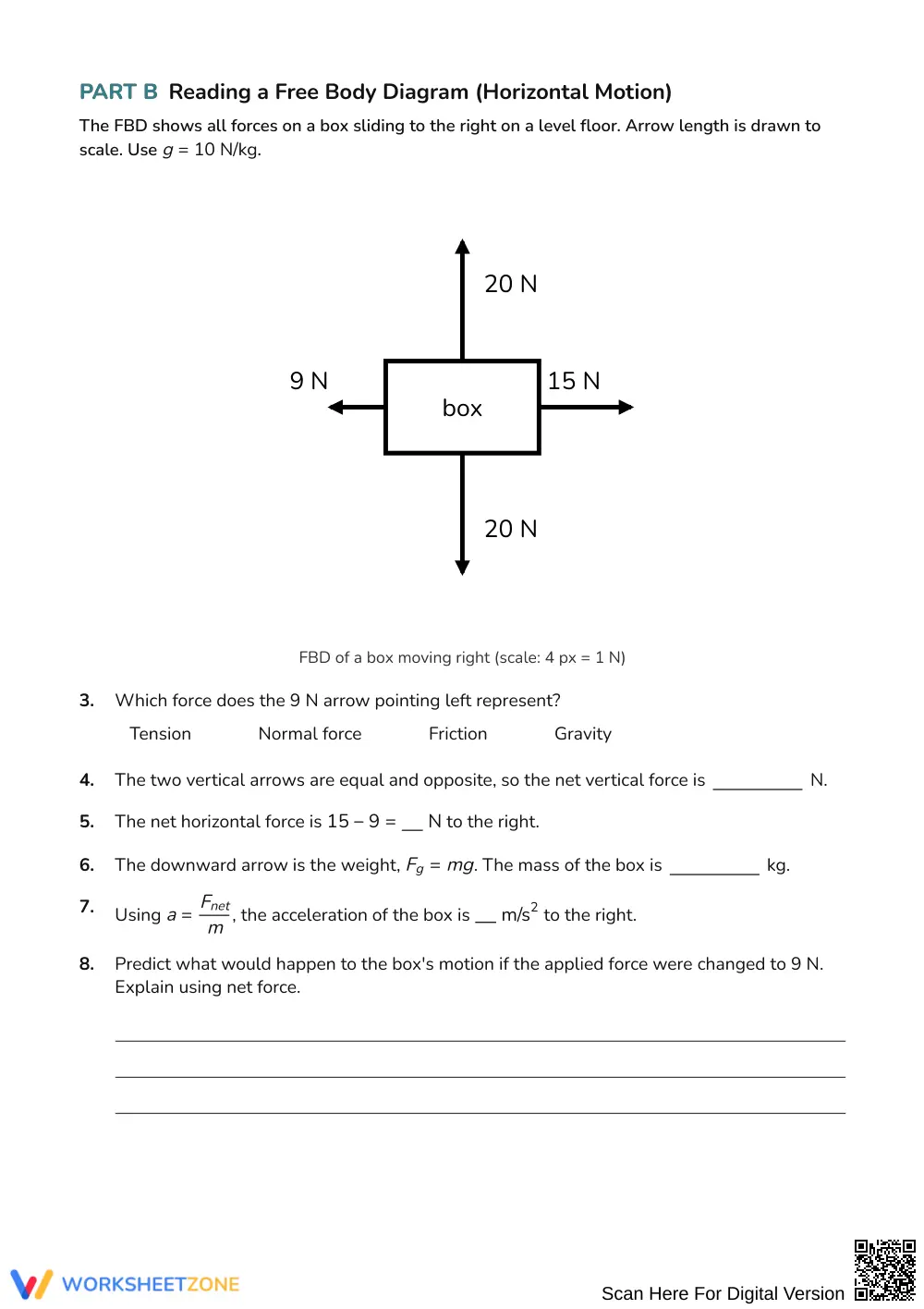
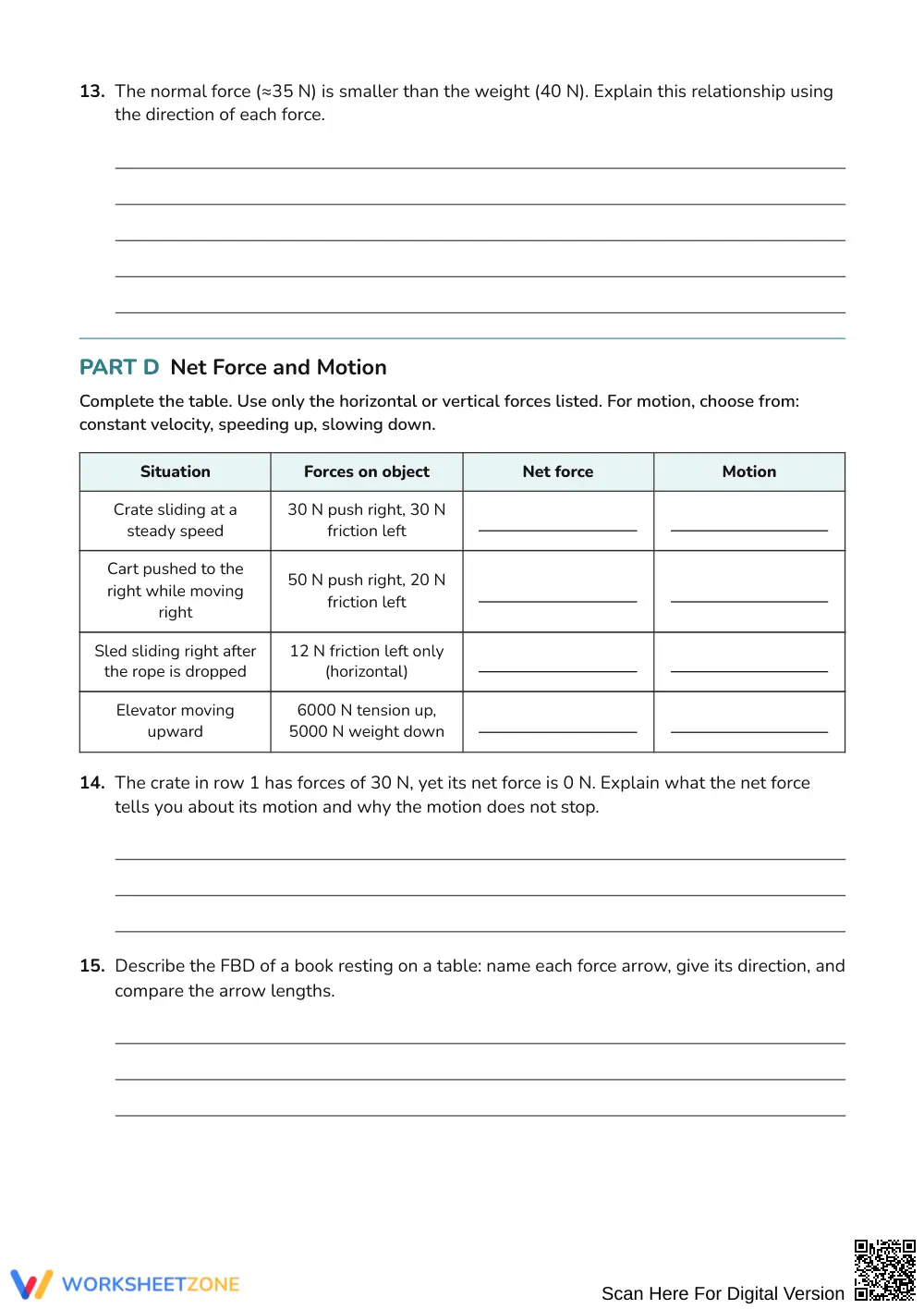
Across four pages and 28 tasks, students work through force classification, diagram reading, numerical computations, and conceptual explanations. Features include scale diagrams for horizontal surfaces and 30-degree inclines, net force analysis tables, and a complete 4-page answer key with step-by-step math and physics rationales.
Skill Progression
- Guided practice (Part A): Match scenarios to force types—normal, gravity, tension, friction—and identify vector directions.
- Supported practice (Parts B & C): Interpret horizontal and inclined free body diagrams to calculate net force, mass, and acceleration.
- Independent practice (Part D): Complete a multi-situation table linking net force to states of motion using Newton's laws.
This gradual-release structure builds foundational vector concepts before advancing to quantitative calculations.
Standards Alignment
This worksheet aligns with high school physical science performance expectations requiring students to analyze force interactions and apply Newton's second law. Supporting standards emphasize balanced forces and equilibrium under Newton's first law. Both standard descriptions can be copied directly into lesson plans, IEP goals, or district curriculum mapping tools.
How to Use It
Implement this resource following direct instruction on Newton's laws. Use Parts A and B for paired practice, checking vector arrows formatively before students analyze inclines in Part C. Part D works well for independent closure. Expected completion time is 45 to 60 minutes.
Who It's For
Designed for physical science and high school physics students, this activity offers visual scaffolds for emerging learners and challenging incline calculations for advanced students. Pair this worksheet directly with a ramp dynamics lab or interactive force simulation.
Free body diagrams represent a crucial conceptual bridge in secondary physics education, requiring learners to translate complex spatial interactions into quantified vector representations. According to Fisher & Frey (2014), gradual release instructional models that transition students systematically from visual categorization to quantitative problem-solving foster significant gains in conceptual retention and procedural fluency. In this 28-task resource, students develop systematic habits by identifying force types, calculating net horizontal and vertical forces, and evaluating component forces on inclined planes. By explicitly connecting net force calculations to Newton's first and second laws, students overcome persistent misconceptions regarding motion and equilibrium. Teachers can rely on this structured practice to deliver measurable mastery data, verifying that students can accurately interpret force interactions across varied mechanical contexts while establishing a solid baseline for advanced mechanics coursework and lab investigations.


