































Essential Free Body Diagram Worksheet | Grades 8–12 Science

Paste this activity's link or code into your existing LMS (Google Classroom, Canvas, Teams, Schoology, Moodle, etc.).
Students can open and work on the activity right away, with no student login required.
You'll still be able to track student progress and results from your teacher account.
Mastering force diagrams requires distinguishing between forces acting on an object and forces exerted by it. This 3-page science worksheet delivers 29 structured tasks targeting core vocabulary, vector diagram reading, and common misconceptions about motion. Students analyze contact forces, compute net force along coordinate axes, and apply Newton's laws to realistic physical scenarios.
At a Glance
- Grade: Grades 8–12 · Subject: Science / Physics
- Standard: Forces and Motion — Analyze forces acting on an object and determine net vector force
- Skill Focus: Free-body diagram construction, force vocabulary, and misconception checks
- Format: 3 pages · 29 problems · Answer key included · PDF
- Best For: Introductory physics units and concept review
- Time: 35–45 minutes
What's Inside: The resource provides a 3-page student packet accompanied by a matching 3-page complete answer key. Across three structured sections, students work through formal definitions, an example and non-example classification table, a fully diagrammed box problem requiring vector decomposition, and tabular net force calculations alongside multiple-choice misconception probes.
Skill Progression
- Guided practice (Part A, 11 tasks): Students review explicit definitions for six foundational terms (net force, normal force, weight, tension, friction) and classify five physical scenarios as valid or invalid components on a target object's diagram.
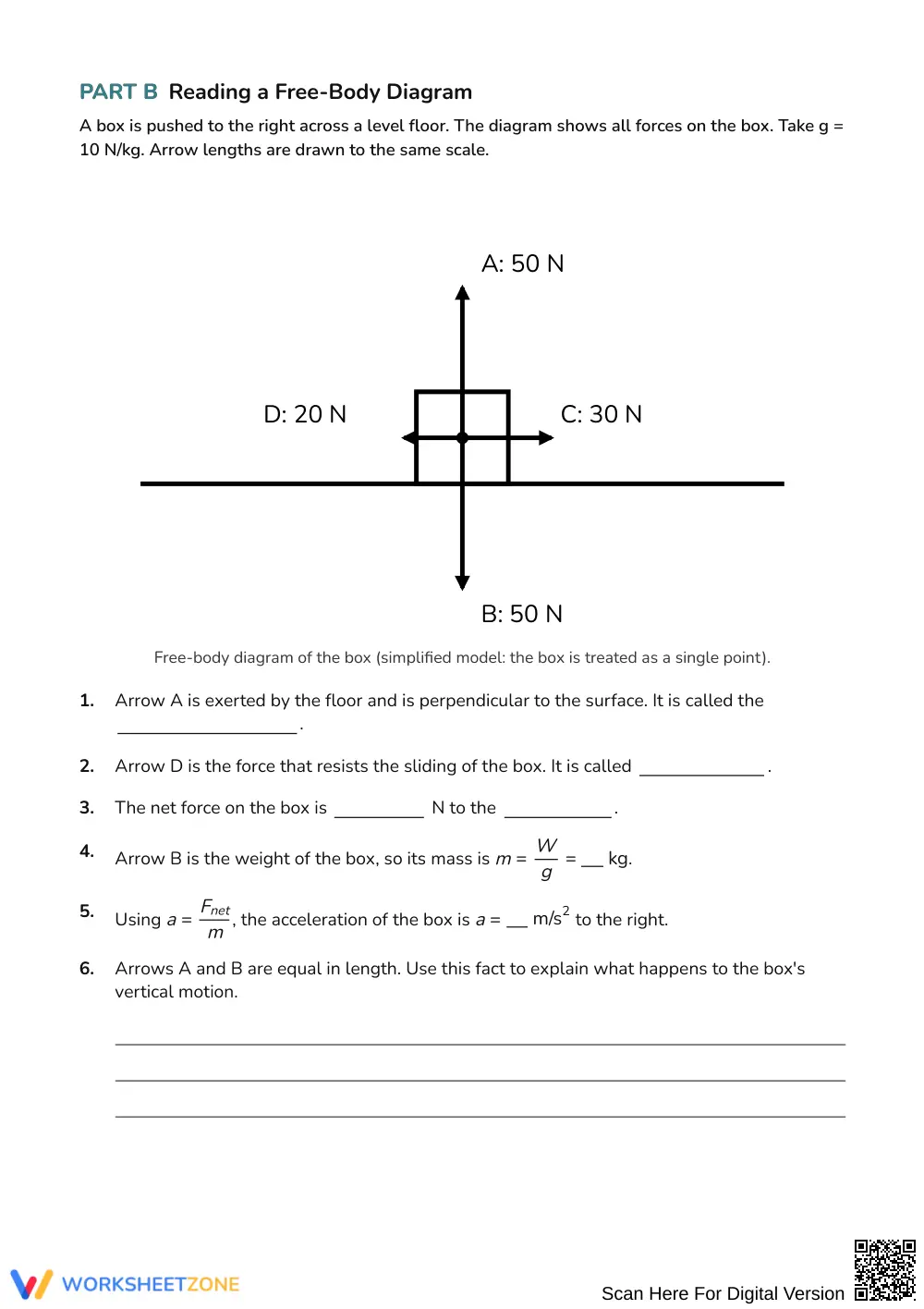
- Supported practice (Part B, 7 tasks): Learners inspect a labeled free-body diagram of a sliding box, identify specific force vectors, calculate mass using local gravity ($g = 10\text{ N/kg}$), and determine horizontal acceleration.
- Independent practice (Part C, 11 tasks): Students compute net forces across four dual-force systems, evaluate velocity changes, and write conceptual explanations dismantling the persistent "force of motion" fallacy.
This sequence mirrors the gradual-release framework, moving learners smoothly from shared vocabulary acquisition to independent diagnostic reasoning.
Standards Alignment
This resource aligns with high school physical science standards governing forces, motion, and Newton's laws. Students analyze balanced and unbalanced forces to predict changes in an object's motion and quantify acceleration using $F_{\text{net}} = ma$. Both standard codes can be copied directly into lesson plans, IEP goals, or district curriculum mapping tools.
How to Use It
Deploy this worksheet during the initial guided practice phase following direct instruction on Newton's first two laws. Alternatively, assign it as a mid-unit checkpoint before students transition to angled vector components. During completion, monitor how students resolve the sliding puck scenario in Part C; circling the incorrect "force of motion" option immediately identifies students who still equate velocity with net force. Expect completion within 35 to 45 minutes.
Who It's For
This practice set serves introductory physics, physical science, and conceptual mechanics classrooms in grades 8 through 12. Built-in term definitions support English learners and students with processing accommodations, while the analytical justification items challenge advanced thinkers. Pair this printable with a direct instruction lesson or a hands-on spring scale lab.
According to Fisher & Frey (2014), structured guided practice that explicitly confronts common domain-specific misconceptions produces significantly higher retention in secondary science than unguided problem solving. This worksheet systematically addresses physics students' tendency to invent an internal "force of motion" for moving objects by contrasting velocity with net acceleration across 29 focused items. Through clear visual representations, consistent vector modeling, and explicit non-examples, students establish robust mental models for contact and field forces. The embedded progression from foundational definitions to quantitative Newton's second law calculations ensures learners build genuine conceptual fluency before encountering complex multidimensional mechanics problems.


