





























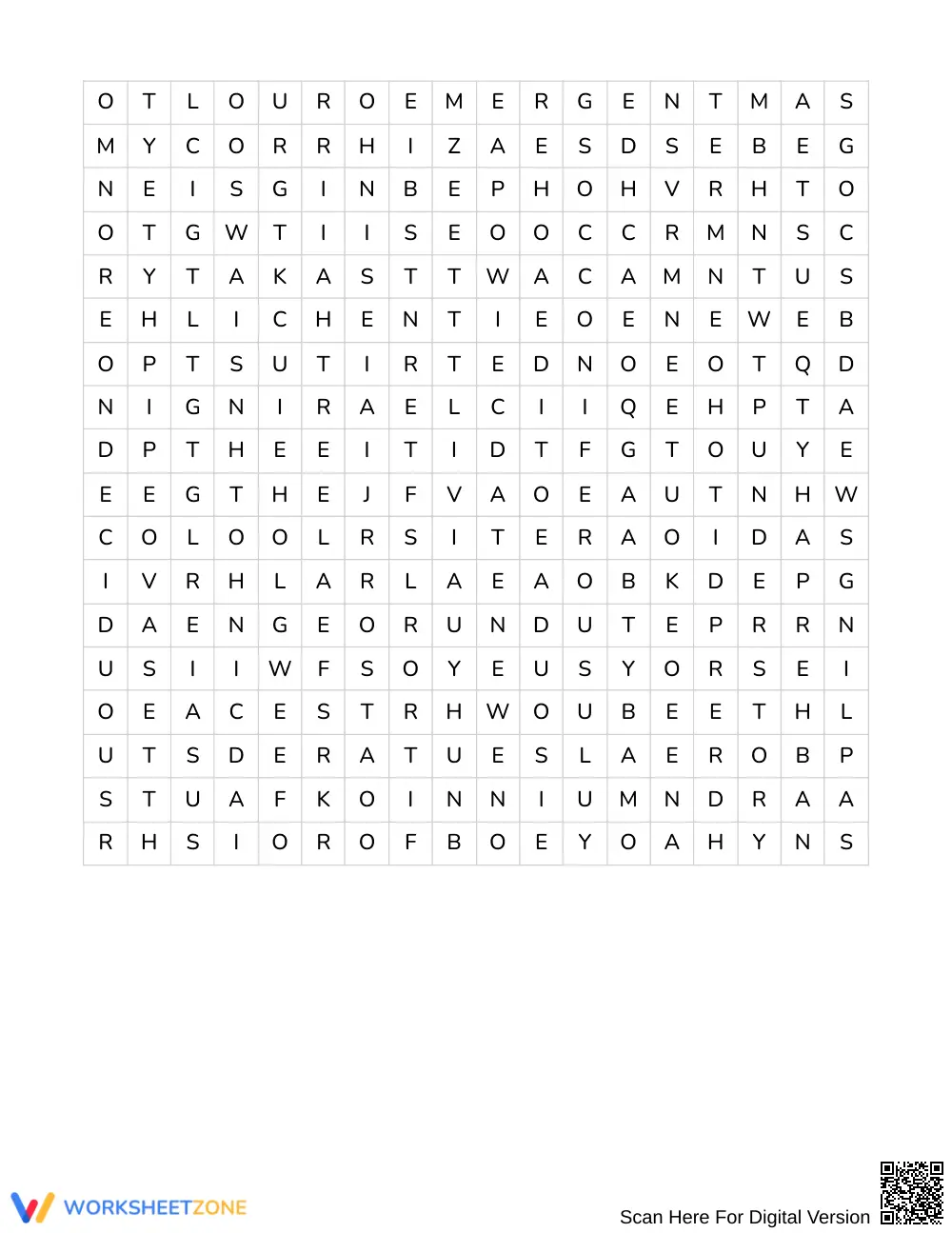


Essential Forest Habitats Word Search | Grades 6–7 Science

Paste this activity's link or code into your existing LMS (Google Classroom, Canvas, Teams, Schoology, Moodle, etc.).
Students can open and work on the activity right away, with no student login required.
You'll still be able to track student progress and results from your teacher account.
Strengthen middle school life science literacy with this forest habitats word search. Students apply ecological knowledge by reading descriptive clues to identify and locate 16 specialized forest ecology terms. This activity reinforces essential botanical vocabulary and forest layer concepts without relying on a simple word bank.
At a Glance
- Grade: Grades 6–7 · Subject: Science & Ecology
- Standard: Not standards-assessed — vocabulary enrichment for middle school science
- Skill Focus: Forest habitats, biome layers, and ecological terminology
- Format: 3 student pages · 16 words to find · Answer key included · PDF
- Best For: Vocabulary review, early finishers, and sub plans
- Time: 25–35 minutes of focused student work
This 3-page printable science resource contains a clue-based forest habitats puzzle and a complete 4-page answer key. Rather than scanning a pre-printed word bank, students must read 16 rigorous ecological definitions to deduce each target term. The accompanying solution sheets display the exact letter coordinates and placement paths for rapid, accurate checking.
This challenge is built upon a dense 18 × 18 letter grid designed to test students' retrieval and pattern recognition. Words are hidden across all eight compass directions: north, northeast, east, southeast, south, southwest, west, and northwest. Because no word bank is provided, learners rely entirely on context clues and botanical definitions to identify each hidden term before locating it in the puzzle.
This activity provides targeted vocabulary enrichment and is not aligned to a formal state or national science standard. It serves as supplemental terminology reinforcement to deepen student familiarity with forest biome ecological structures and plant adaptations.
Use this resource after introducing woodland biomes and forest strata during direct instruction. It functions well as a collaborative paired review, where partners solve clues together, or as an independent task for early finishers. For formative assessment, scan student answer sheets before they search the grid to verify whether they correctly deduced terms like mycorrhizae and epiphytes. Expect completion in 25 to 35 minutes.
This puzzle is tailored for Grades 6–7 general science and life science classrooms. It provides engaging enrichment for students needing rigorous vocabulary practice without visual crutches. Pair this activity with an illustrated diagram of forest canopy strata or a woodland ecology reading passage to reinforce concept comprehension.
Academic vocabulary acquisition in secondary science requires deliberate cognitive engagement rather than passive rote memorization. Research by Fisher & Frey (2014) demonstrates that structured vocabulary tasks requiring students to retrieve meanings from descriptive clues significantly enhance long-term retention compared to simple word matching. In this forest habitats activity, learners do not merely scan for letter patterns; they must actively analyze complex ecological definitions covering forest biomes, symbiotic relationships, and botanical structures to deduce each target term. This two-step process—semantic clue resolution followed by spatial pattern recognition across an 18 by 18 grid—deepens comprehension of vital scientific concepts like mycorrhizae, epiphytes, and stratified canopy layers. Combining rigorous contextual definitions with focused word search mechanics provides middle school students with purposeful language reinforcement that directly supports broader scientific literacy and text comprehension in ecology units.


