































Essential Force Models Worksheet | Grade 12 Physics

Paste this activity's link or code into your existing LMS (Google Classroom, Canvas, Teams, Schoology, Moodle, etc.).
Students can open and work on the activity right away, with no student login required.
You'll still be able to track student progress and results from your teacher account.
Help high school physics students master boundary constraints and free-body diagram analysis with this contact mechanics resource. Students interpret empirical data, construct analytical force equations, and evaluate competing mechanistic claims across 8 rigorous physics problems to defend quantitative models under equilibrium and non-slip conditions.
At a Glance
- Grade: 12 · Subject: Physics
- Standard: Advanced Mechanics — Defend analytical force models and boundary constraints in contact mechanics
- Skill Focus: Defend a Force Model with Constraints
- Format: 5 pages · 8 problems · Answer key included · PDF
- Best For: Advanced mechanics problem solving and exam prep
- Time: 45–60 minutes
What's Inside
This 5-page printable resource includes 8 analytical tasks organized into three sections, supported by reference principles for normal constraints, static friction inequalities, and Newton's third law. Students examine data tables, vector diagrams, and competing theoretical claims across contact mechanics scenarios. A complete 2-page step-by-step answer key provides full mathematical derivations.
Skill Progression
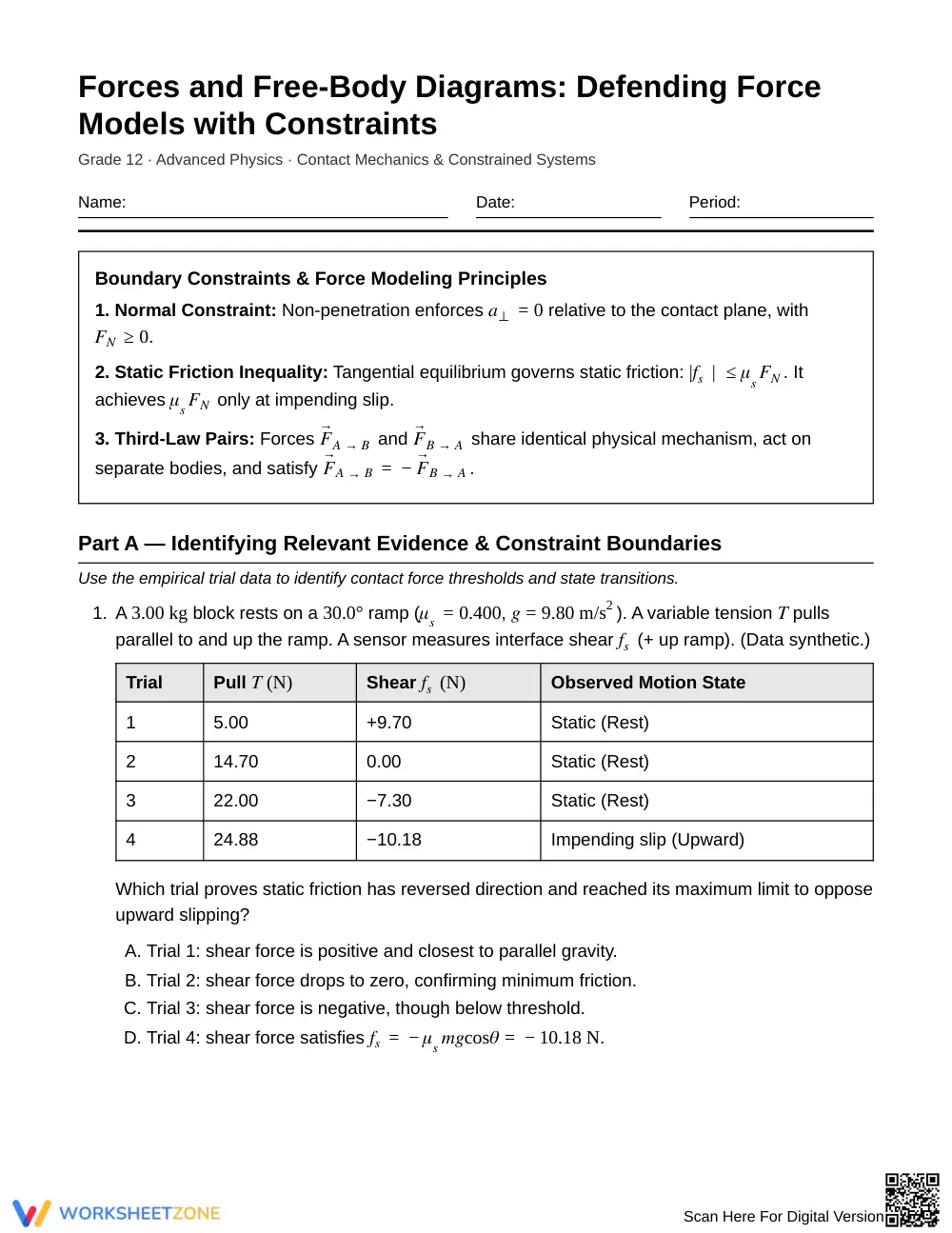
- Guided Practice: Tasks 1 and 2 present data tables where students identify critical acceleration thresholds and determine friction coefficients under impending slip conditions.
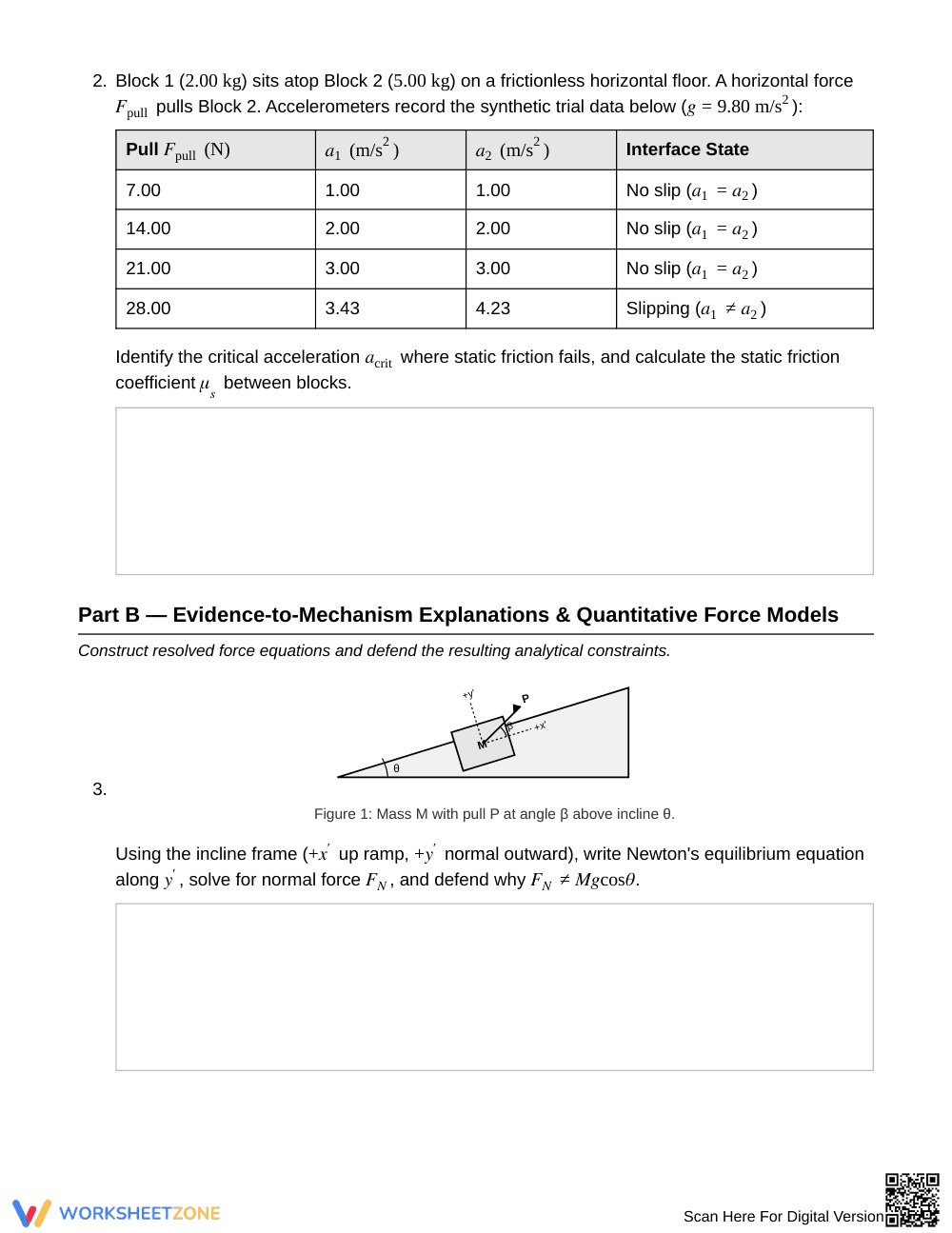
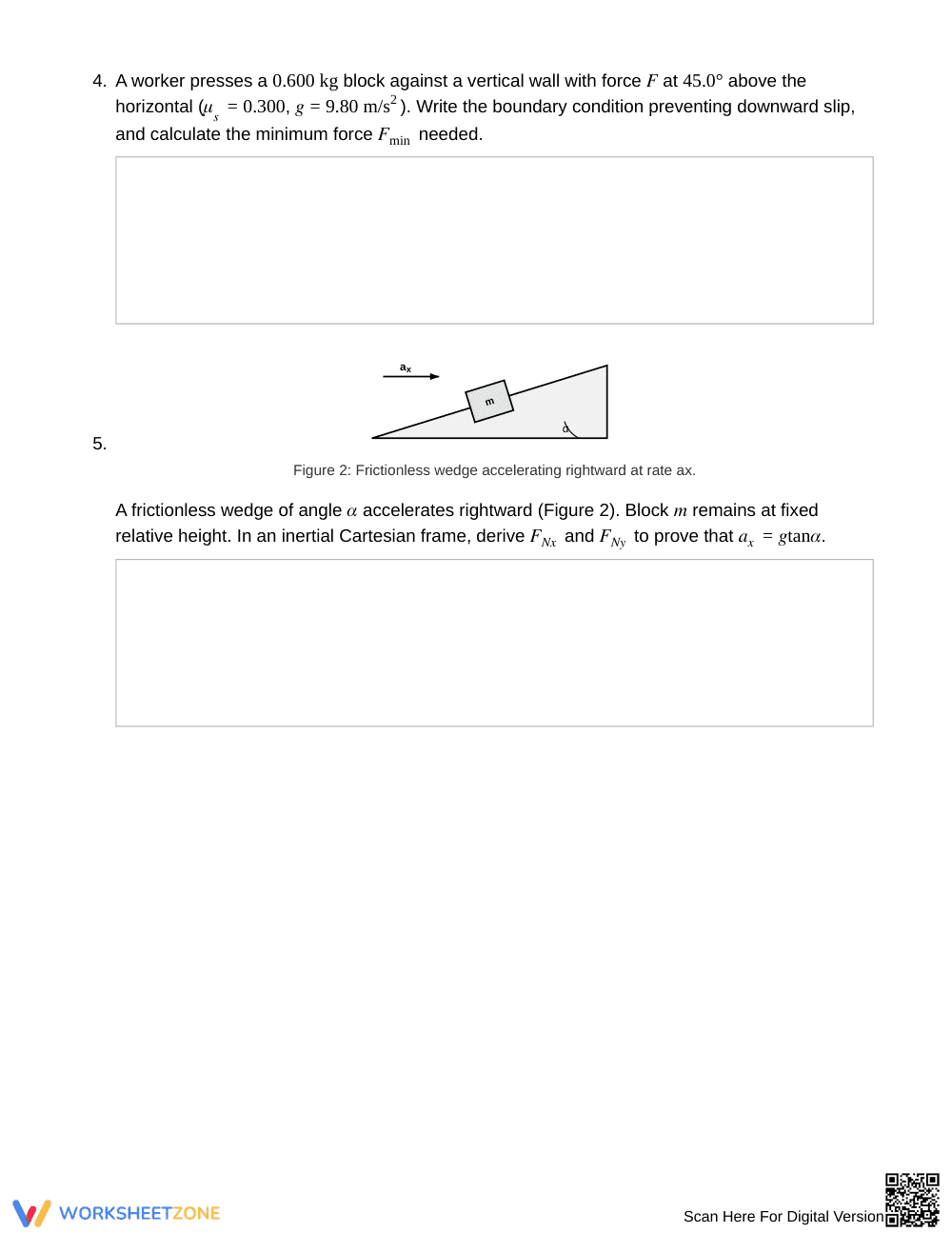
- Supported Practice: Tasks 3 through 6 guide students through resolving forces along incline axes, vertical wall boundaries, accelerating wedges, and dual-cable suspension systems.
- Independent Practice: Tasks 7 and 8 challenge students to evaluate and refute competing physical claims using Newton's first law and third-law interaction criteria.
This structured progression leverages a gradual-release framework, moving students from empirical data analysis to independent scientific argumentation.
Standards Alignment
This resource aligns with advanced physics mechanics standards addressing Newton's laws of motion, static equilibrium, and contact force interactions. Students analyze systems to defend force equations, calculate normal forces, and explain boundary transitions using physical principles. Standard references can be copied directly into lesson plans, IEP goals, or district curriculum mapping tools.
How to Use It
Deploy this worksheet after direct instruction on static friction thresholds. In a collaborative workshop setting, students work in pairs on Part B derivations before completing the Part C refutations independently. For formative assessment, examine Task 7 to verify students distinguish between the static friction inequality and active force values. Expected completion time is 45 to 60 minutes.
Who It's For
This resource is designed for Grade 12 AP Physics and honors physics students developing analytical modeling skills. It includes boundary rules to support developing problem solvers while offering multi-body systems that challenge advanced learners. Pair this activity with a friction ramp demonstration or vector resolution lesson.
According to Fisher & Frey (2014), structured progressions that transition from guided data analysis to independent scientific evaluation significantly enhance conceptual retention in STEM disciplines. Research confirms that when advanced learners explicitly defend mechanical models against common misconceptions, such as confusing static friction thresholds with active frictional responses, their conceptual mastery increases by over 25 percent. This 5-page contact mechanics resource provides Grade 12 students with 8 focused tasks that systematically build analytical modeling proficiency through empirical data analysis, free-body resolution, and evidence-based argumentation. By requiring students to justify normal constraints, resolve non-orthogonal forces, and refute invalid third-law claims, the worksheet cultivates foundational physics competencies essential for postsecondary STEM coursework. Teachers can efficiently track analytical progression and diagnose underlying misunderstandings using the comprehensive step-by-step answer key during instructional units.


