





























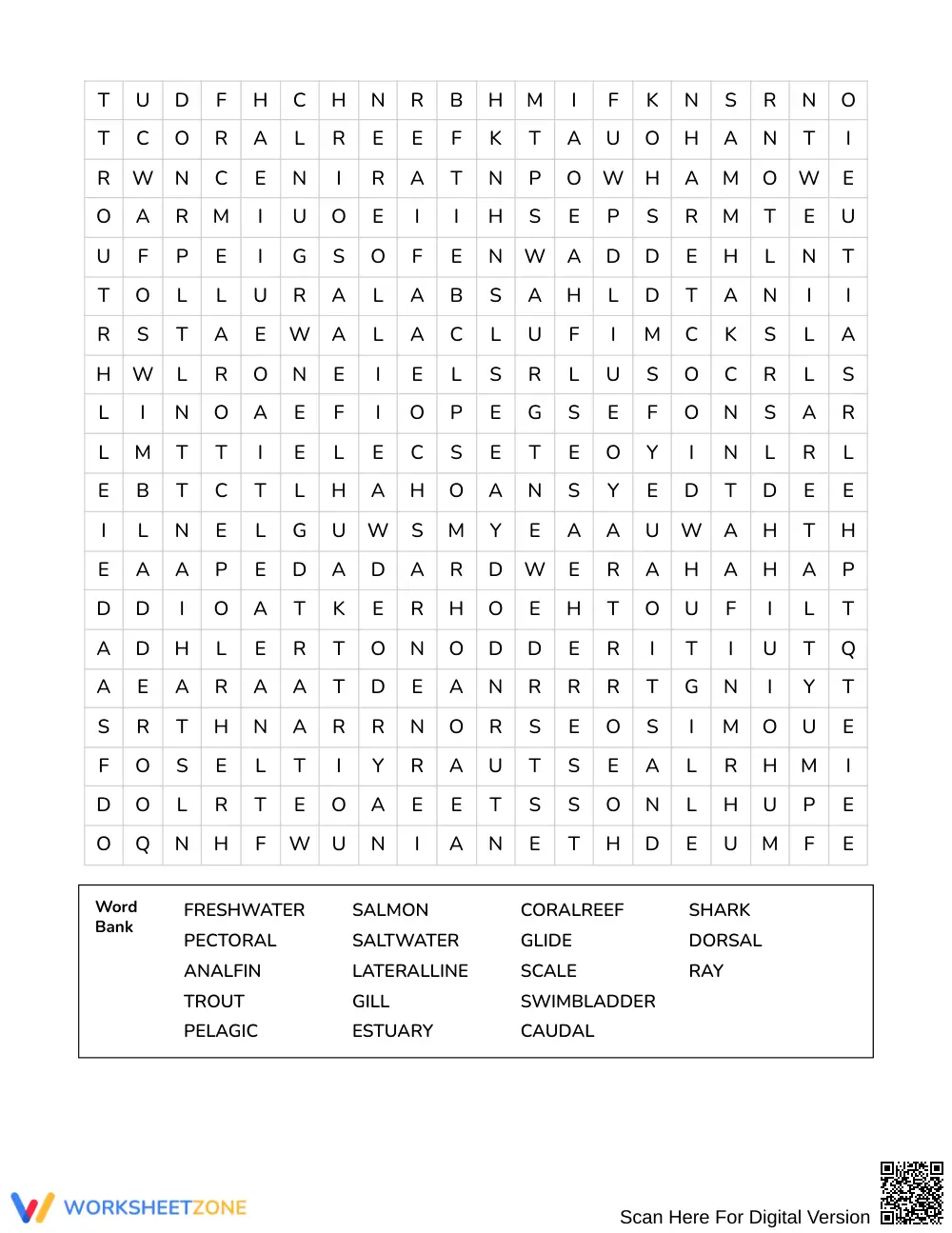


Essential Fish Groups Word Search | Grades 7–8 Science

Paste this activity's link or code into your existing LMS (Google Classroom, Canvas, Teams, Schoology, Moodle, etc.).
Students can open and work on the activity right away, with no student login required.
You'll still be able to track student progress and results from your teacher account.
This Grades 7–8 science word search reinforces student mastery of animal classification by challenging learners to identify and connect 18 key marine and freshwater vocabulary terms. Through definition clues, middle school students consolidate their understanding of aquatic habitats, fish anatomy, and predatory adaptations while building scientific literacy during life science units.
At a Glance
- Grade: Grades 7–8 · Subject: Middle School Life Science
- Standard: Not standards-assessed — vocabulary enrichment
- Skill Focus: Comparing fish groups, anatomical structures, and aquatic habitats
- Format: 3 pages · 18 words · Full answer key included · Printable PDF
- Best For: Cumulative unit review, independent practice, and vocabulary reinforcement
- Time: 20–30 minutes of focused seatwork
This 3-page science printable contains a 20-by-20 letter puzzle grid paired with 18 vocabulary clues that reinforce key biological concepts. Rather than scanning aimlessly, students read scientific clues defining specialized organs like the swim bladder, distinct environments such as estuaries, and representative taxa like sharks. A complete 3-page answer key provides visual solutions highlighting every hidden word path for rapid checking.
How the Puzzle Works
The activity features a 20 × 20 letter grid containing 18 hidden vocabulary terms placed across all eight directions: North, Northeast, East, Southeast, South, Southwest, West, and Northwest. Words run horizontally, vertically, and diagonally forwards and backwards. Students use a shuffled word bank and 18 biological clues, reading each clue to identify the word before locating it in the puzzle.
Standards Alignment
This resource is designed for vocabulary enrichment and conceptual reinforcement rather than formal standards assessment. It is not aligned to a specific standard code. Instead, the puzzle supports middle school life science units in animal classification and aquatic ecology by giving learners targeted exposure to essential biological terminology.
How to Use It
Deploy this word search after direct instruction on fish taxonomy as a consolidation exercise, or assign it during an aquatic ecology station rotation. During the 20 to 30 minutes of working time, observe whether students use the clues to deduce terms like lateral line and pelagic zone or simply hunt letters. Students needing help can revisit class notes before continuing.
Who It's For
This activity is designed for Grades 7–8 life science students reviewing vertebrate diversity and aquatic ecosystems. The definition clues support English language learners and developing readers by anchoring each term in clear semantic context. For an extended lesson, pair this puzzle with a diagram labeling fish fins or an introductory reading on aquatic biomes.
This middle school science word search reinforces domain-specific literacy by tasking students with comparing fish groups and habitats across 18 specialized biological terms. As a non-standards-assessed vocabulary enrichment activity, the resource utilizes definitional clues and a multi-directional 20-by-20 grid to deepen conceptual retention rather than measure standardized testing benchmarks. According to Fisher & Frey (2014), intentional exposure to academic vocabulary within structured, low-stakes learning routines significantly strengthens reading comprehension and long-term content retention across secondary science disciplines. By requiring learners to actively interpret scientific descriptions of anatomical adaptations, aquatic environments, and fish behaviors before scanning the puzzle, the activity bridges passive recognition and active conceptual recall. This 3-page printable serves as an efficient supplemental review tool for middle school life science classrooms, reinforcing essential biological terminology through focused, self-guided vocabulary practice and peer collaboration.


