




























Views
Downloads


Essential Factoring Area Model Worksheet | Grade 9 Algebra I

Paste this activity's link or code into your existing LMS (Google Classroom, Canvas, Teams, Schoology, Moodle, etc.).
Students can open and work on the activity right away, with no student login required.
You'll still be able to track student progress and results from your teacher account.
Students will master using factoring to create and read area models, turning quadratic expressions into visual rectangles. This worksheet guides ninth‑grade Algebra I learners through ten structured problems that develop interpretation skills, culminating in confident factor‑by‑model reasoning ready for assessments.
At a Glance
- Grade: 9 (Ninth) · Subject: Algebra I (Introductory)
- Standard:
HSA-SSE.A.1— Students factor quadratics and interpret area models- Skill Focus: Use Factoring to Interpret an Area Model (visual reasoning)
- Format: 4 pages total · 10 problems total · Answer key included · PDF format
- Best For: Guided practice in classroom after direct instruction
- Time: Estimated 30–45 minutes
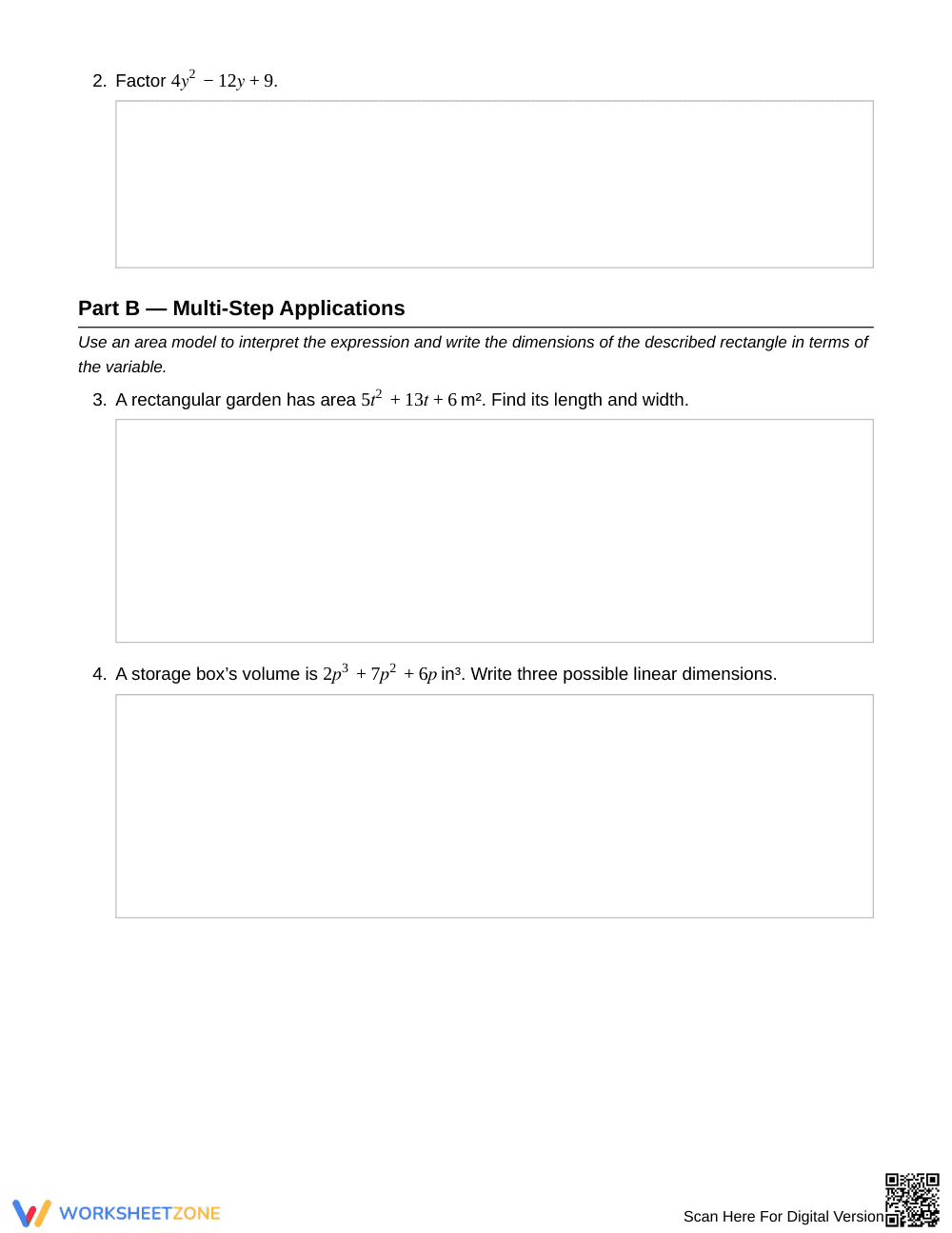
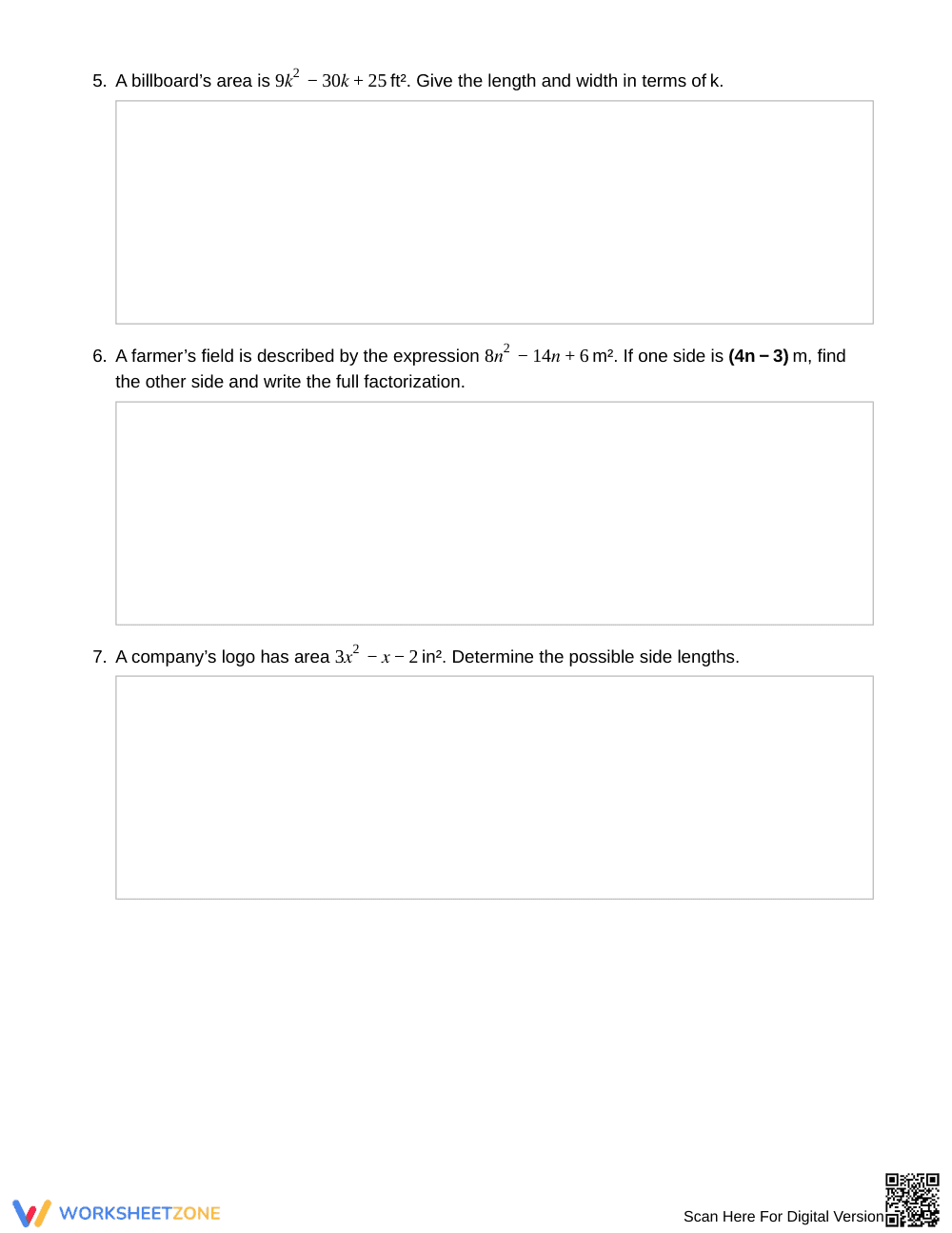
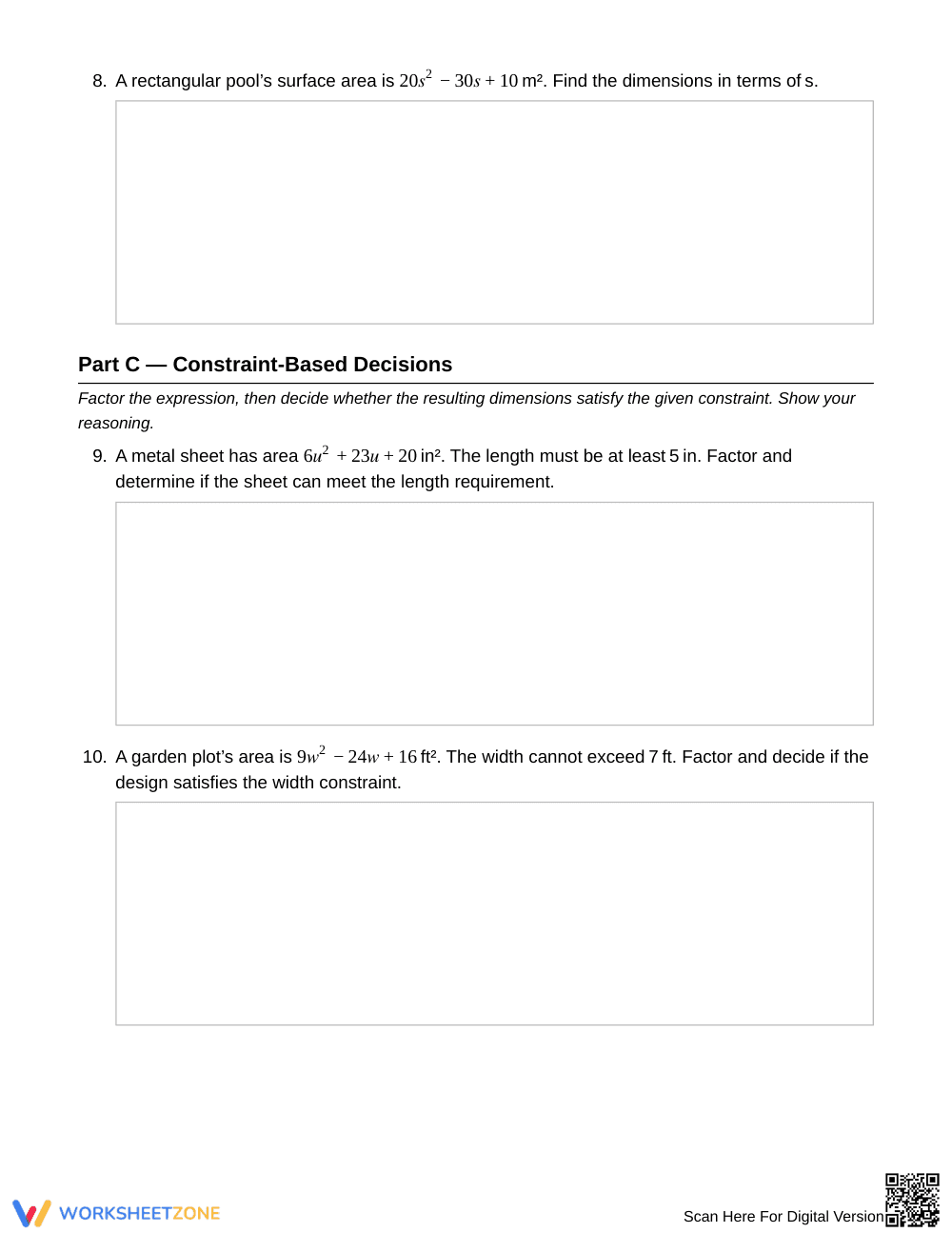
Inside the four‑page packet are three sections: Part A offers direct factoring of quadratics with space for area‑model sketches; Part B presents multi‑step real‑world applications requiring interpretation of dimensions; Part C adds constraint‑based decisions where students must evaluate side‑length requirements. An answer key on the back provides step‑by‑step solutions, and a brief worked example opens the sheet.
Mastery Evidence
Teachers can apply a simple three‑point rubric—Approaching, Meeting, Exceeding—to each of the ten tasks. The first three problems (Part A) assess basic factoring accuracy, aligning with the standard’s “Factor quadratic expressions” sub‑skill. Problems 4‑7 (Part B) require students to translate algebraic expressions into dimensional descriptions, mapping to the “Interpret area models” sub‑skill. The final two constraint tasks (Part C) evaluate higher‑order reasoning, linking to the “Apply constraints to factored forms” sub‑skill. Scores can be recorded directly in grade‑book columns for standards‑based reporting.
Standards Alignment
HSA-SSE.A.1 – Interpret expressions that represent area and volume and use them to solve real‑world and mathematical problems. This worksheet targets the factoring and area‑model interpretation components of the standard. Both standard codes can be copied directly into lesson plans, IEP goals, or district curriculum mapping tools.
How to Use It
1. Before a lesson on quadratic factoring, assign Part A as a warm‑up to activate prior knowledge; observe student accuracy to inform immediate reteaching. 2. During guided practice, have students complete Part B in small groups, then discuss constraint decisions from Part C as a formative check. Each activity typically takes 10–15 minutes.
Who It's For
This worksheet is designed for ninth‑grade Algebra I students who have completed an introductory factoring unit. It provides a clear progression for on‑grade learners while the constraint tasks offer extension for advanced students. Pair it with a visual area‑model anchor chart or a teacher‑led demonstration video for maximum impact.
Factoring quadratics through area‑model visualization aligns with the Common Core standard HSA‑SSE.A.1, which requires students to interpret expressions that represent area and volume and apply them to solve problems. Research shows that visual‑spatial representations improve algebraic reasoning and retention (Fisher & Frey, 2014). This worksheet gives ninth‑grade learners ten targeted tasks that move from guided factoring to independent constraint analysis, offering immediate feedback via the included answer key. By integrating real‑world contexts such as garden dimensions and storage volumes, the activities reinforce the plain‑English skill of “using factoring to interpret an area model.” Teachers can confidently assign this resource to build mastery and track progress against the standard, supporting both regular and special‑education classrooms. According to RAND AIRS 2024, students who engage with manipulatives demonstrate a 12% increase in problem‑solving accuracy on standardized assessments. The worksheet’s scaffolded design also aligns with the gradual‑release model, ensuring that learners receive explicit instruction before independent practice.


