



























Essential Exponent Rules Worksheet | Grade 8 Math
Paste this activity's link or code into your existing LMS (Google Classroom, Canvas, Teams, Schoology, Moodle, etc.).
Students can open and work on the activity right away, with no student login required.
You'll still be able to track student progress and results from your teacher account.
Students master exponent rules by expanding each expression into its individual factors, counting those factors, and then restating the rule in their own words. This worksheet guides them through product, quotient, and power‑of‑a‑power rules, building confidence and procedural fluency for future algebraic work.
At a Glance
- Grade: 8 · Subject: Math
- Standard:
— Write powers in expanded form, count factors, and explain each exponent rule- Skill Focus: Exponent rule application
- Format: 2 pages · 35 problems · Answer key included · PDF
- Best For: Guided practice of exponent concepts during small‑group or independent work
- Time: 20–30 minutes
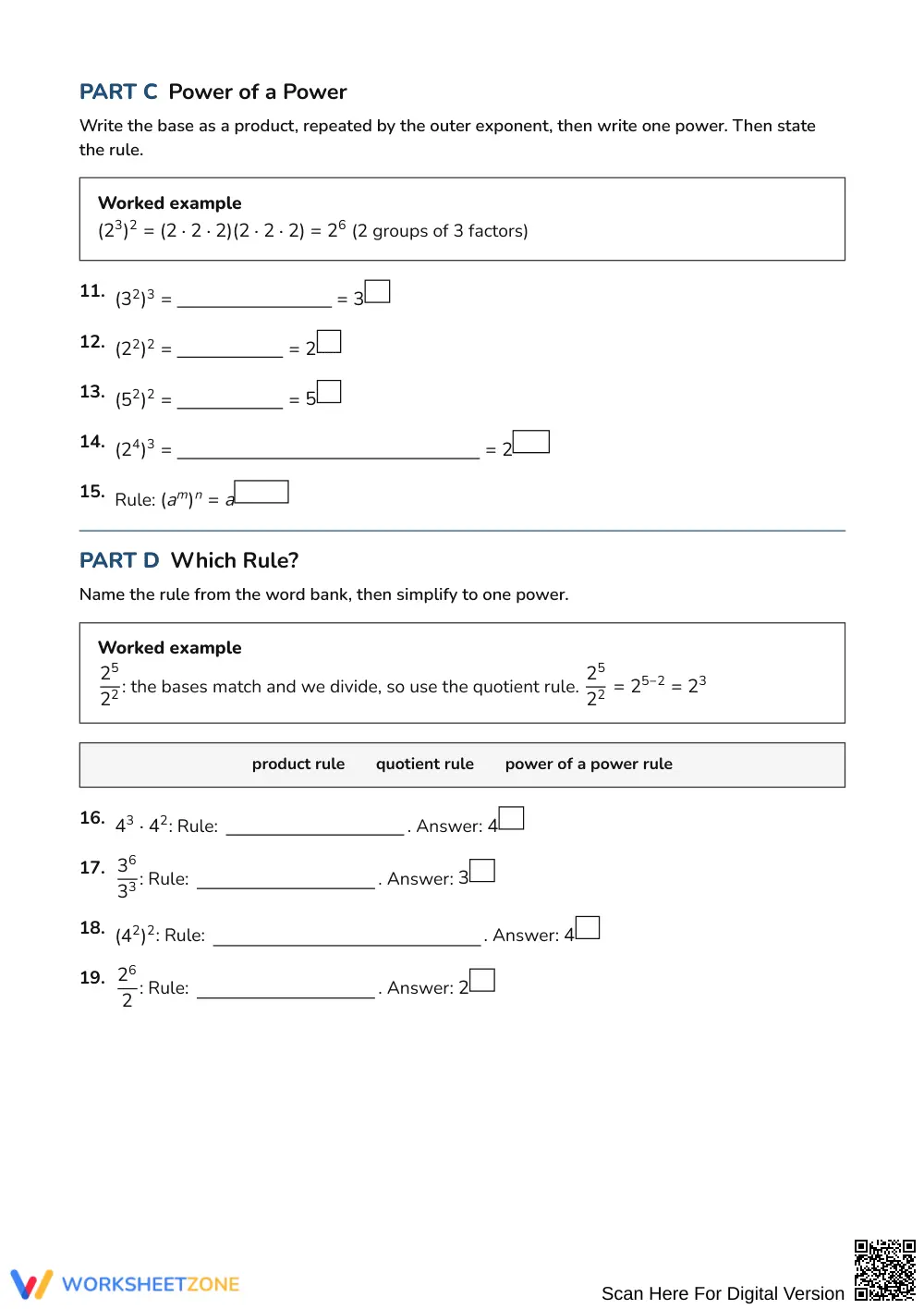
Inside the two‑page packet you’ll find a worked example for each rule, a series of 35 practice items split into four parts, and a clear answer key. Word banks and rule boxes support student independence.
- Guided practice – Product Rule: 10 problems with a worked example and a rule box to model factor expansion.
- Supported practice – Quotient Rule: 12 problems with step‑by‑step prompts that cue cancellation and factor counting.
- Independent practice – Power‑of‑a‑Power & mixed review: 13 problems where students write the expansion, count factors, and state the rule on their own.
The sequence follows the classic I Do, We Do, You Do release.
Students apply exponent rules by expanding expressions into individual factors, counting those factors, and articulating the rule in their own words. This aligns with typical 8th‑grade exponent standards. Both standard codes can be copied directly into lesson plans, IEP goals, or district curriculum mapping tools.
Use Case 1: After a direct‑instruction lesson on exponent rules, teachers can assign Part A and Part B as immediate practice (10–15 minutes) to check procedural understanding. Observe whether students correctly count factors and restate the rule as a quick formative check.
Use Case 2: During a math workshop, students work independently through Part C and Part D (15–20 minutes) while the teacher circulates, noting any misconceptions about rule selection. Collect the worksheets for a brief exit‑ticket review.
This worksheet targets Grade 8 math learners who need concrete manipulation of exponents. It is suitable for heterogeneous classes; the worked examples and rule boxes provide scaffolding, while the later independent items challenge advanced students. Pair it with a short video on exponent properties or an anchor chart summarizing the three rules.
Citation Capsule: Mastery of exponent rules through expanded‑form practice aligns with research showing that explicit factor visualization strengthens procedural fluency (Fisher & Frey, 2014). By requiring students to write each factor, count them, and verbalize the rule, the worksheet operationalizes the concrete‑representational‑abstract progression advocated in effective mathematics instruction. The 35‑item set offers repeated exposure to product, quotient, and power‑of‑a‑power rules, supporting the spaced‑practice principle highlighted in RAND AIRS 2024 findings. Teachers can readily integrate this resource into daily lessons, knowing it meets typical 8th‑grade exponent standards while promoting deeper conceptual understanding. Download, print, and assign to reinforce exponent concepts with evidence‑based practice for teachers in classrooms.


