



























Essential Exponent Laws Worksheet | Grade 9 Math
Paste this activity's link or code into your existing LMS (Google Classroom, Canvas, Teams, Schoology, Moodle, etc.).
Students can open and work on the activity right away, with no student login required.
You'll still be able to track student progress and results from your teacher account.
This targeted Grade 9 algebra worksheet builds fluency simplifying monomial expressions using the properties of exponents. Students master all seven core exponent laws through systematic practice, transforming expressions containing single variables, multivariable terms, negative powers, and quotients. The structured layout ensures learners develop automaticity before tackling complex multi-step simplifications.
At a Glance
- Grade: 9 · Subject: Math
- Standard:
HSA-SSE.A.2— Use exponent structure to rewrite algebraic expressions involving monomials- Skill Focus: Monomial exponent rules and simplification
- Format: 2 pages · 25 problems · Answer key included · PDF
- Best For: Independent practice or skill remediation
- Time: 40–50 minutes
What's Inside
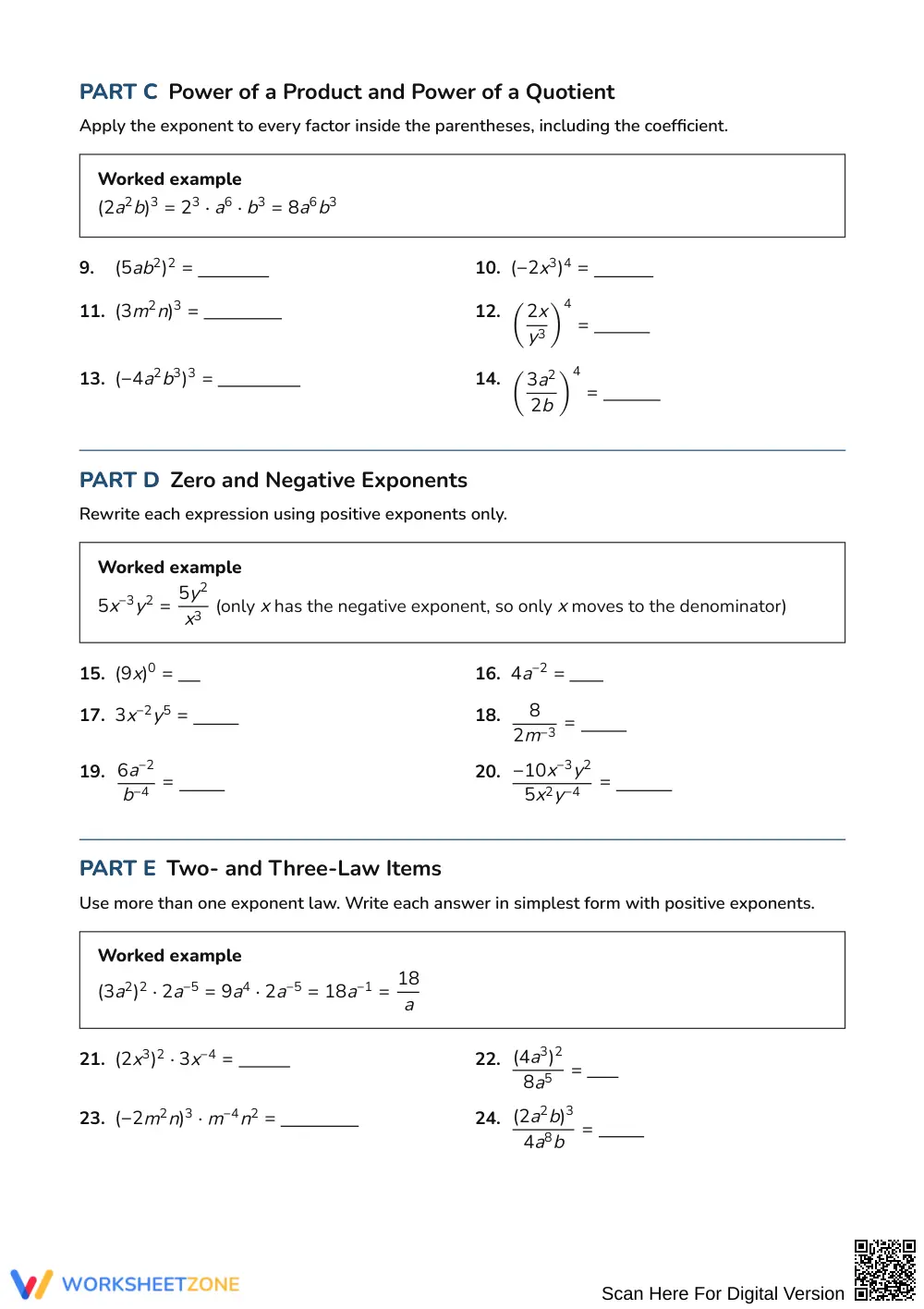
This 2-page resource features an organized reference chart displaying seven foundational exponent laws paired with algebraic monomial examples. Across four distinct practice blocks, students solve 25 computational problems supported by clear worked examples. A comprehensive 2-page answer key provides complete step-by-step solutions for immediate feedback.
Skill Progression
- Guided Practice (Part B: 8 problems): Focuses on foundational product, quotient, and power of a power rules with single and two-variable terms, scaffolded by explicit worked examples.
- Supported Practice (Parts C & D: 13 problems): Expands algebraic reasoning to power of products, power of quotients, zero exponents, and negative exponents requiring positive denominator conversion.
- Independent Practice (Part E: 4 problems): Challenges students to synthesize multiple properties simultaneously by combining two- and three-law operations into fully simplified expressions.
This sequence reinforces student independence through a gradual-release model, transitioning learners from isolated rule execution to multi-step algebraic synthesis.
Standards Alignment
Primary Standard: HSA-SSE.A.2 — Use the structure of an expression to identify ways to rewrite it. For example, see x4 − y4 as (x2)2 − (y2)2, thus recognizing it as a difference of squares that can be factored. This worksheet applies structural decomposition directly to monomial bases and powers. Both standard codes can be copied directly into lesson plans, IEP goals, or district curriculum mapping tools.
How to Use It
Administer this worksheet during the independent practice portion of your exponent unit or as a focused review prior to polynomial multiplication. When monitoring student work, check Part D closely to ensure students apply negative exponents solely to their specific variable bases rather than moving entire terms or positive coefficients into denominators. Expect most Grade 9 students to complete the 25 problems within 40 to 50 minutes.
Who It's For
Designed for Grade 9 Algebra 1 students, this worksheet offers robust reinforcement for general education classrooms and targeted intervention for high schoolers needing remediation on power rules. Pair this activity directly with a whole-group mini-lesson or an exponent rules anchor chart to maximize retention.
According to Fisher & Frey (2014) on the gradual release of responsibility framework, structured cognitive scaffolds enable high school mathematics students to transfer foundational procedures into complex problem-solving domains. This 2-page worksheet operationalizes standard HSA-SSE.A.2 by providing high school learners with explicit monomial models before prompting autonomous execution. Across 25 systematically leveled problems, students practice applying product, quotient, power, zero, and negative exponent laws to rewrite algebraic terms into simplest form. By anchoring computational exercises in worked examples, the resource addresses persistent misconceptions regarding negative bases and variable exponents. The design ensures learners build procedural fluency and structural awareness, bridging initial rule introduction with advanced polynomial manipulation in secondary mathematics curricula.


