



























Essential Dilations from a Center Worksheet | Grade 8 Math
Paste this activity's link or code into your existing LMS (Google Classroom, Canvas, Teams, Schoology, Moodle, etc.).
Students can open and work on the activity right away, with no student login required.
You'll still be able to track student progress and results from your teacher account.
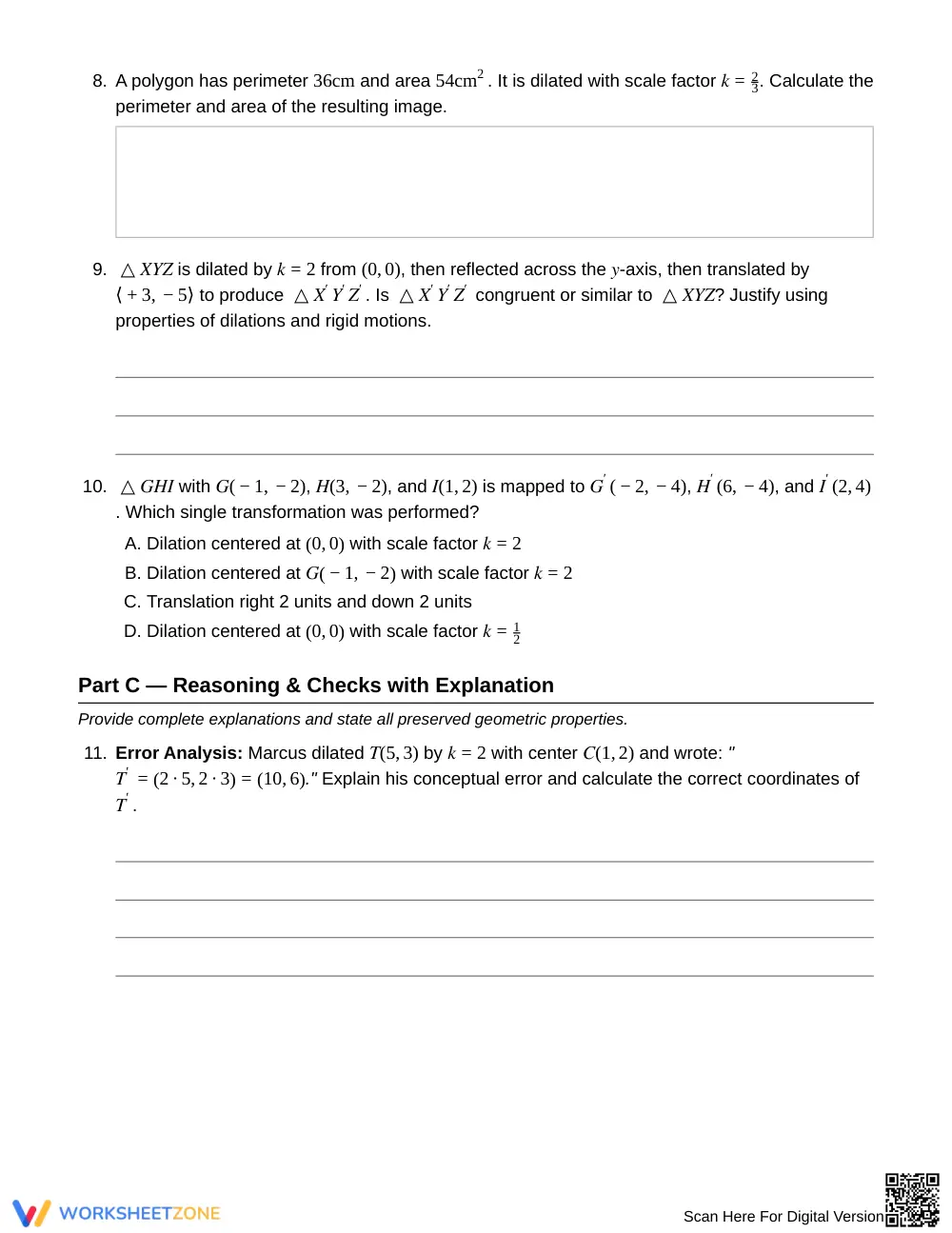
This Grade 8 geometry worksheet trains students to perform dilations from both the origin and arbitrary center points on the coordinate plane. Learners apply coordinate rules, calculate vector displacements, evaluate scale factors, and explore geometric invariants including angle preservation, perimeter scaling, and area changes across twelve rigorous, step-by-step math problems.
At a Glance
- Grade: 8 · Subject: Math
- Standard: Apply scale factors and coordinate rules to dilate figures from stated centers
- Skill Focus: Dilations from origin and arbitrary center points
- Format: 4 pages · 12 problems · Answer key included · PDF
- Best For: Independent practice and transformations review
- Time: 35–45 minutes
What's Inside
This 4-page printable resource includes a foundational reference box with algebraic rules for origin and arbitrary center dilations, followed by two fully worked guided models. The 12 student tasks span missing-step vector calculations, multi-step coordinate transformations, visual scale factor determinations, compound transformations, perimeter and area scaling, and conceptual error analysis prompts, accompanied by a complete 2-page answer key.
Skill Progression
- Guided practice: Part A features 4 missing-step completion tasks that scaffold vector displacement formulas and coordinate scaling step by step.
- Supported practice: Part B presents 6 multi-step problems requiring students to calculate coordinates, determine scale factors from diagrams, and analyze similarity under composite transformations.
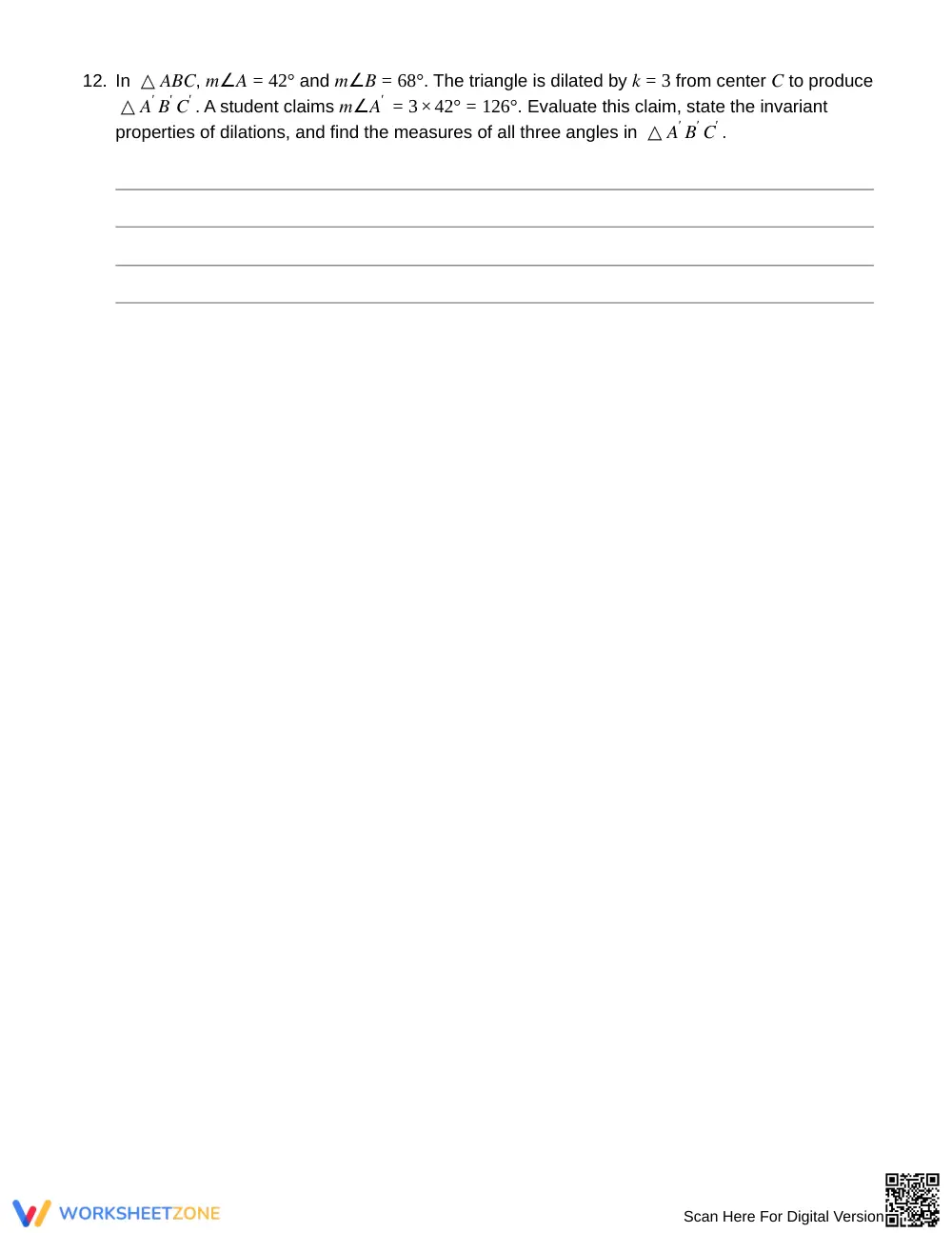
- Independent practice: Part C delivers 2 in-depth reasoning and error-analysis tasks challenging students to critique non-origin dilation misconceptions and justify angle invariance.
This sequence follows a gradual-release instructional model that systematically transfers mathematical autonomy to the learner.
Standards Alignment
This resource aligns with Grade 8 geometry standards addressing similarity, dilations, and transformations on the coordinate plane. Students describe the effect of dilations using coordinates and explore how scale factors modify line segments, perimeter, and area while preserving angle measurements and parallelism. The curriculum benchmarks can be copied directly into lesson plans, IEP goals, or district curriculum mapping tools.
How to Use It
Deploy this worksheet during the direct practice phase following an introductory lesson on non-origin dilations, or utilize it as a targeted review before a unit exam. As a formative assessment tip, check Part A Step 1 to ensure students subtract the center coordinates before scaling displacements rather than multiplying raw coordinates directly. The entire set takes approximately 35 to 45 minutes to complete.
Who It's For
This worksheet is designed for eighth-grade math students mastering coordinate geometry and geometric transformations. It offers structured scaffolds for developing learners while providing rigorous reasoning prompts for advanced students. Pair this activity with an interactive coordinate grid demonstration or a transformations anchor chart.
According to Fisher & Frey (2014), structured gradual-release frameworks significantly enhance problem-solving accuracy in secondary mathematics by systematically fading procedural scaffolds. This Grade 8 transformation worksheet embodies that research-backed design by moving students from guided missing-step coordinate formulas to autonomous multi-step dilation calculations and conceptual error analysis. When students dilate geometric figures from arbitrary center points, they must coordinate spatial reasoning with multi-step algebraic manipulation. Providing explicit vector displacement models before requiring independent execution prevents common cognitive overload, such as conflating origin-based multiplication with displacement scaling. Research confirms that pairing procedural execution with written justification—such as verifying angle invariance and calculating quadratic area growth—builds durable conceptual mastery in middle school geometry. As a result, teachers can reliably assess both procedural fluency and geometric reasoning within a focused 12-problem instructional sequence.


