


























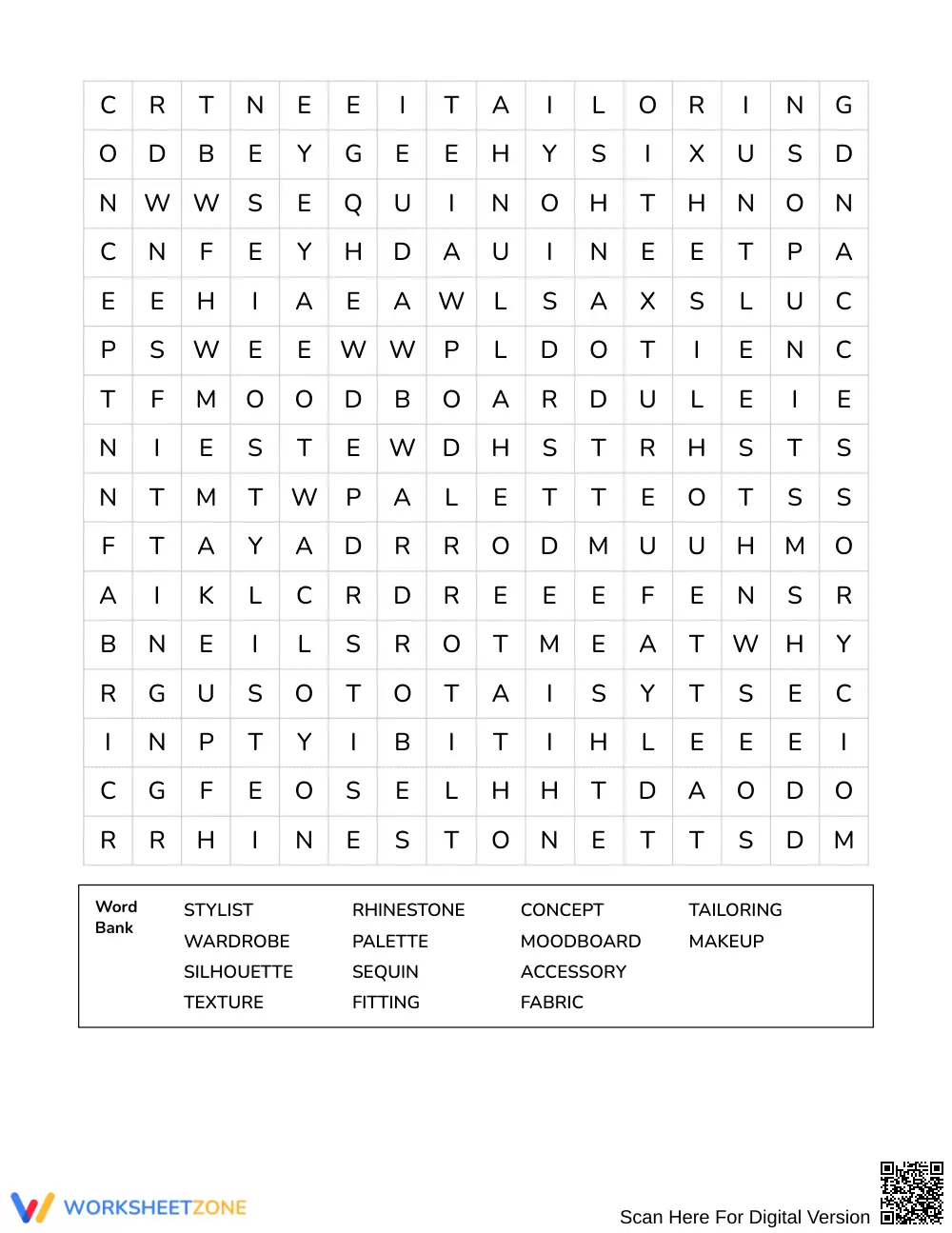

Essential Costume Design Word Search | Grades 4–5 Fine Art
Paste this activity's link or code into your existing LMS (Google Classroom, Canvas, Teams, Schoology, Moodle, etc.).
Students can open and work on the activity right away, with no student login required.
You'll still be able to track student progress and results from your teacher account.
This Grades 4–5 fine art word search reinforces key concepts in costume and visual design by challenging learners to identify and define essential industry terminology. Students read contextual definitions to uncover 14 visual design terms, building foundational art literacy while exploring how creative production elements come together on stage.
At a Glance
- Grade: Grades 4–5 · Subject: Fine Art and Visual Design
- Standard: Not standards-assessed — vocabulary enrichment
- Skill Focus: Costume and visual design stage production terminology
- Format: 3 pages · 14 words · Complete answer key included · Printable PDF
- Best For: Art vocabulary review, unit introduction, and early finishers
- Time: 15–25 minutes of engaged learning
What's Inside
This 3-page printable resource features a visual design "Clue Detective" word search puzzle accompanied by a complete 3-page answer key. Instead of a simple word list, the activity challenges students to read 14 descriptive definitions—covering critical concepts such as silhouette, moodboard, palette, and tailoring—and determine the corresponding terms before searching for them. A shuffled word bank provides necessary spelling support while reinforcing accurate domain-specific vocabulary.
Puzzle Structure and Mechanics
The activity is built upon a dense 16 x 16 letter grid containing 14 hidden vocabulary terms. Students locate words placed across four distinct orientations: northeast (NE), east (E), southeast (SE), and south (S). Incorporating diagonal and vertical placements encourages focused visual tracking, while the shuffled word bank prompts students to connect each written clue directly to its target concept before circling words in the puzzle grid.
Standards Alignment
This word search is designed strictly for vocabulary enrichment and is not aligned to a formal academic content standard. It supports cross-disciplinary visual arts education by introducing foundational technical vocabulary—such as fabric selection, tailoring, color palettes, and stage lighting accessories—enhancing general visual literacy without standardized testing constraints.
How to Use It
Use this word search as an engaging launch activity before direct instruction to preview performance design terminology, or assign it after direct instruction to consolidate key definitions. During independent work, circulate to observe whether students use the contextual clues to predict words before searching, noting which design concepts require clarification. Most learners will complete the search within 15 to 25 minutes.
Who It's For
This activity is created for students in Grades 4–5 studying visual art, theater production, or costume design. Students needing extra reading support can work in pairs to decode the clues, while advanced learners can sketch an original costume using at least four discovered elements. Pair this puzzle with a costume sketch template or an introductory lesson on performance aesthetics.
Designed for Grades 4–5 fine art instruction, this 14-word visual design word search develops costume and visual design vocabulary through contextual clue identification. Although not aligned to a formal standard, the activity provides purposeful domain-specific vocabulary enrichment that anchors creative visual expression in real-world technical terminology. Research highlighted by Fisher & Frey (2014) demonstrates that intentional vocabulary acquisition across specialized content areas strengthens overall reading comprehension and expressive precision when students interact with contextual definitions prior to word recognition and puzzle solving. By translating functional descriptions of apparel, stagecraft, textiles, and materials into concrete artistic concepts, learners effectively bridge commercial stage production methods with aesthetic visual analysis. This printable resource offers elementary art educators an accessible, high-engagement instructional tool that reinforces foundational design principles, actively supports collaborative discussion, and promotes independent artistic vocabulary mastery across diverse classroom environments.


