





























Essential Coordinate Proofs Worksheet | Grade 10 Geometry
Paste this activity's link or code into your existing LMS (Google Classroom, Canvas, Teams, Schoology, Moodle, etc.).
Students can open and work on the activity right away, with no student login required.
You'll still be able to track student progress and results from your teacher account.
Mastering coordinate geometry proofs requires students to bridge algebraic computation with geometric reasoning. This comprehensive 5-page worksheet provides 16 rigorous problems where high school students calculate slope, distance, and midpoints to establish properties of quadrilaterals and triangles, culminating in generalized coordinate proofs.
At a Glance
- Grade: 10 · Subject: Geometry
- Standard:
HSG-GPE.B.4— Use coordinates to prove simple geometric theorems algebraically- Skill Focus: Coordinate-Geometry Check
- Format: 5 pages · 16 problems · Answer key included · PDF
- Best For: Independent practice and assessment review
- Time: 45–60 minutes
This 5-page instructional resource contains 16 structured tasks organized into three distinct tiers of difficulty. It features an essential formula reference box, precise coordinate figures, and an extensive 3-page step-by-step answer key that details algebraic justifications for every slope, distance, and midpoint calculation.
Skill Progression
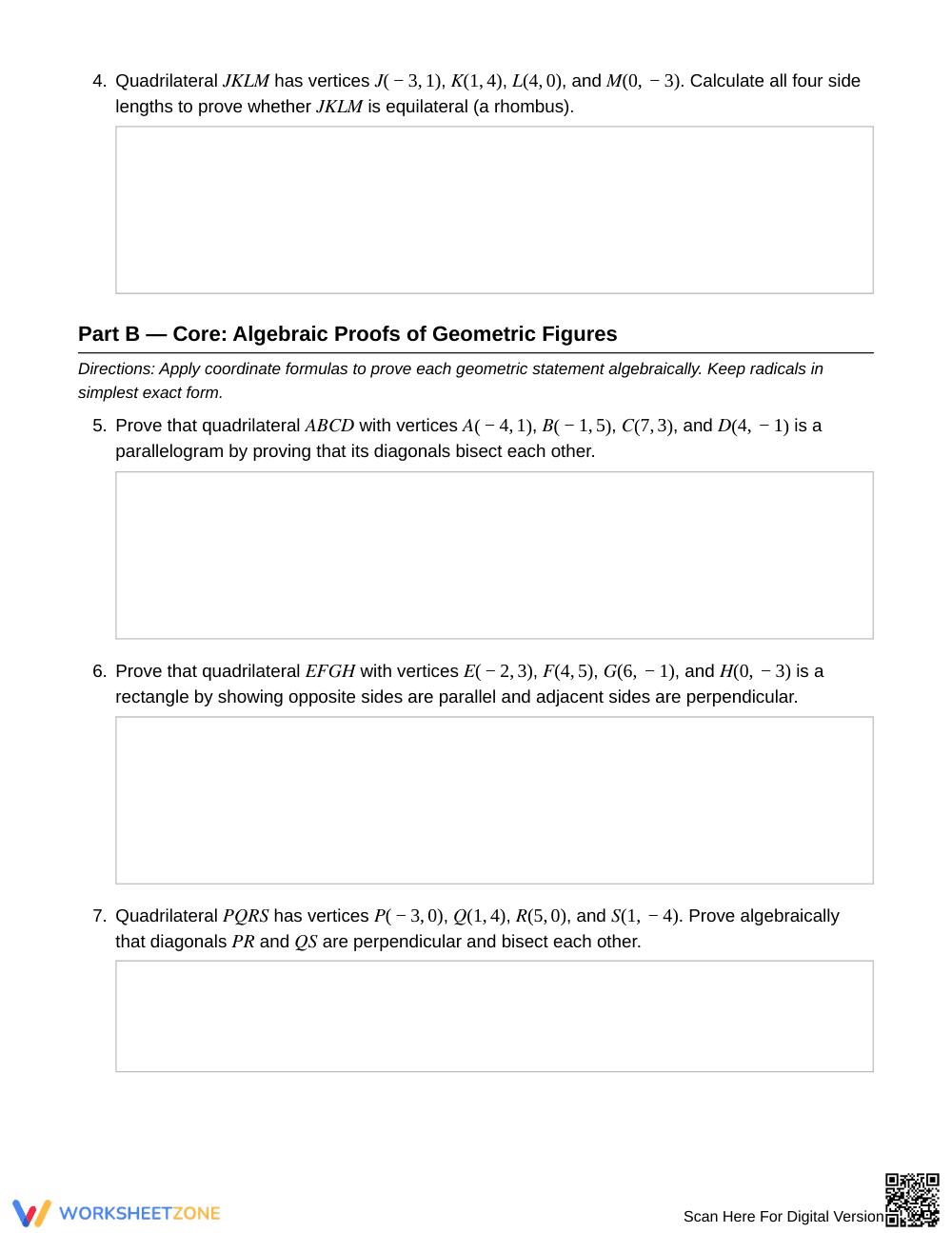
- Guided practice (Part A, 4 problems): Students review foundational formulas by finding exact slopes, distances, and midpoints to test perpendicularity and triangle classifications.
- Supported practice (Part B, 8 problems): Learners construct rigorous algebraic proofs to verify parallelograms, rectangles, squares, midsegments, and circumcenters on numerical coordinate planes.
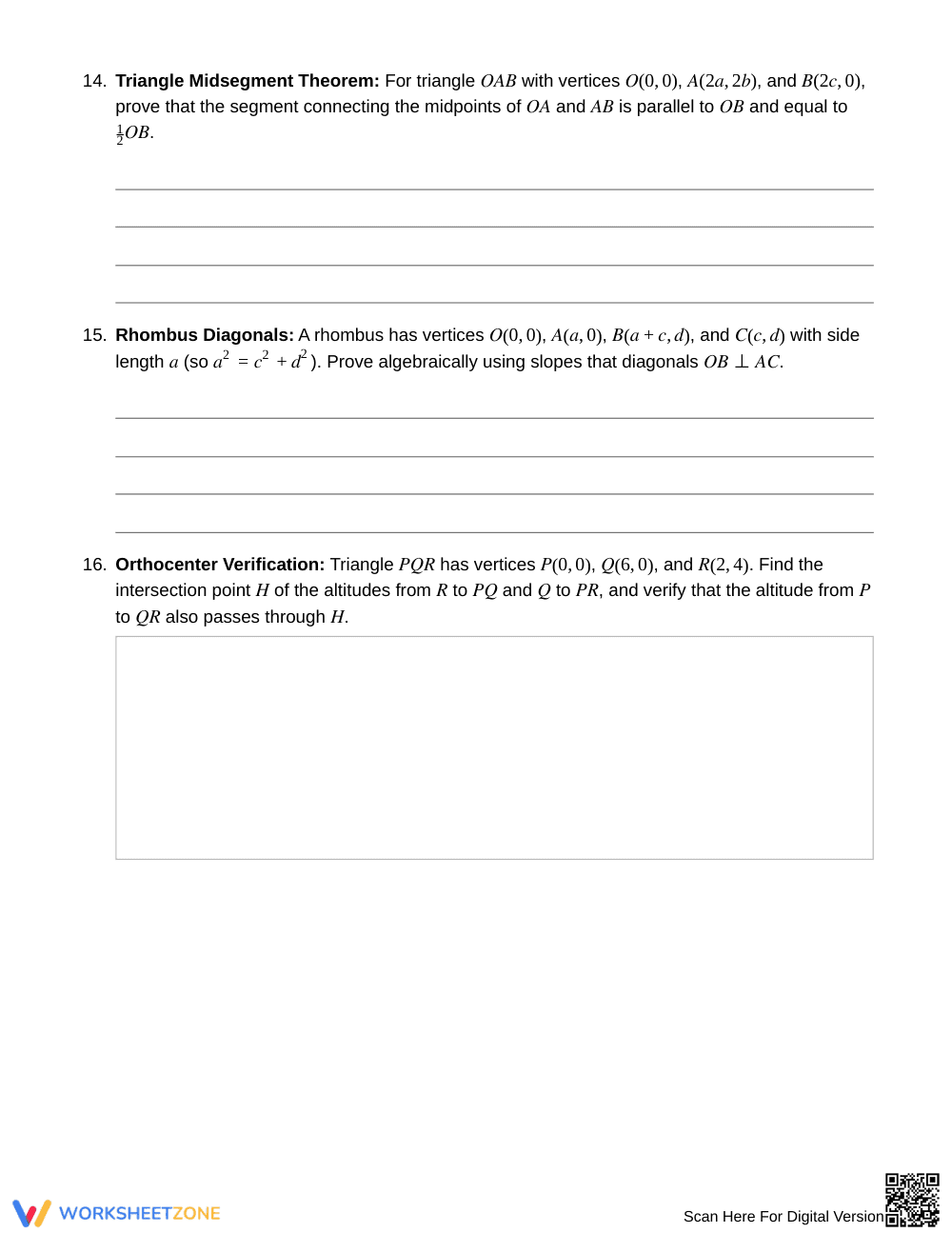
- Independent practice (Part C, 4 problems): Advanced problems require students to complete generalized algebraic proofs using variable coordinates for rectangles, rhombi, and the triangle midsegment theorem.
This sequence follows a structured gradual-release framework, guiding students from mechanical calculations to abstract algebraic proofs.
Standards Alignment
This resource aligns directly with standard HSG-GPE.B.4: Use coordinates to prove simple geometric theorems algebraically. Students apply the distance formula, slope criteria for parallel and perpendicular lines, and midpoint formulas to verify geometric properties analytically. Both standard codes can be copied directly into lesson plans, IEP goals, or district curriculum mapping tools.
How to Use It
Deploy this worksheet after direct instruction on slope criteria and distance formulas. Use Part A and Part B during paired classwork, allowing teachers to observe whether students correctly identify negative reciprocal slopes for perpendicularity. Part C serves as an effective post-lesson summative assessment. Typical completion time spans 45 to 60 minutes across one or two class periods.
Who It's For
This activity is designed for Grade 10 Geometry students learning analytic geometry. It accommodates learners needing scaffolded numerical practice while challenging honors students with generalized coordinate proofs. Pair this printable with an introductory lesson on quadrilateral classifications or coordinate plane graphing anchors.
According to research by Fisher & Frey (2014) on purposeful instructional design, scaffolded problem progressions allow high school mathematics students to successfully bridge procedural computation and formal deductive reasoning. Analytic geometry standards, particularly standard HSG-GPE.B.4, require learners to use coordinates to prove geometric theorems algebraically rather than relying strictly on synthetic methods. When students calculate exact slope ratios, determine segment congruence via the distance formula, and evaluate midpoints across structured tiers, they establish rigorous mathematical justifications for quadrilateral classifications and triangle properties. Engaging with 16 multi-tiered coordinate problems deepens conceptual understanding of coordinate geometry by linking algebraic manipulations to spatial relationships. Research demonstrates that pairing concrete numerical proofs with abstract variable-based coordinate proofs fosters long-term retention of geometric principles and prepares high school learners for advanced analytic coursework in secondary mathematics programs.


