


























Views
Downloads




Essential Coordinate Design Worksheet | Grade 10 Geometry
Paste this activity's link or code into your existing LMS (Google Classroom, Canvas, Teams, Schoology, Moodle, etc.).
Students can open and work on the activity right away, with no student login required.
You'll still be able to track student progress and results from your teacher account.
This Grade 10 Geometry worksheet trains students to model coordinate design constraints by translating structural specifications into algebraic proofs. High school learners apply distance, slope, and midpoint formulas to real-world engineering layouts, verifying whether municipal plazas, gantry tracks, and stormwater basins satisfy geometric criteria.
At a Glance
- Grade: 10 · Subject: Geometry
- Standard: Model geometric specifications and algebraically verify structural constraints on a coordinate plane
- Skill Focus: Model a Coordinate Design Constraint
- Format: 6 pages · 10 multi-step problems · Answer key included · PDF
- Best For: Coordinate geometry practice and applied modeling
- Time: 45–60 minutes
What's Inside
This 6-page printable packet features 10 rigorous coordinate geometry modeling tasks organized into three progressive parts. Students reference an opening formula guide and worked platform design model before completing direct algebraic setups, multi-step geometric proofs, and engineering decision scenarios. A comprehensive 5-page answer key provides complete step-by-step calculations and visual coordinate verifications.
Skill Progression
- Guided practice (Part A, 2 tasks): Students calculate missing vertices and perpendicular pipe slopes using foundational vector displacement and coordinate formulas supported by the opening reference model.
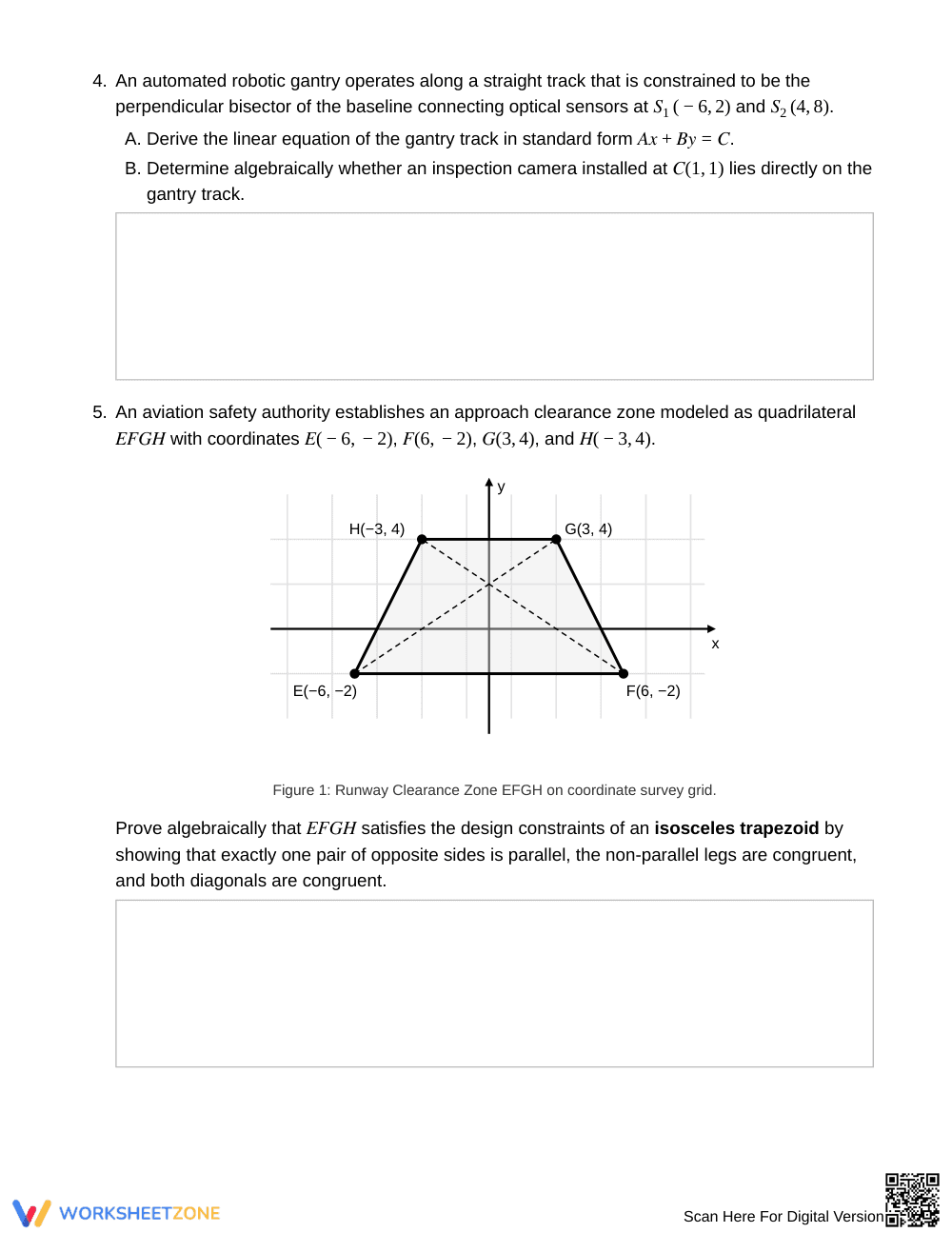
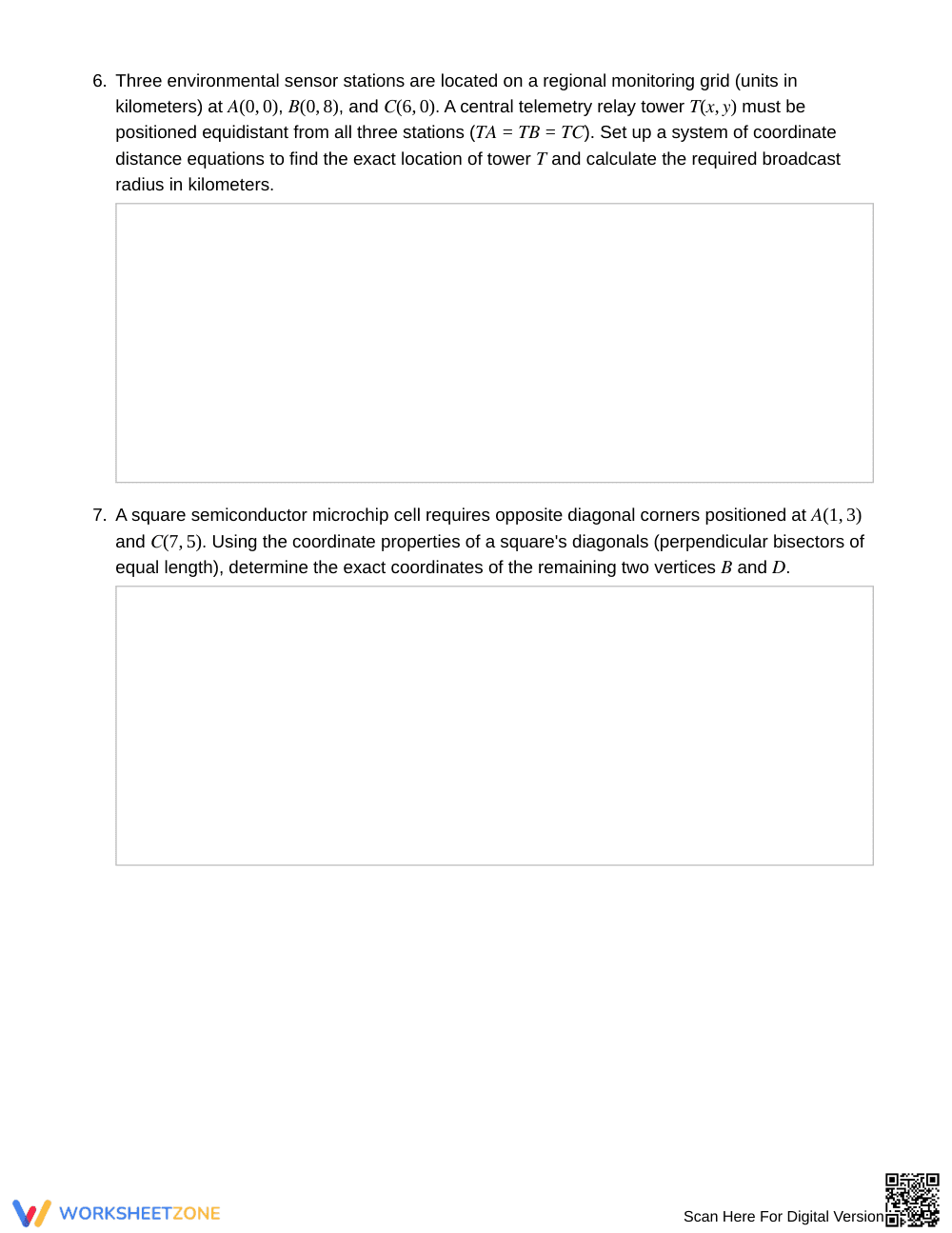
- Supported practice (Part B, 6 tasks): Learners prove rectangle boundaries, perpendicular bisector equations, isosceles trapezoids, and equidistant telemetry towers across authentic engineering contexts.
- Independent practice (Part C, 2 tasks): Students evaluate conflicting architectural claims and evaluate competing detention basin designs against multi-variable geometric constraints.
This sequence reinforces the gradual-release framework, guiding students from structured formula application to independent spatial reasoning.
Standards Alignment
This resource focuses on using coordinates to prove simple geometric theorems algebraically and modeling design problems with geometric criteria. Learners algebraically confirm parallelism, perpendicularity, and congruence within real-world constraints. Both standard codes can be copied directly into lesson plans, IEP goals, or district curriculum mapping tools.
How to Use It
Deploy this resource during the application phase following direct instruction on coordinate proofs and slope criteria. For collaborative review, assign Part B in pairs, observing whether students check both side slopes and diagonal lengths when proving rectangular boundaries. Alternatively, assign Part C as an end-of-unit summative assessment to measure independent modeling ability. Expected completion time spans 45 to 60 minutes.
Who It's For
Designed for tenth-grade Geometry students, this resource suits honors and standard classrooms practicing coordinate proofs. Provide struggling learners with the worked solar array example as an anchor reference, while challenging advanced students to justify the detention basin optimization in Part C. Pair this packet with an interactive graphing utility lesson.
This Grade 10 Geometry worksheet enables students to model coordinate design constraints by applying algebraic distance, slope, and midpoint formulas to authentic structural specifications. Learners verify geometric boundaries, calculate perpendicular bisectors, and evaluate competing civil engineering proposals across 10 multi-step problems. According to research from Fisher & Frey (2014), implementing purposeful gradual-release structures—moving from fully modeled worked examples to complex decision-making scenarios—substantially deepens student conceptual understanding and spatial transfer in high school mathematics. By connecting abstract coordinate formulas with concrete municipal layouts, robotic tracks, and architectural framing, this resource strengthens procedural fluency alongside mathematical modeling rigor. The accompanying 5-page answer key details every slope calculation, radical simplification, and coordinate proof step, allowing educators to identify algebraic misconceptions rapidly. The complete 6-page student packet delivers rigorous, standards-aligned geometry practice ready for immediate classroom implementation.


