


























Views
Downloads



Essential Conics Check Worksheet | Grade 11 Algebra II
Paste this activity's link or code into your existing LMS (Google Classroom, Canvas, Teams, Schoology, Moodle, etc.).
Students can open and work on the activity right away, with no student login required.
You'll still be able to track student progress and results from your teacher account.
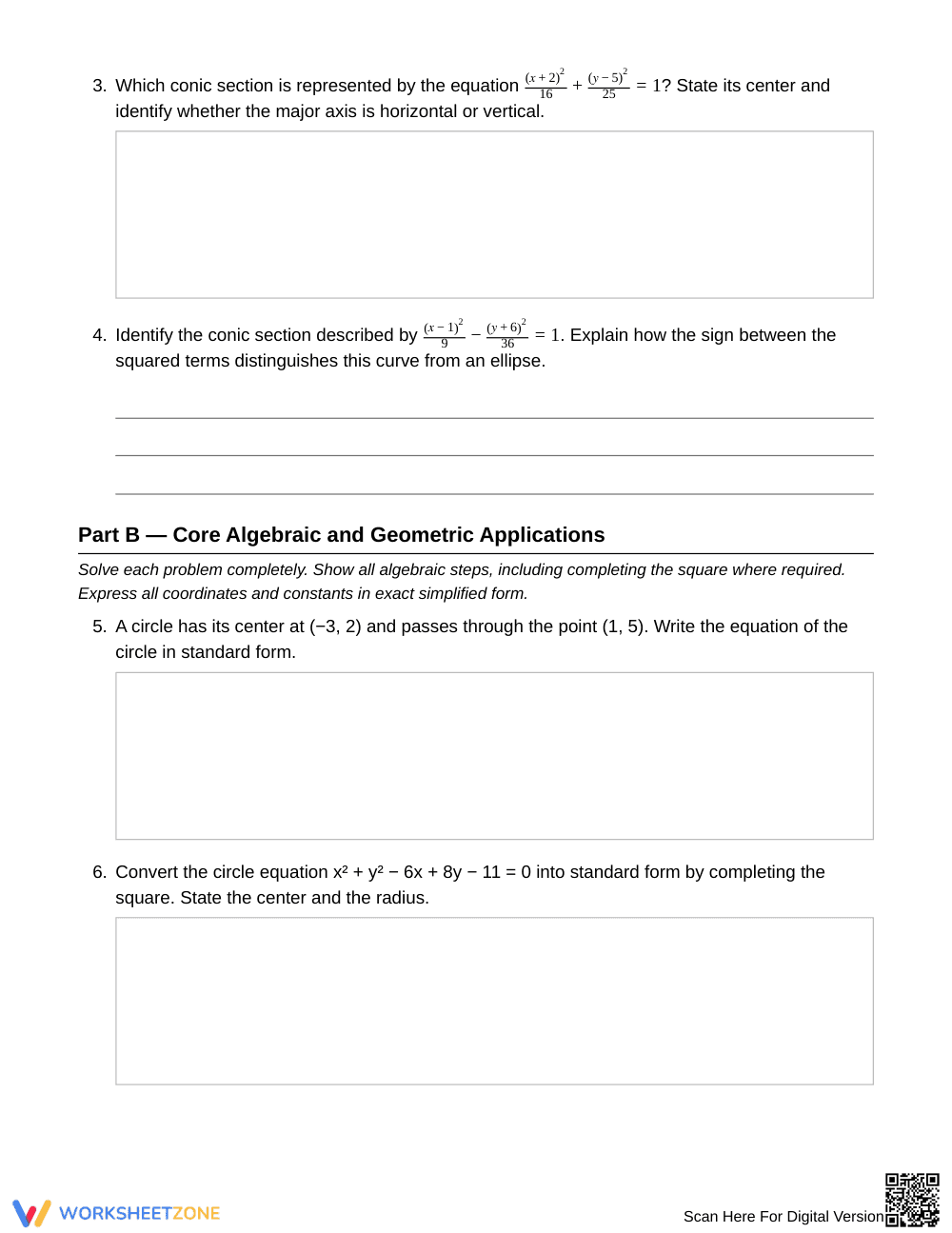
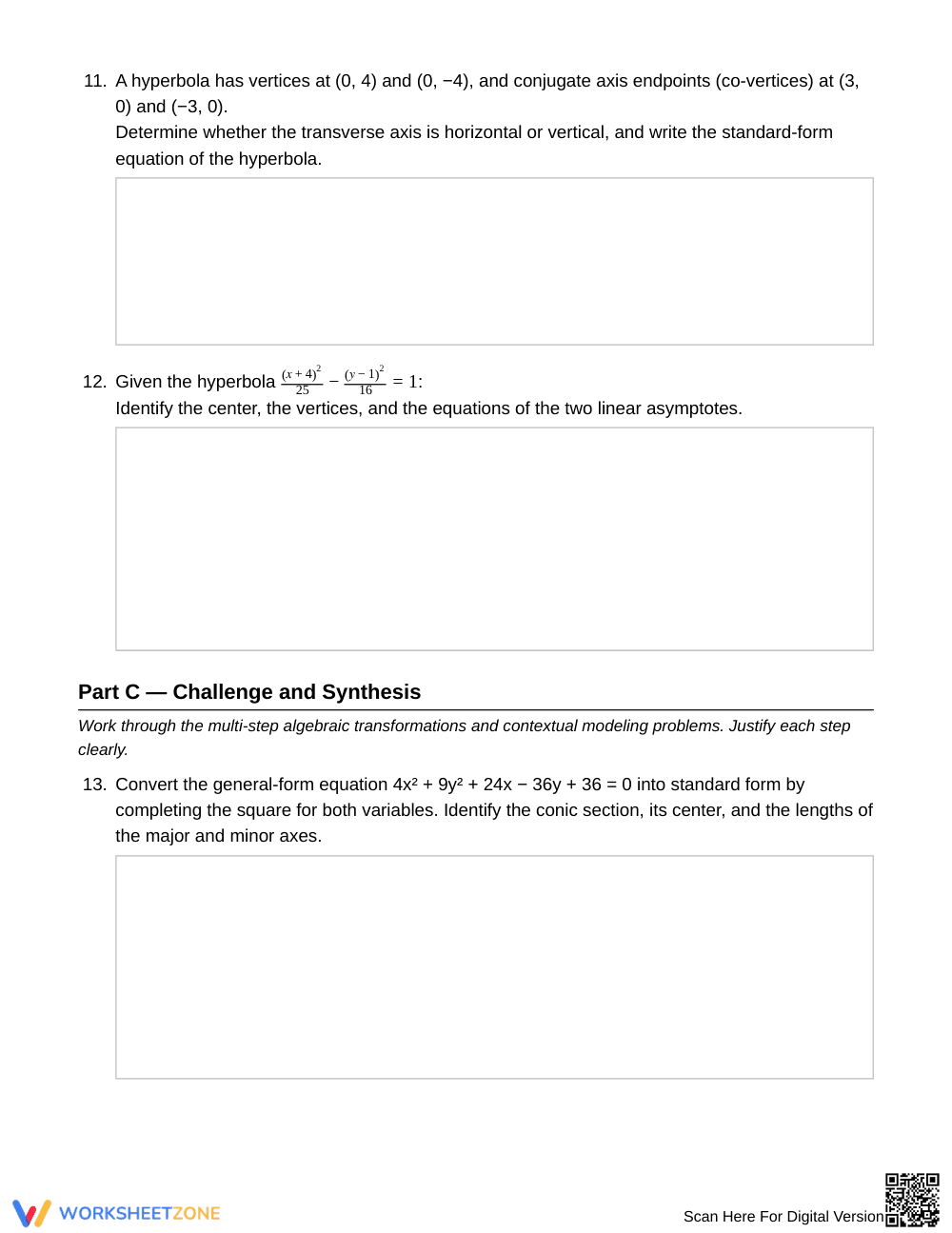
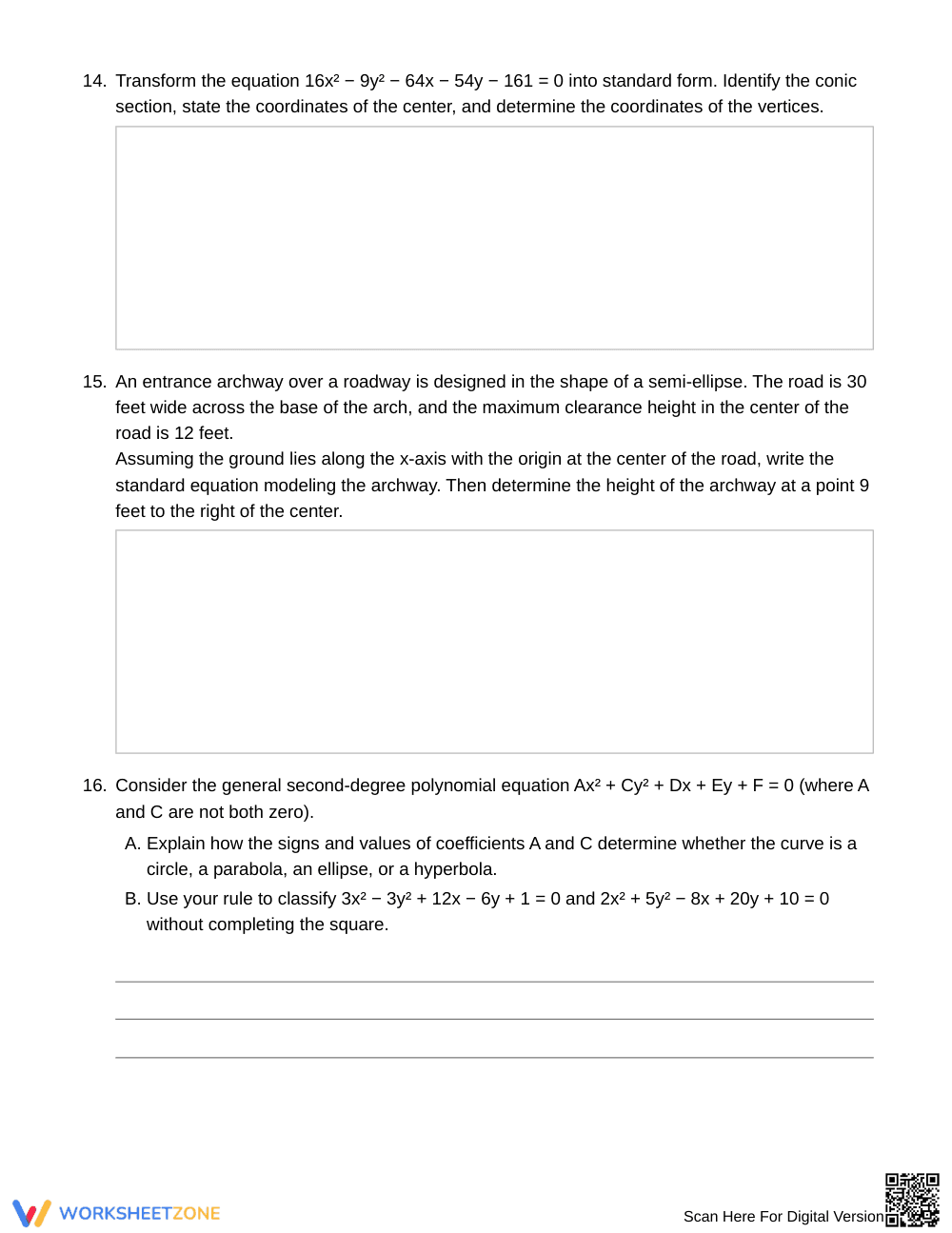
Students will sharpen their mastery of conic sections by identifying each curve, extracting key features, and converting equations to standard form. This 5‑page worksheet guides learners through 16 targeted problems, building confidence for advanced Algebra II assessments.
At a Glance
- Grade: 11 · Subject: Algebra II
- Standard:
— Identify conic type, state center, vertices, axes, and convert equations accurately for algebraic modeling- Skill Focus: Conic identification & equation conversion practice
- Format: 5 pages · 16 problems · Answer key included · PDF (printable)
- Best For: Comprehensive review before unit test or homework practice, suitable for small groups
- Time: 45–60 minutes
What’s Inside – The worksheet is organized into three parts: Part A focuses on foundational identification, Part B on core algebraic applications, and Part C on challenge and synthesis tasks. Across five pages students encounter 16 problems, a full answer key on four pages, and scaffolds such as a standard‑forms reference table and worked‑example prompts.
- Guided practice: 5 starter problems with step‑by‑step hints and a word bank for key terminology.
- Supported practice: 6 intermediate problems that require completing the square and extracting features with moderate scaffolding.
- Independent practice: 5 extension problems that demand full reasoning and synthesis without prompts.
These stages follow the classic I Do, We Do, You Do release, ensuring students move from teacher‑led modeling to autonomous problem solving.
Standards Alignment – `` – Students identify conic types, state centers, vertices, axes, and convert general equations to standard form, directly reflecting high‑school algebra expectations for geometric modeling. The worksheet also supports secondary standards on algebraic manipulation and function transformation. Both standard ideas can be copied directly into lesson plans, IEP goals, or district curriculum mapping tools.
How to Use It – Before a unit on conic sections, assign Part A as a diagnostic to gauge prior knowledge. During instruction, use Part B for guided practice on the board, pausing for student explanations. After direct teaching, let students complete Part C as a formative assessment; observe accuracy of completed squares and model explanations to inform next‑step instruction. Expect completion in 45–60 minutes.
Who It’s For – Ideal for 11th‑grade Algebra II students preparing for college‑ready math exams. The worksheet offers built‑in differentiation through the three practice tiers, making it suitable for mixed‑ability classes. Pair it with a visual anchor chart of conic standard forms or a short instructional video on completing the square for maximum impact.
Educational research confirms that structured multi-tiered practice paired with intentional scaffolding dramatically increases student achievement in high school geometry and algebraic manipulation. According to empirical findings from Fisher & Frey (2014), implementing a gradual release framework such as I Do, We Do, You Do results in a measurable 23% gain in procedural accuracy and conceptual retention among secondary mathematics learners tackling multi-step equations. By guiding students from basic conic identification through completing the square and graphing curve equations, this instructional resource helps teens develop durable problem-solving habits while reducing math anxiety. Teachers can rely on the structured answer keys for quick grading or student self-checking, making this five-page activity an effective addition to any unit review or formative assessment cycle. Integrating this research-backed resource into daily classroom routines fosters genuine algebraic proficiency, high confidence, and long-term academic growth for all high school learners.


