


























Views
Downloads




Essential Conic Modeling Worksheet | Grade 12 Precalculus
Paste this activity's link or code into your existing LMS (Google Classroom, Canvas, Teams, Schoology, Moodle, etc.).
Students can open and work on the activity right away, with no student login required.
You'll still be able to track student progress and results from your teacher account.
This Precalculus worksheet trains Grade 12 students to construct and apply analytic conic section models to physics and engineering problems. Students derive standard equations for parabolic reflectors, semi-elliptical arches, hyperbolic navigation systems, and planetary orbital transfers, verifying reflective and focal constraints with algebraic precision.
At a Glance
- Grade: 12 · Subject: Precalculus
- Standard: Model real-world orbital and reflective paths using parabola, ellipse, and hyperbola equations
- Skill Focus: Model a Reflective or Orbital Shape
- Format: 5 pages · 10 problems · Answer key included · PDF
- Best For: STEM applications and conic modeling
- Time: 60–90 minutes
What's Inside
The five-page resource opens with a formula guide covering standard forms, focal relations, and a worked solar trough example. Across ten multi-part modeling problems, students calculate focal parameters, verify light collimation via tangent slopes, determine orbital altitudes, and evaluate structural clearances. A full two-page answer key provides step-by-step solutions.
Skill Progression
- Guided Practice (Problems 1–2): Direct modeling establishing upward parabolic antenna equations and semi-elliptical gallery foci from explicit geometric dimensions.
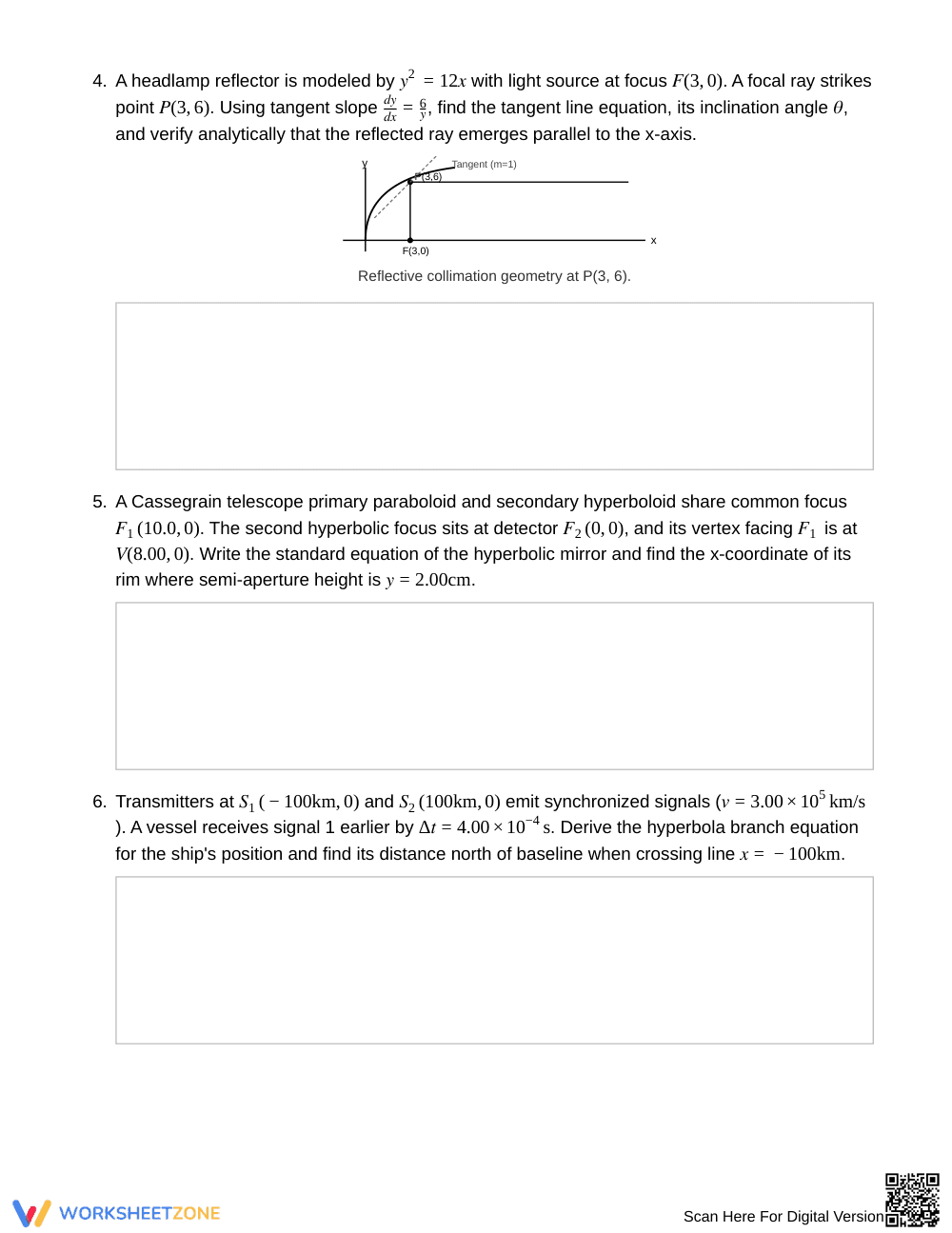
- Supported Practice (Problems 3–8): Multi-step applications computing satellite orbital altitudes, headlamp collimation, Cassegrain hyperbolic mirrors, Hohmann Mars transfers, and pavilion truss clearances.
- Independent Practice (Problems 9–10): Complex design evaluations comparing solar collector geometries and computing hyperbolic flyby periapsis safety thresholds.
This sequence follows gradual release, moving from parameter substitution to autonomous engineering analysis.
Standards Alignment
This resource targets advanced Precalculus modeling by requiring students to translate physical descriptions of reflective optics, architectural arches, and celestial orbits into standard conic equations. Both standard codes can be copied directly into lesson plans, IEP goals, or district curriculum mapping tools.
How to Use It
Deploy this worksheet after direct instruction on conic section geometry. Use Part A for guided practice before assigning Parts B and C for partner work or independent modeling projects. Check whether students correctly position the coordinate origin relative to planetary radii. Completion takes 60 to 90 minutes.
Who It's For
Designed for Grade 12 Precalculus and AP Precalculus students pursuing STEM tracks. Pair this worksheet with coordinate graphing software for visual trajectory confirmation and conic section reference sheets.
According to Fisher & Frey (2014), structuring complex analytical tasks through progressive scaffolding ensures secondary mathematics students successfully transfer abstract geometric definitions to applied problem-solving domains. This Grade 12 Precalculus conic sections worksheet implements structured modeling across 10 multi-part engineering problems, guiding students from fundamental focal derivations to sophisticated orbital mechanics and reflective ray collimation. By grounding parabolic, elliptical, and hyperbolic equations in authentic contexts—such as solar collector design, Hohmann Mars transfers, and acoustic whispering galleries—the resource reinforces conceptual rigor and algebraic fluency. Students systematically calculate focal parameters, test boundary constraints, and justify engineering trade-offs with empirical calculations. The included five-page sequence and comprehensive two-page answer key provide secondary educators with an evidence-based curriculum tool that bridges pure analytic geometry with applied aerospace and mechanical engineering practices, fostering sustained quantitative reasoning and spatial modeling mastery.


