


























Views
Downloads



Essential Conic Features Worksheet | Grade 11 Algebra II
Paste this activity's link or code into your existing LMS (Google Classroom, Canvas, Teams, Schoology, Moodle, etc.).
Students can open and work on the activity right away, with no student login required.
You'll still be able to track student progress and results from your teacher account.
This 5-page Algebra II worksheet equips Grade 11 students to master conic sections by comparing equations and identifying key graph features. Learners evaluate circles, parabolas, ellipses, and hyperbolas across 12 targeted exercises, transitioning from standard-form extraction to completing the square and analyzing equation equivalence.
At a Glance
- Grade: 11 · Subject: Algebra II
- Standard: Advanced Algebra Conic Sections — Analyze and compare conic section equations with their corresponding graphical features
- Skill Focus: Compare Equations and Graph Features
- Format: 5 pages · 12 problems · Answer key included · PDF
- Best For: Independent practice and unit test preparation
- Time: 40–50 minutes
Students receive a 5-page resource featuring a clear reference box containing standard formulas for all four conic sections. The 12-item problem set includes direct feature extraction, algebraic conversion requiring completing the square, algebraic equivalence verification, and conceptual non-real conic analysis. A complete 2-page answer key provides step-by-step solutions for rapid grading.
Skill Progression
- Guided practice (Problems 1–3): Direct identification of centers, vertices, radii, axes, and foci from given standard or factored conic equations using the built-in reference box.
- Supported practice (Problems 4–6): Algebraic manipulation and completing the square to convert general quadratic equations into standard vertex and center-radius forms.
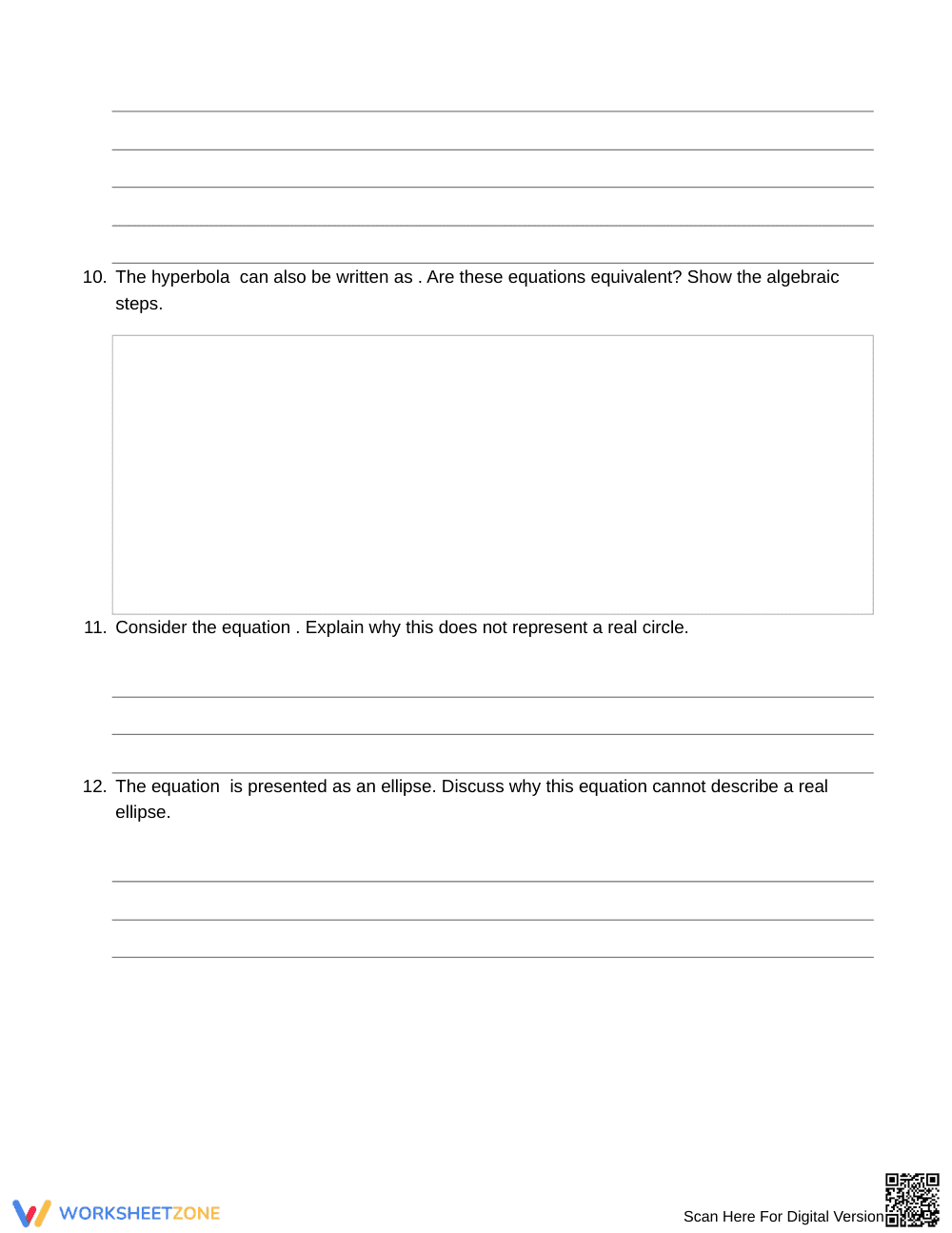
- Independent practice (Problems 7–12): High-level comparative analysis, testing algebraic equivalence between expanded and standard forms, and justifying degenerate or non-real solutions.
This structured layout follows a gradual-release model, advancing high school mathematicians from foundational formula application to rigorous conceptual critique.
Standards Alignment
This resource aligns with high school advanced algebra standards covering the derivation and graphing of conic section equations. Students translate fluently between expanded polynomial forms and standard conic equations to identify centers, vertices, foci, and axes. Both standard expectations can be copied directly into lesson plans, IEP goals, or district curriculum mapping tools.
How to Use It
Assign this resource immediately after direct instruction on converting quadratic forms or use it as a mid-unit formative review before high-stakes assessments. For active monitoring, observe whether students correctly complete the square when isolating x and y terms in Problems 4 and 5. Students typically complete the 12 problems within 40 to 50 minutes.
Who It's For
Designed for Grade 11 Algebra II and Pre-Calculus students, this activity supports on-level learners while offering built-in scaffolds for students who need reference reminders. For differentiated instruction, provide physical graph paper or coordinate graphing software to help visual learners graph the equations alongside their algebraic proofs.
Comparing conic section equations and graph features represents a critical milestone in high school algebraic reasoning, bridging geometric properties with quadratic manipulation. According to Fisher & Frey (2014), structured instructional sequences that move intentionally from scaffolded feature identification to independent comparative analysis produce substantial gains in conceptual retention and procedural fluency. This 12-problem worksheet operationalizes that instructional framework by requiring Grade 11 students to extract key parameters from standard formulas, complete the square across multiple variables, and evaluate equation equivalence. By challenging learners to analyze non-real cases and justify why specific quadratic equations fail to produce real circles or ellipses, the activity fosters rigorous analytical thinking beyond rote computation. Secondary mathematics educators can deploy this comprehensive 5-page resource during conic section units to ensure students achieve measurable mastery across algebraic representations and graphical curves.


