


























Views
Downloads


Essential Conic Distance Worksheet | Grade 12 Precalculus
Paste this activity's link or code into your existing LMS (Google Classroom, Canvas, Teams, Schoology, Moodle, etc.).
Students can open and work on the activity right away, with no student login required.
You'll still be able to track student progress and results from your teacher account.
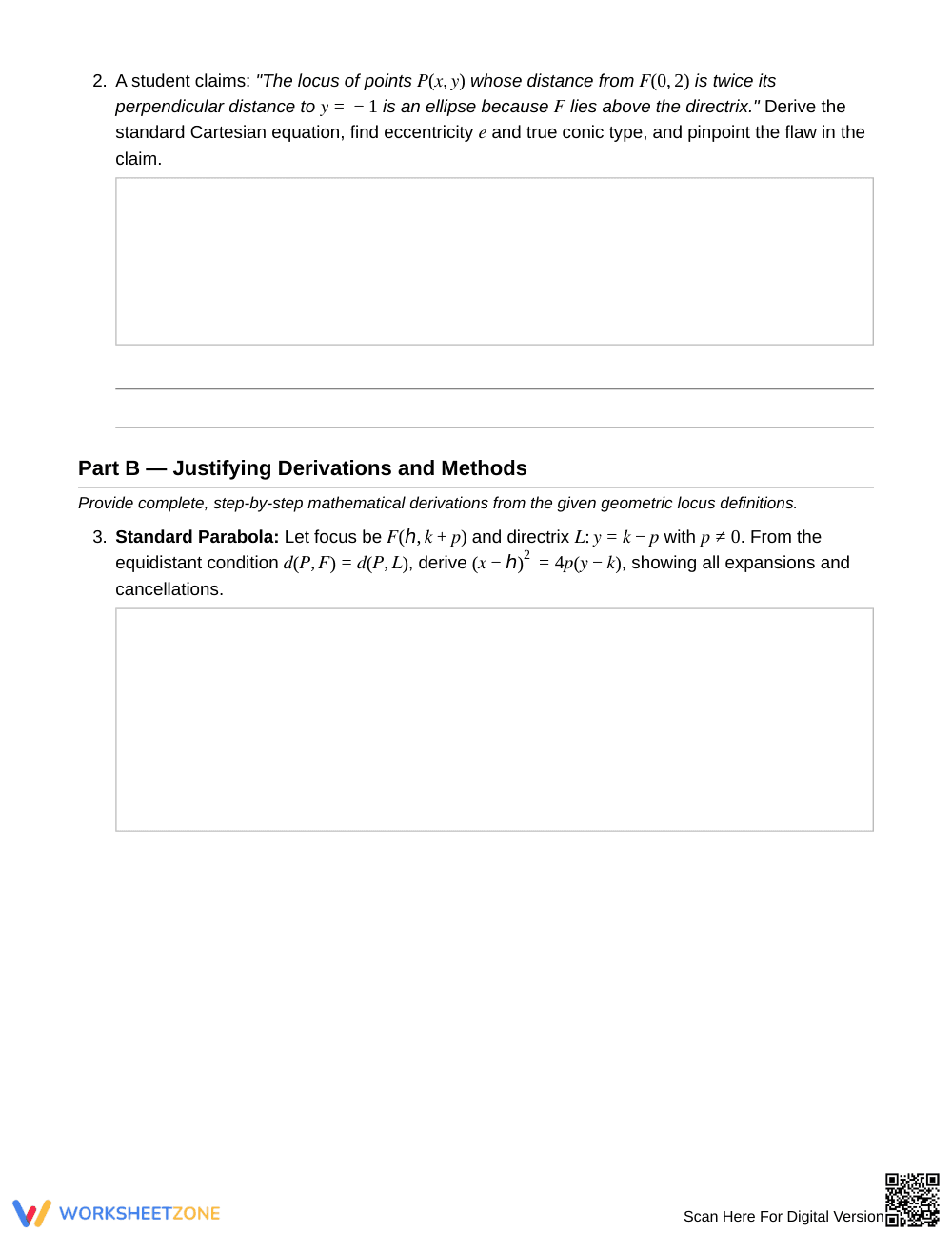
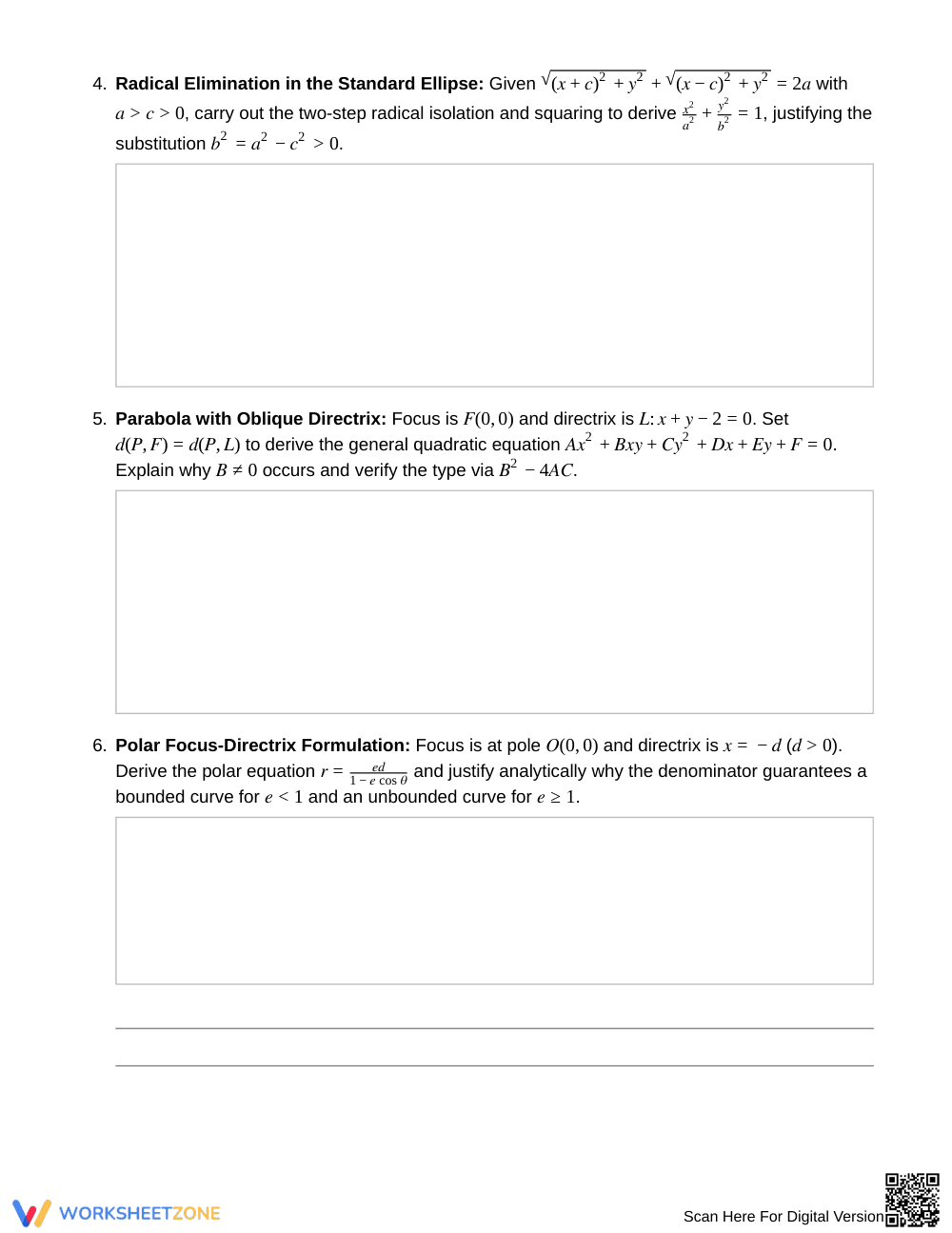
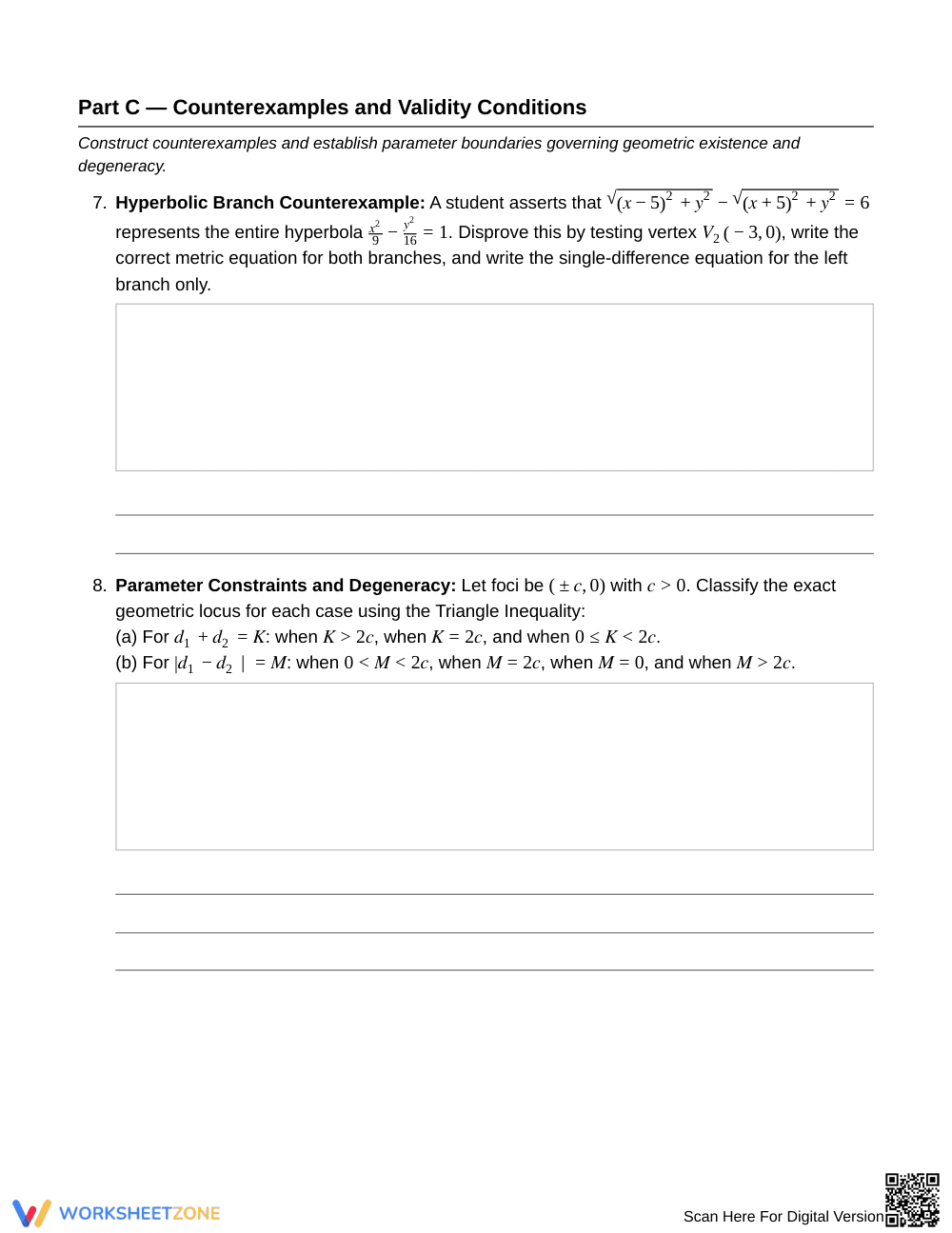
This Grade 12 Precalculus worksheet guides students through justifying conic sections directly from analytic distance conditions and locus definitions. Learners analyze metric definitions, verify student claims using the Triangle Inequality, and construct algebraic proofs that derive Cartesian and polar equations for parabolas, ellipses, and hyperbolas.
At a Glance
- Grade: 12 · Subject: Precalculus
- Standard: Focus-Directrix & Bifocal Metrics — Justify conic types and derive equations from distance locus conditions
- Skill Focus: Justify a Conic from a Distance Condition
- Format: 4 pages · 8 problems · Answer key included · PDF
- Best For: Advanced analytic geometry mastery practice
- Time: 45–60 minutes
What's Inside
The 4-page student activity features 8 rigorous analytic tasks divided across three conceptual stages, supplemented by an opening reference box defining focus-directrix eccentricity and bifocal metric conditions. A detailed 3-page answer key provides complete algebraic proofs, radical isolations, rotation discriminant verifications, and parameter boundary explanations.
Skill Progression
- Guided Practice (Part A, Problems 1–2): Students evaluate flawed peer claims using distance formulas, applying the Triangle Inequality to identify degenerate cases and finding eccentricity values to expose false geometric conclusions.
- Supported Practice (Part B, Problems 3–6): Students complete four formal geometric derivations, including equidistant focus-directrix parabola proofs, two-step radical elimination for ellipses, general quadratics with oblique directrices, and polar locus formulations.
- Independent Practice (Part C, Problems 7–8): Students work without scaffolding to construct counterexamples disproving single-branch hyperbola equations and classify geometric degeneracies across varying focal constant sums and differences.
This structured progression reflects the gradual-release framework, transferring analytical independence to students as they move from evaluating arguments to generating formal derivations.
Standards Alignment
This resource aligns with advanced high school Precalculus standards in analytic geometry requiring students to derive the equations of ellipses, parabolas, and hyperbolas given foci and directrices, and to analyze locus criteria using distance metrics. Supporting geometry standards require justifying geometric properties using algebraic coordinates and distance formulas. Both standard codes can be copied directly into lesson plans, IEP goals, or district curriculum mapping tools.
How to Use It
Deploy this worksheet after direct instruction on locus definitions of conics and prior to formal unit assessments. During classwork, monitor student execution of the radical isolation step in Part B to verify that algebraic cancellations preserve geometric equivalence rather than introducing extraneous solution branches. The activity fits a 45- to 60-minute instructional block, either as an intensive partner derivation task or as an individual proof portfolio assignment.
Who It's For
Designed for Grade 12 Precalculus and honors-level analytic geometry students preparing for collegiate calculus, this worksheet serves learners ready to bridge geometric intuition and algebraic rigor. Differentiate instruction by pairing students with coordinate graph paper or dynamic geometry software to visualize metric constraints alongside their algebraic proofs.
According to Fisher & Frey (2014), purposeful instructional architecture that transitions students through evaluated claims, guided derivations, and unprompted counterexamples secures durable mathematical reasoning. This Grade 12 Precalculus worksheet applies that exact pedagogy across 8 multi-step problems, requiring learners to justify conic sections using distance formulas, eccentricity parameters, and the Triangle Inequality. Instead of relying on rote template matching, students derive Cartesian equations from equidistant loci, evaluate rotational cross-terms from oblique directrices, and resolve branch degeneracies. Supported by an exhaustive 3-page answer key, this 4-page resource ensures rigorous analytic geometry preparation for advanced collegiate STEM coursework.


