

































Essential Congruence Mapping Worksheet | Grade 10 Geometry

Paste this activity's link or code into your existing LMS (Google Classroom, Canvas, Teams, Schoology, Moodle, etc.).
Students can open and work on the activity right away, with no student login required.
You'll still be able to track student progress and results from your teacher account.
This Grade 10 Geometry worksheet builds students' ability to justify congruence by identifying and describing specific rigid-motion mappings. Across 8 carefully sequenced problems, students move from evaluating congruence claims to constructing transformation sequences and analyzing counterexamples—developing the proof-level reasoning that HSG-CO.B.6 demands.
At a Glance
- Grade: 10 · Subject: Geometry
- Standard:
HSG-CO.B.6— Use geometric descriptions of rigid motions to predict and verify congruence- Skill Focus: Justify congruence through a mapping
- Format: 5 pages · 8 problems · Answer key included · PDF
- Best For: Practice after direct instruction on rigid motions
- Time: 35–50 minutes
What's Inside
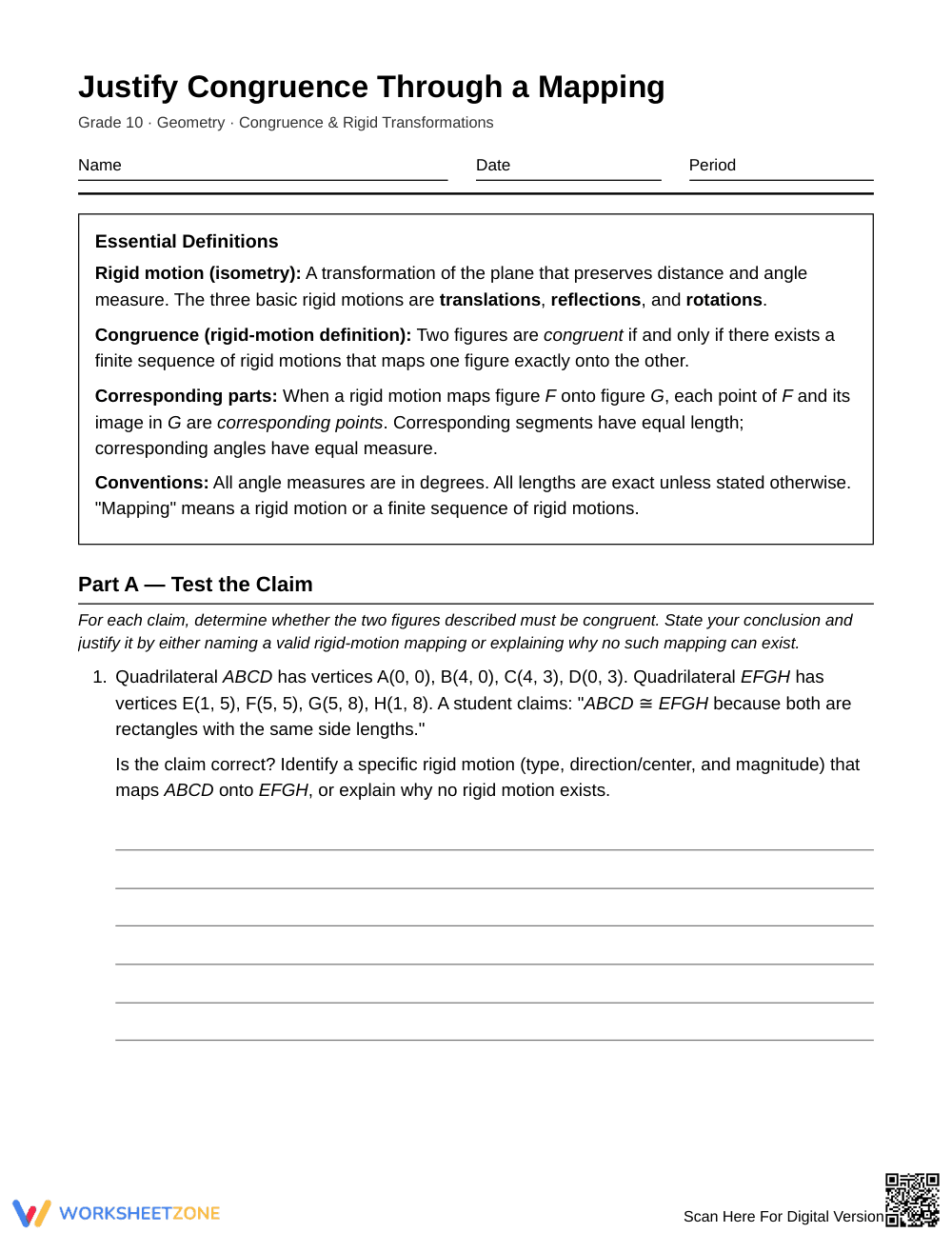
The worksheet opens with a reference box containing essential definitions—rigid motion, congruence, corresponding parts, and notation conventions—so students can cite precise language in every justification. The 8 problems span three parts across 5 pages, and a full answer key provides model responses with step-by-step reasoning. Problem types include claim evaluation, single-transformation identification, multi-step mapping descriptions, coordinate verification, and counterexample construction.
Skill Progression
- Guided practice (Part A, 2 problems): Students evaluate pre-written congruence claims about a rectangle pair and a triangle pair. Each prompt scaffolds the response by asking students to name a specific rigid motion or explain why none exists.
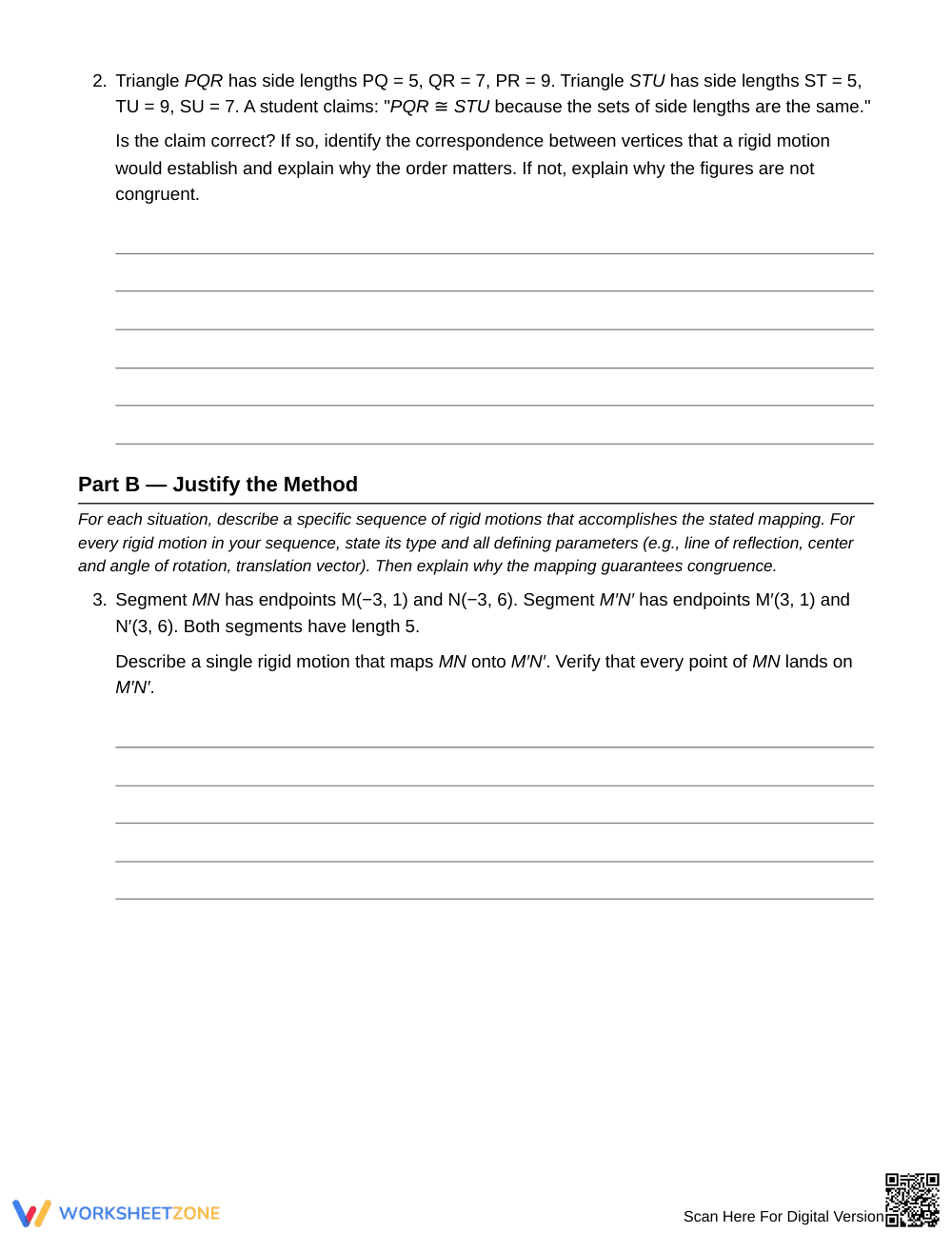
- Supported practice (Part B, 4 problems): Students describe rigid motions—reflections, rotations, translations—with full parameters. Tasks increase in complexity from a single reflection to a two-step coordinate-grid mapping.
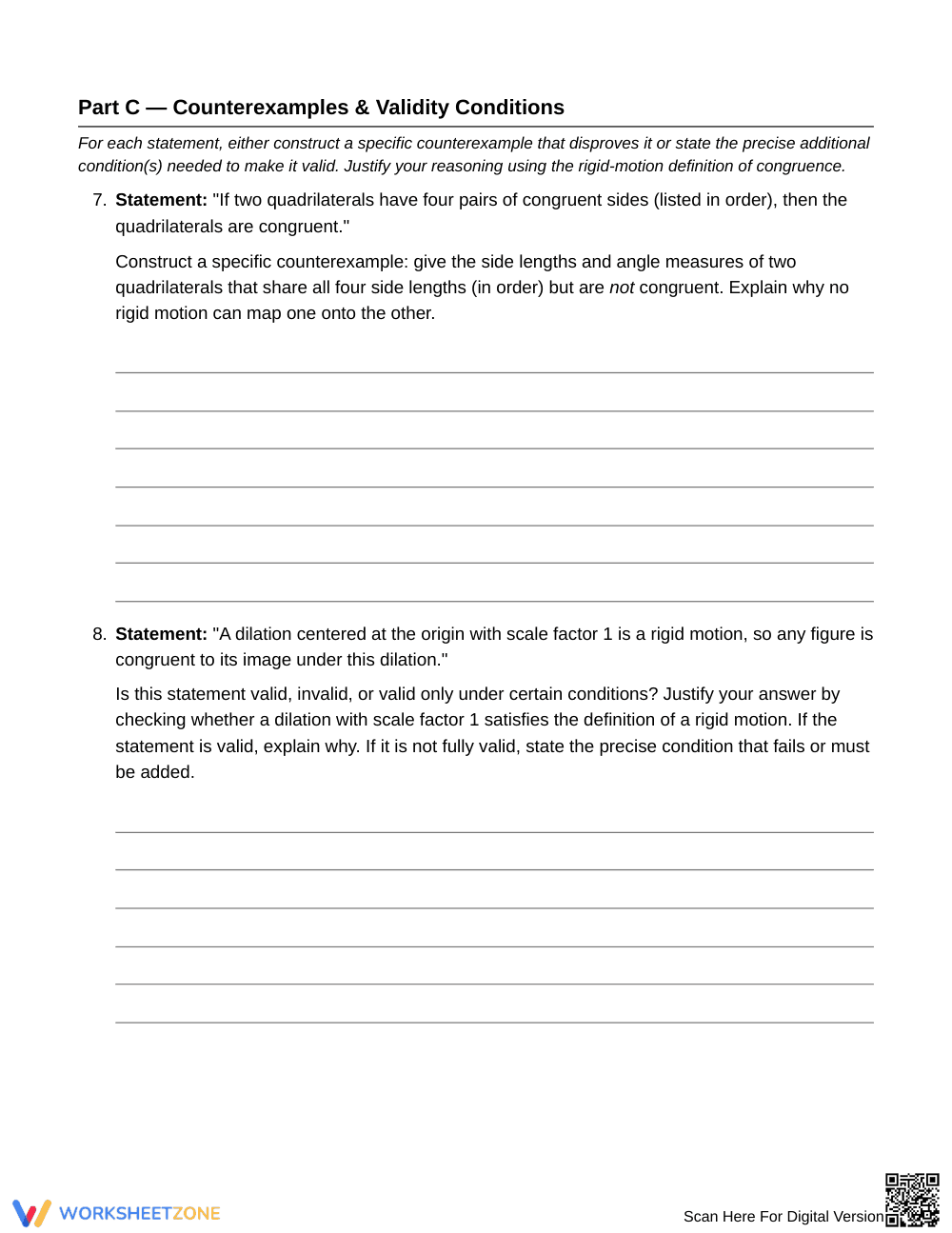
- Independent practice (Part C, 2 problems): Students construct a counterexample disproving a false congruence statement and evaluate whether a scale-factor-1 dilation qualifies as a rigid motion. No scaffolds remain.
Standards Alignment
The primary standard is HSG-CO.B.6: Use geometric descriptions of rigid motions to transform figures and to predict the effect of a given rigid motion on a given figure; given two figures, use the definition of congruence in terms of rigid motions to decide if they are congruent. Supporting work touches HSG-CO.A.5 as students define translation vectors, reflection lines, and rotation parameters.
How to Use It
Assign the worksheet after direct instruction on the rigid-motion definition of congruence. Use Part C as a formative exit ticket: a student who produces an accurate counterexample with a clear explanation has met the standard. Expected completion time is 35–50 minutes.
Who It's For
Designed for on-grade-level Grade 10 Geometry students in a Congruence and Rigid Transformations unit. Pair this worksheet with a coordinate-plane anchor chart to reinforce prerequisite vocabulary before students write full justifications.
This 8-problem worksheet targets HSG-CO.B.6, the standard requiring students to use rigid-motion definitions to justify whether two figures are congruent. The skill—constructing and evaluating transformation-based congruence arguments—is central to high school geometry and appears consistently on state assessments. According to Fisher & Frey (2014), a gradual-release instructional model significantly improves students' ability to transfer reasoning skills to novel problems, which is exactly the trajectory this resource follows: guided claim evaluation, supported mapping descriptions, and independent counterexample construction across 5 pages. Teachers can use the included answer key for immediate, consistent scoring. The worksheet is printable, standards-aligned, and ready to integrate into any congruence unit.


