


























Views
Downloads


Essential Climate Trends Worksheet | Grade 12 Earth Science
Paste this activity's link or code into your existing LMS (Google Classroom, Canvas, Teams, Schoology, Moodle, etc.).
Students can open and work on the activity right away, with no student login required.
You'll still be able to track student progress and results from your teacher account.
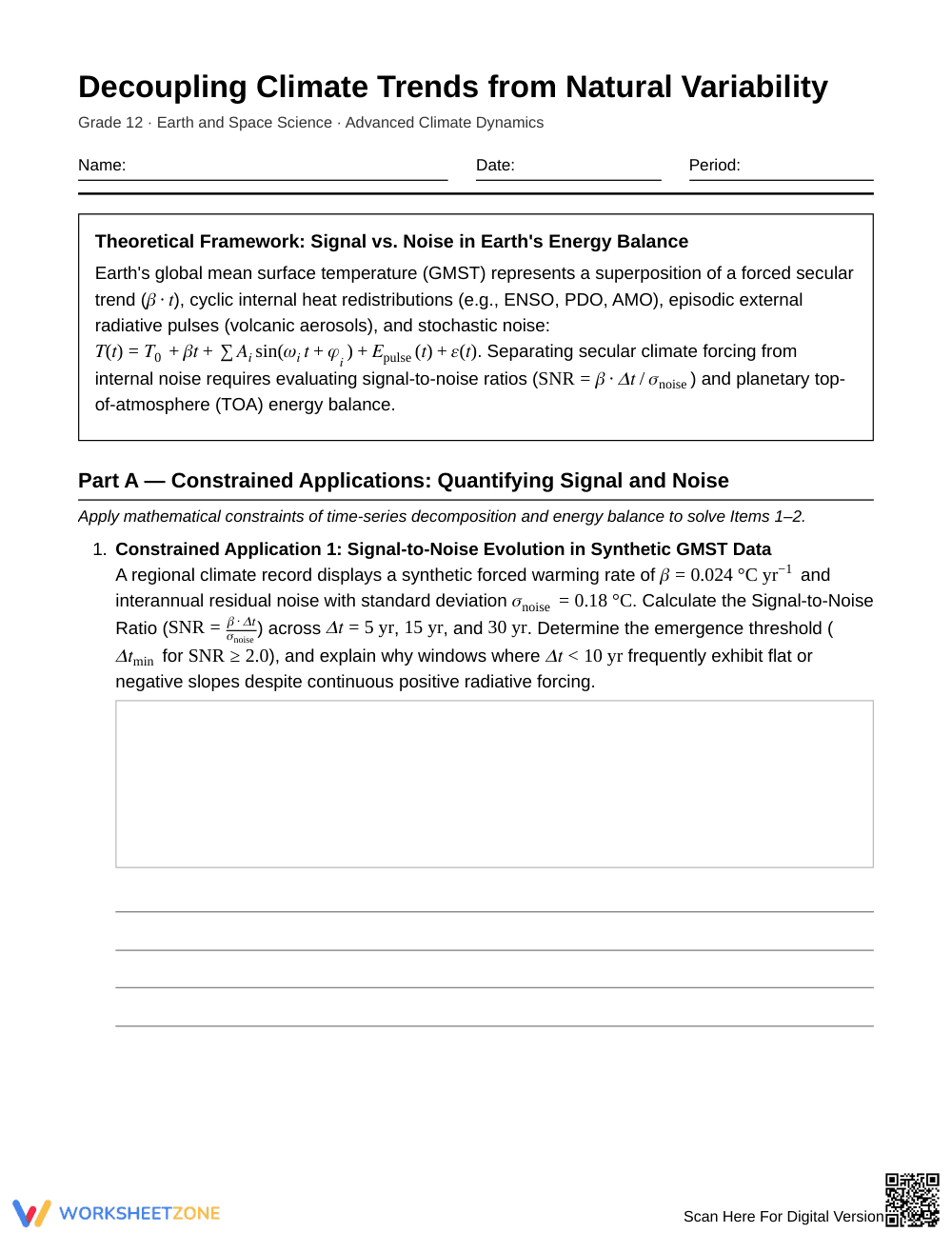
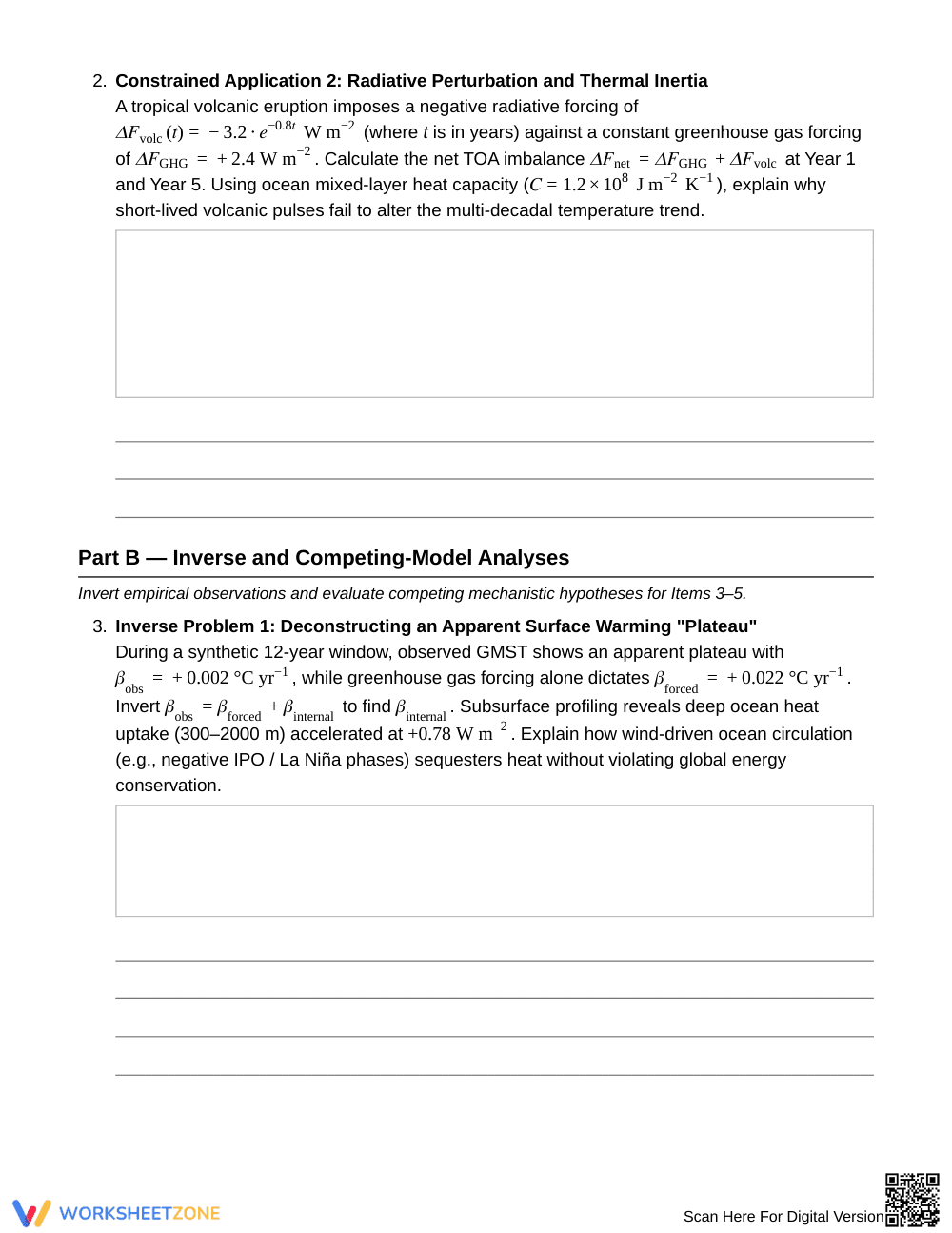
This Grade 12 science worksheet guides students to decouple short-term climate variability from long-term warming trends. By analyzing signal-to-noise ratios, radiative forcing, and ocean heat uptake, learners evaluate complex climate records and explain why transient cooling anomalies naturally coexist with forced secular warming.
At a Glance
- Grade: 12 · Subject: Earth & Space Science
- Standard: Analyze climate time-series data and energy balance to evaluate warming trends
- Skill Focus: Explain How Variability Coexists with a Long-Term Trend
- Format: 5 pages · 6 problems · Answer key included · PDF
- Best For: Advanced climate dynamics and AP preparation
- Time: 45–60 minutes
What's Inside
This 5-page worksheet provides 6 multi-step analytical problems accompanied by a complete 3-page answer key. Students work with time-series signal-to-noise formulas, volcanic radiative perturbation equations, deep-ocean heat uptake calculations, a diagnostic model comparison table, and Northern Hemisphere area-weighted anomaly equations.
Skill Progression
- Guided Practice (Problems 1–2): Students calculate emergence thresholds and evaluate volcanic radiative damping against greenhouse forcing using explicit formulas.
- Supported Practice (Problems 3–5): Students invert surface warming plateaus, evaluate competing solar versus greenhouse mechanisms, and calculate area-weighted Rossby wave anomalies.
- Independent Practice (Problem 6): Students write a 150–250 word technical defense of coastal infrastructure planning, synthesizing time-series statistics, energy balance, and scale separation.
This gradual-release progression moves students from scaffolded mathematical calculations to unprompted scientific argumentation.
Standards Alignment
This resource aligns with high school Earth and Space Science expectations focusing on Earth's energy balance and global climate models. Students examine how internal variability, volcanic aerosols, and greenhouse gas forcing interact across distinct time scales. This alignment can be copied directly into lesson plans, IEP goals, or curriculum mapping tools.
How to Use It
Use this worksheet following direct instruction on planetary energy balance and time-series analysis. It works well as an independent problem set or a collaborative assessment. During work time, check Problem 3 to ensure students understand that surface warming plateaus reflect internal heat redistribution rather than stopped global heating. Completion takes 45 to 60 minutes.
Who It's For
This worksheet is tailored for Grade 12 Earth Science and AP Environmental Science students. Support emerging learners by reviewing the Signal-to-Noise Ratio formula prior to independent work, and challenge advanced students to elaborate their municipal defense in Problem 6. Pair this activity with global temperature anomaly graphs.
Mastering the ability to explain how short-term natural variability coexists with forced long-term climate trends represents an essential analytical competency in secondary Earth systems education. According to research on effective science pedagogy synthesized by Fisher & Frey (2014), structured instructional progression from constrained computational modeling to unprompted technical defense significantly deepens conceptual retention and scientific literacy. This comprehensive 5-page worksheet targets core high school geoscience standards by guiding Grade 12 students through 6 rigorous analytical tasks. Students decouple cyclical internal climate oscillations—such as the El Niño-Southern Oscillation and deep ocean heat uptake—from secular greenhouse gas forcing using signal-to-noise ratios and top-of-atmosphere radiative flux calculations. By synthesizing mathematical modeling with fundamental thermodynamic principles across a 45-to-60-minute instructional window, learners construct durable scientific arguments that distinguish regional weather noise from planetary energy imbalance, establishing measurable evidence-based mastery in climate dynamics.


