




























Essential Chemistry of Life Worksheet | Grades 9-12 Science
Paste this activity's link or code into your existing LMS (Google Classroom, Canvas, Teams, Schoology, Moodle, etc.).
Students can open and work on the activity right away, with no student login required.
You'll still be able to track student progress and results from your teacher account.
This introductory biochemistry worksheet equips high school biology students to master fundamental biochemical concepts through targeted vocabulary and data analysis. Students define core terms, classify major macromolecule groups, interpret molecular diagrams of water polarity, evaluate enzyme kinetics across temperature gradients, and correct persistent biological misconceptions with clear, evidence-based reasoning.
At a Glance
- Grade: Grades 9–12 · Subject: Science
- Standard: Biochemistry — Relate macromolecule structures, water polarity, and enzyme function to biological processes
- Skill Focus: Foundational chemical vocabulary and biomolecule concepts
- Format: 4 pages · 24 problems · Answer key included · PDF
- Best For: Unit introduction or prior-knowledge review
- Time: 40–50 minutes
What's Inside
Structured across four print pages, this comprehensive activity features 24 discrete prompts organized into five purposeful sections. Students work through definition matching, cloze sentences with a supportive word bank, comparative nutrient classification tables, molecular diagram analysis of hydrogen bonding, graph-based enzyme rate interpretation, and multiple-choice misconception diagnostics accompanied by short-response scientific justifications. A thorough four-page teacher answer key provides complete model responses for seamless grading.
Skill Progression
- Guided practice (Tasks 1–9): Matches foundational vocabulary definitions and completes scaffolded sentence frames using a structured word bank to reinforce key terms such as monomer, polymer, enzyme, and active site.
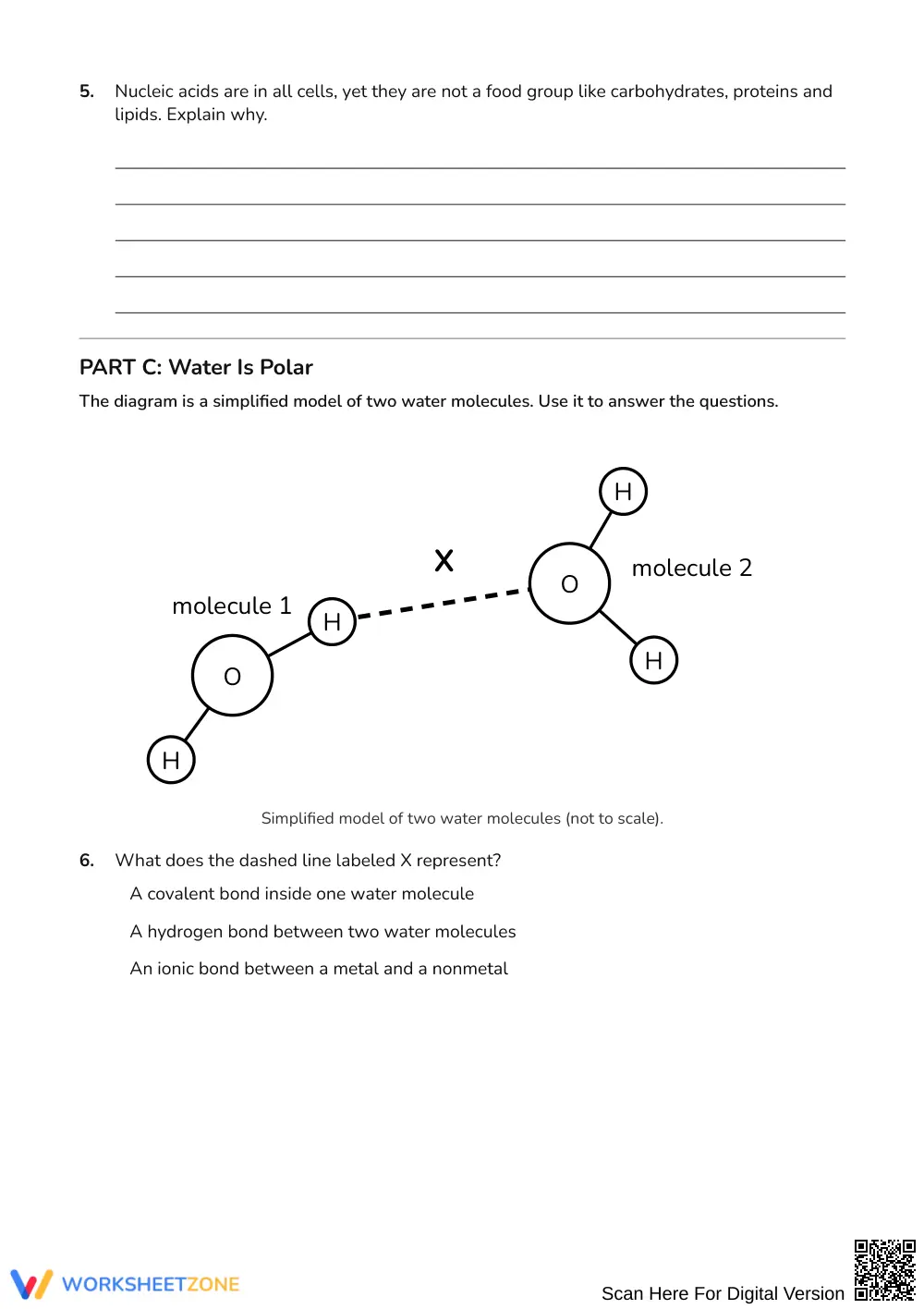
- Supported practice (Tasks 10–18): Directs students through real-world macromolecule classification tables and model-based analysis of water polarity and hydrogen bonding interactions.
- Independent practice (Tasks 19–24): Challenges learners to interpret enzyme temperature activity curves and evaluate common biological misconceptions using written scientific arguments.
This structured sequence follows the gradual release of responsibility model, ensuring students build conceptual confidence before tackling open-ended scientific explanations.
Standards Alignment
This worksheet directly addresses core high school life science standards regarding the organizational chemistry of organisms. Students investigate how carbon, hydrogen, oxygen, and nitrogen assemble into complex polymers, examine water's unique chemical properties, and model how environmental changes alter enzyme structure and function. Standard objectives can be copied directly into lesson plans, IEP goals, or district curriculum mapping tools.
How to Use It
Deploy this resource during the direct instruction phase of an introductory biochemistry unit or as an anchor task following a macromolecule lecture. Formative-assessment observation tip: monitor student responses on Part C and Part D to identify whether learners confuse intramolecular polar covalent bonds with intermolecular hydrogen bonds, or assume enzymes are consumed during metabolic reactions. Expect completion within 40 to 50 minutes.
Who It's For
Designed for high school students in general biology, honors biology, or introductory life science courses. It offers built-in support for multilingual learners and developing readers via explicit word banks and diagram models. Pair this activity directly with a hands-on macromolecule indicator lab or an enzyme catalase wet lab.
High school science instruction requires structured practice to link chemical vocabulary with biological mechanisms. According to Fisher & Frey (2014), intentional gradual release scaffolds allow secondary students to translate technical terminology into authentic disciplinary reasoning. This worksheet addresses foundational biochemistry standards by guiding students through 24 rigorous tasks covering macromolecule structure, water polarity, and enzyme kinetics. Beginning with scaffolded term matching, students progress to diagram analysis of polar water molecules and evaluate enzyme denaturation curves. By addressing prevalent student errors, such as the misconception that enzymes are consumed reactants, this resource establishes a strong conceptual bridge between cellular chemistry and macroscopic physiology across all high school biology classrooms.


