




























Essential Chemistry of Life Worksheet | Grade 9–12 Science
Paste this activity's link or code into your existing LMS (Google Classroom, Canvas, Teams, Schoology, Moodle, etc.).
Students can open and work on the activity right away, with no student login required.
You'll still be able to track student progress and results from your teacher account.
Opening Paragraph
This worksheet guides 9‑12 grade science students through 20 scaffolded problems that move from recalling macromolecule facts to predicting enzyme behavior and explaining biochemical scenarios, building confidence in applying chemistry of life concepts.
At a Glance
- Grade: 9–12 · Subject: Science
- Standard: — Apply chemistry concepts to biological contexts
- Skill Focus: Guided application of chemistry of life
- Format: 4 pages · 20 problems · Answer key included · PDF
- Best For: High‑school biology labs and review sessions
- Time: 30–45 minutes
What’s Inside
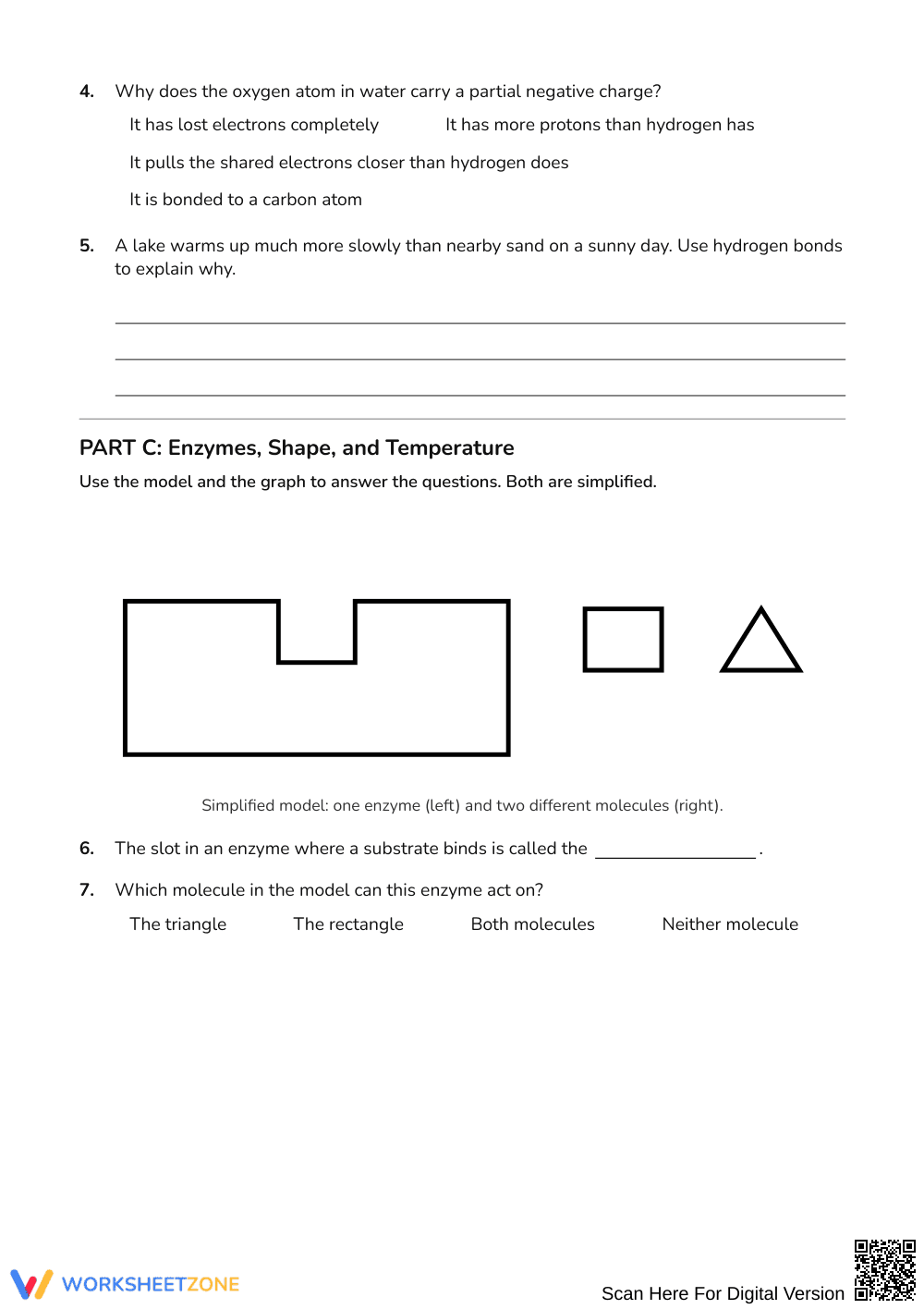
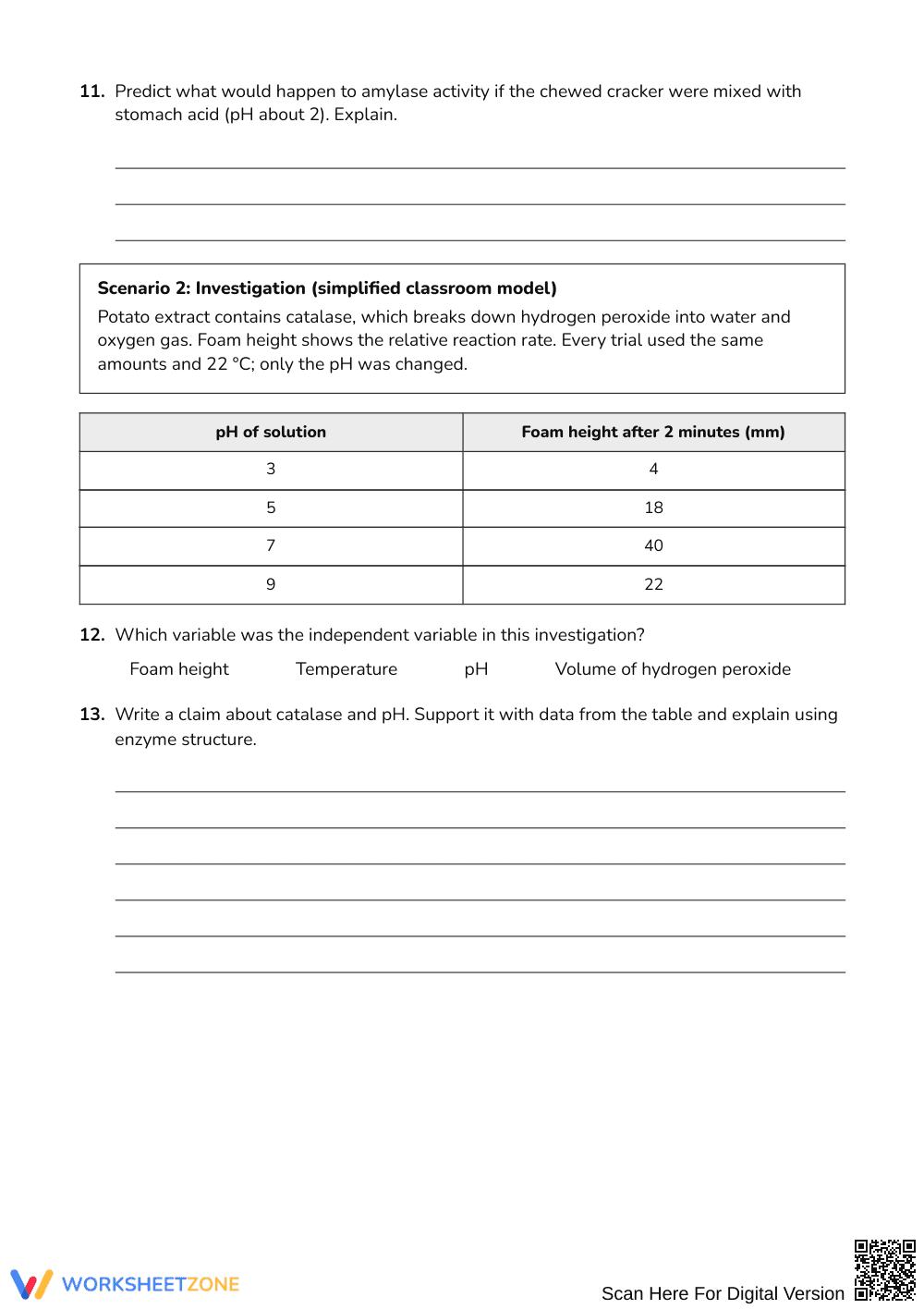
The packet contains four pages of varied tasks: tables for macromolecule classification, diagram analysis of water molecules, enzyme activity graphs, and scenario‑based reasoning questions. An answer key occupies four additional pages, and each section includes brief prompts, sentence frames, and a word bank for key terminology.
Skill Progression
- Guided practice (6 tasks): Direct recall tables and multiple‑choice items with sentence frames.
- Supported practice (7 tasks): Diagram interpretation and short‑answer explanations with a word bank.
- Independent practice (7 tasks): Open‑ended scenario analysis requiring prediction and justification.
This three‑stage release follows the classic I Do, We Do, You Do model, ensuring students move from teacher‑led examples to autonomous reasoning.
Standards Alignment
`Chemistry of Life: guided application` – Students apply concepts of macromolecules, water properties, and enzyme function to novel biological situations, demonstrating the ability to predict outcomes and construct scientific explanations. Both the scaffolded tasks and the open‑ended scenarios map directly to this overarching learning goal, ready for inclusion in lesson plans or IEP objectives.
How to Use It
1. Before a unit test: Use the guided‑practice tables as a quick refresher during a 10‑minute bell‑ringer. Observe student accuracy to gauge readiness for the independent section.
2. During lab work: After a hands‑on enzyme activity lab, assign the scenario questions as a formative check; students must cite observed data to support their predictions.
Who It’s For
Designed for high‑school juniors and seniors in general science or biology courses. The built‑in scaffolds support English‑language learners and students needing extra structure, while the independent section challenges advanced learners. Pair with a textbook chapter on macromolecules or an anchor chart of enzyme kinetics for smooth integration.
Educational research demonstrates that gradual release frameworks and scaffolded problem sets substantially enhance secondary science comprehension and knowledge retention (Fisher & Frey, 2014). When learners encounter structured opportunities to bridge basic chemical vocabulary with higher-order biological scenarios, they construct robust mental models that support long-term academic growth (Hmelo-Silver et al., 2007). Moving systematically from direct identification to multi-step reasoning allows students to build cognitive endurance while reducing working memory overload during complex analytical tasks (Sweller, 2011). Furthermore, embedding explicit prompts, structured sentence stems, and dedicated word banks empowers diverse student cohorts to communicate conceptual explanations with greater precision and scientific clarity. By combining targeted practice with gradual autonomy, this resource provides an evidence-based approach that solidifies essential biochemical principles, reinforces analytical thinking routines, and prepares high school students for rigorous laboratory investigations across diverse scientific curricula.


