































Essential Chemistry of Life Worksheet | Grade 9-12 Science

Paste this activity's link or code into your existing LMS (Google Classroom, Canvas, Teams, Schoology, Moodle, etc.).
Students can open and work on the activity right away, with no student login required.
You'll still be able to track student progress and results from your teacher account.
This high school biochemistry worksheet guides students through sequencing chemical mechanisms and analyzing molecular transformations. Learners examine catalytic enzyme cycles, protein folding pathways, thermal denaturation curves, and macromolecule digestion cascades. By connecting step-by-step molecular structural changes to macroscopic biological functions, students build a rigorous foundation in the chemical processes that sustain living organisms.
At a Glance
- Grade: Grades 9–12 · Subject: Science
- Standard: Biochemistry — Model and sequence molecular transformations in biological systems
- Skill Focus: Ordering biochemical steps and explaining structural changes
- Format: 4 pages · 25 problems · Answer key included · PDF
- Best For: Post-lecture consolidation and test preparation
- Time: 45–60 minutes
What's Inside: The 4-page student activity contains 25 rigorous tasks organized into four focused sections. Students work with reaction models, sequential protein synthesis diagrams, enzyme activity versus temperature plots, and macromolecule nutrient tables. An identical 4-page teacher answer key provides complete model explanations and data readings.
Skill Progression
- Guided Practice: In Part A, students order the five distinct stages of an induced-fit sucrase catalytic cycle and evaluate how active-site conformation lowers activation energy.
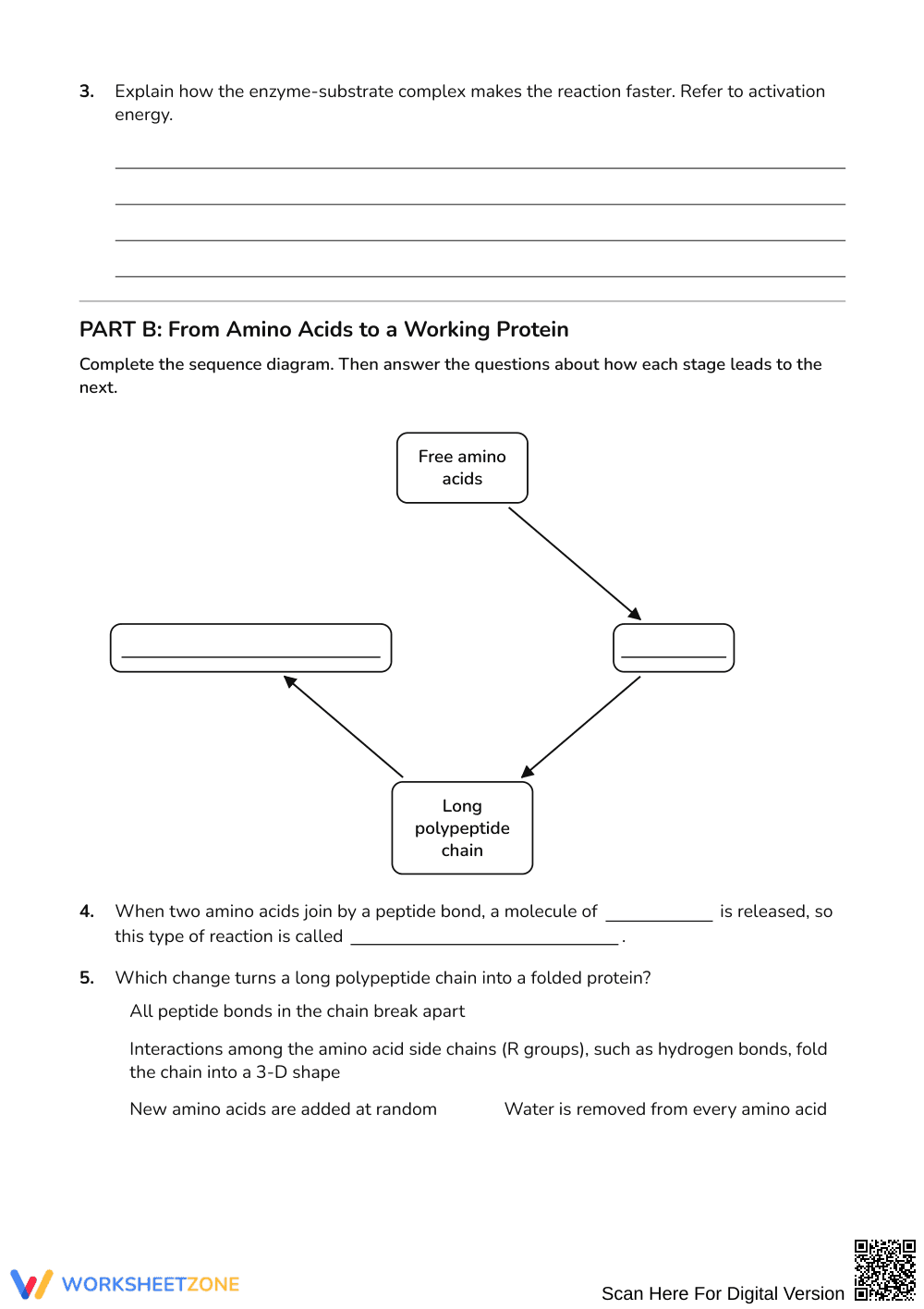
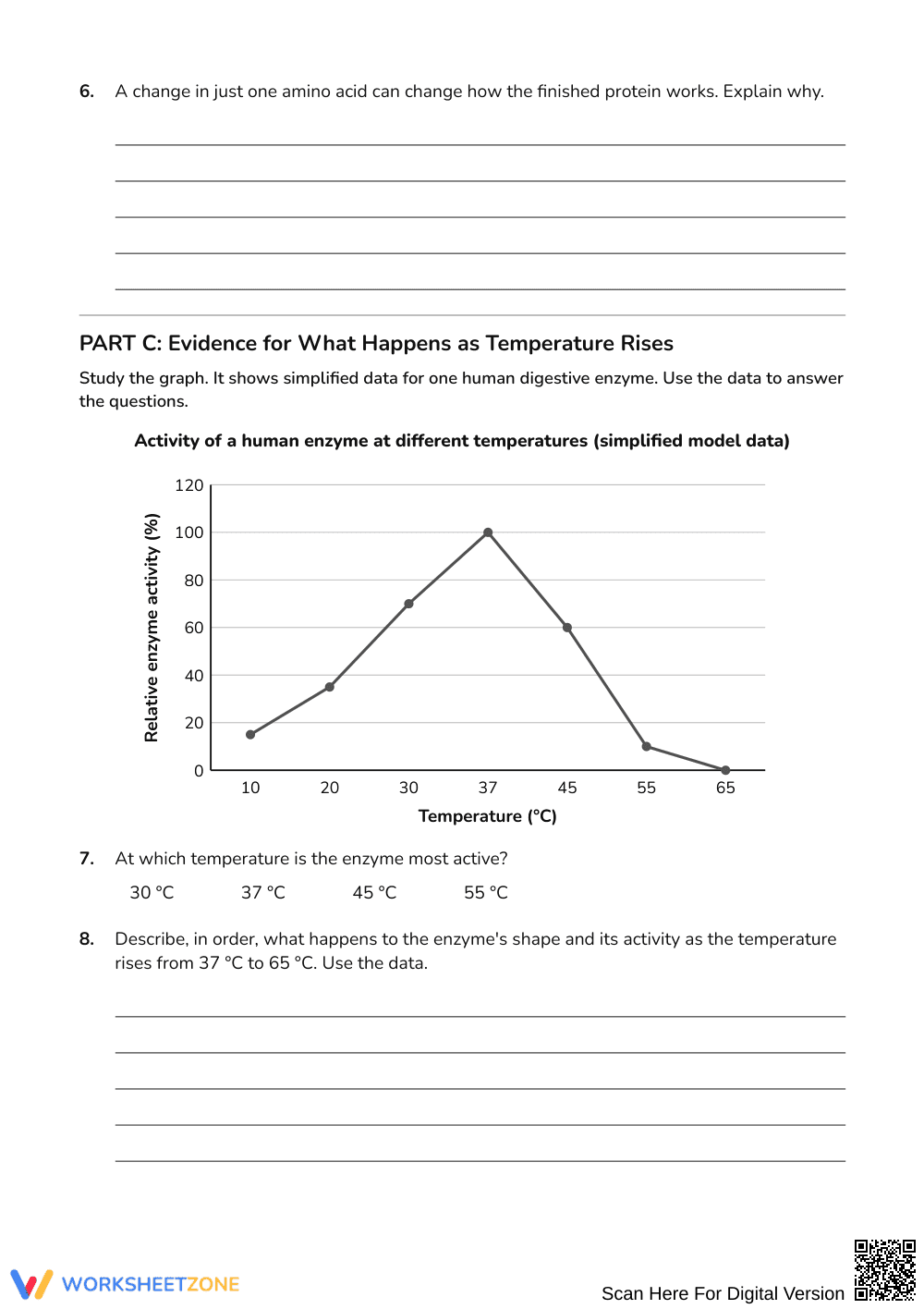
- Supported Practice: In Parts B and C, learners track peptide bond dehydration synthesis through functional protein folding, followed by interpreting a quantitative temperature-activity curve to explain thermal denaturation.
- Independent Practice: In Part D, students independently categorize dietary macromolecules, explain why nucleic acids do not serve as metabolic fuel, and write an end-to-end biochemical sequence detailing starch hydrolysis into cellular glucose.
This scaffolded progression adheres to a gradual-release model, moving high school learners from concrete diagram sequencing to complex chemical explanations.
Standards Alignment
This worksheet addresses secondary biology and chemistry objectives focusing on the structure and properties of biomolecules. Students construct explanations based on evidence for how the structure of DNA, proteins, carbohydrates, and lipids determines their specific structural and functional roles in cells. The targeted skills support state science standards and introductory life science curricula for secondary grades.
How to Use It
Assign this worksheet immediately following direct instruction on enzymes and macromolecules to reinforce molecular terminology. During class, conduct a formative check while students complete Part C by verifying that they attribute denaturation to the disruption of weak intermolecular interactions rather than peptide backbone cleavage. Expect high school students to finish all 25 items within 45 to 60 minutes.
Who It's For
This resource serves general biology, honors biology, and introductory biochemistry students in grades 9 through 12. For students requiring reading support, pair the activity with an enzyme-substrate anchor chart showing active-site conformational changes.
High school life science curricula require students to connect chemical interactions to cellular behavior. According to Fisher & Frey (2014), structured sequencing tasks coupled with written justifications bridge the gap between rote memorization and conceptual modeling in secondary science. This 25-task worksheet equips learners to sequence enzyme-substrate complexes, polypeptide folding, and digestive hydrolysis while analyzing how intermolecular forces dictate biological outcomes. By interpreting quantitative temperature plots alongside visual synthesis diagrams, students articulate why protein conformation determines function. The complete 4-page answer key provides clear benchmarks for evaluating student explanations of activation energy, induced-fit interactions, and macromolecular pathways across standard high school biology units.


