




























Essential Central Dogma Worksheet | Grades 9-12 Science
Paste this activity's link or code into your existing LMS (Google Classroom, Canvas, Teams, Schoology, Moodle, etc.).
Students can open and work on the activity right away, with no student login required.
You'll still be able to track student progress and results from your teacher account.
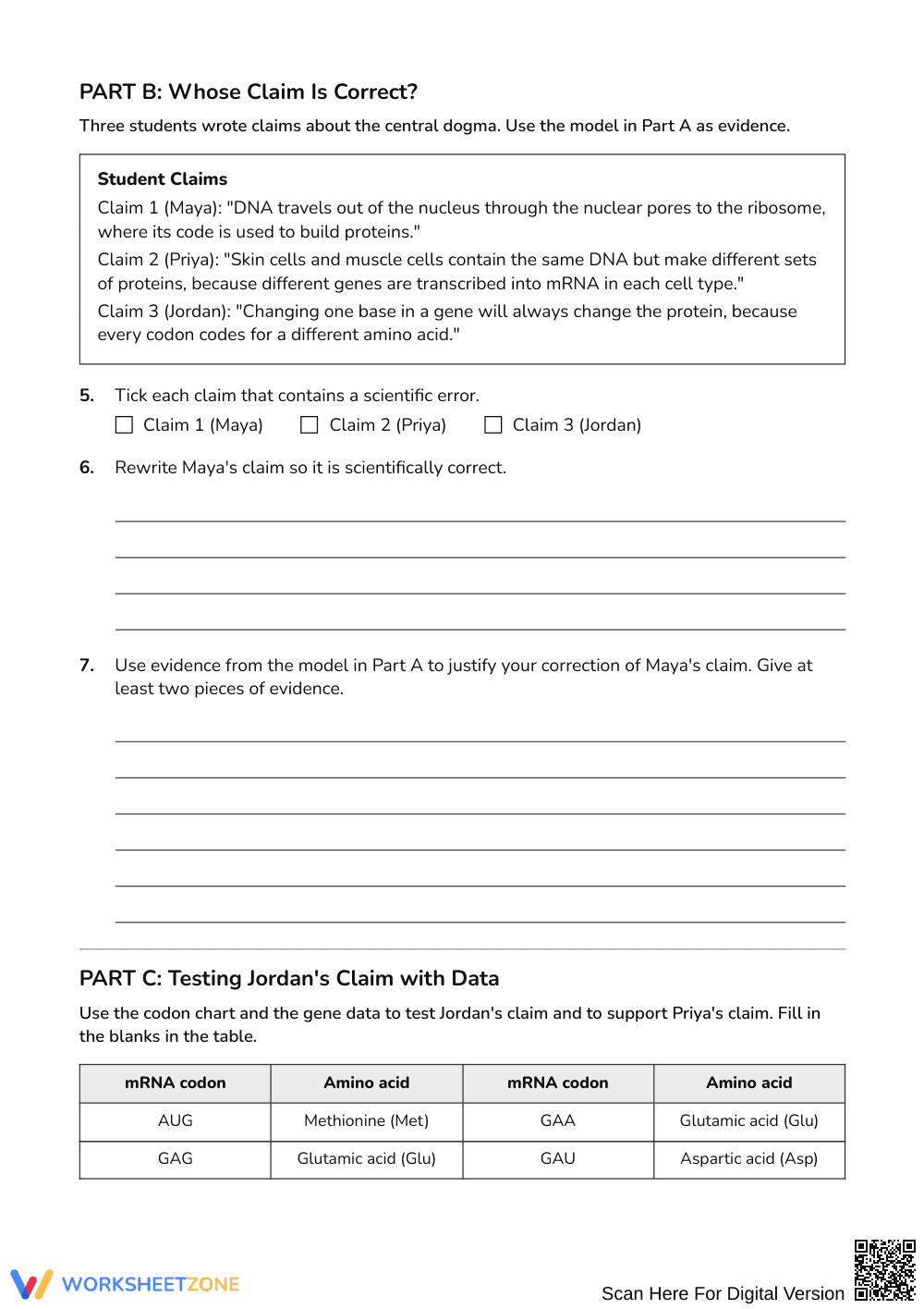
This comprehensive Central Dogma worksheet guides high school science students to identify, correct, and justify scientifically accurate reasoning regarding molecular genetics. Through rigorous error analysis and evidence evaluation, learners deconstruct persistent misconceptions about transcription, translation, and gene expression, directly connecting molecular mechanisms to observed cellular traits.
At a Glance
- Grade: Grades 9–12 · Subject: Science
- Standard: High School Life Science — Model how DNA nucleotide sequences determine protein structure and function
- Skill Focus: Central dogma misconception analysis and evidence-based justification
- Format: 4 pages · 31 problems · Answer key included · PDF
- Best For: Formative assessment, misconception review, or post-lab analysis
- Time: 45–60 minutes
What's Inside
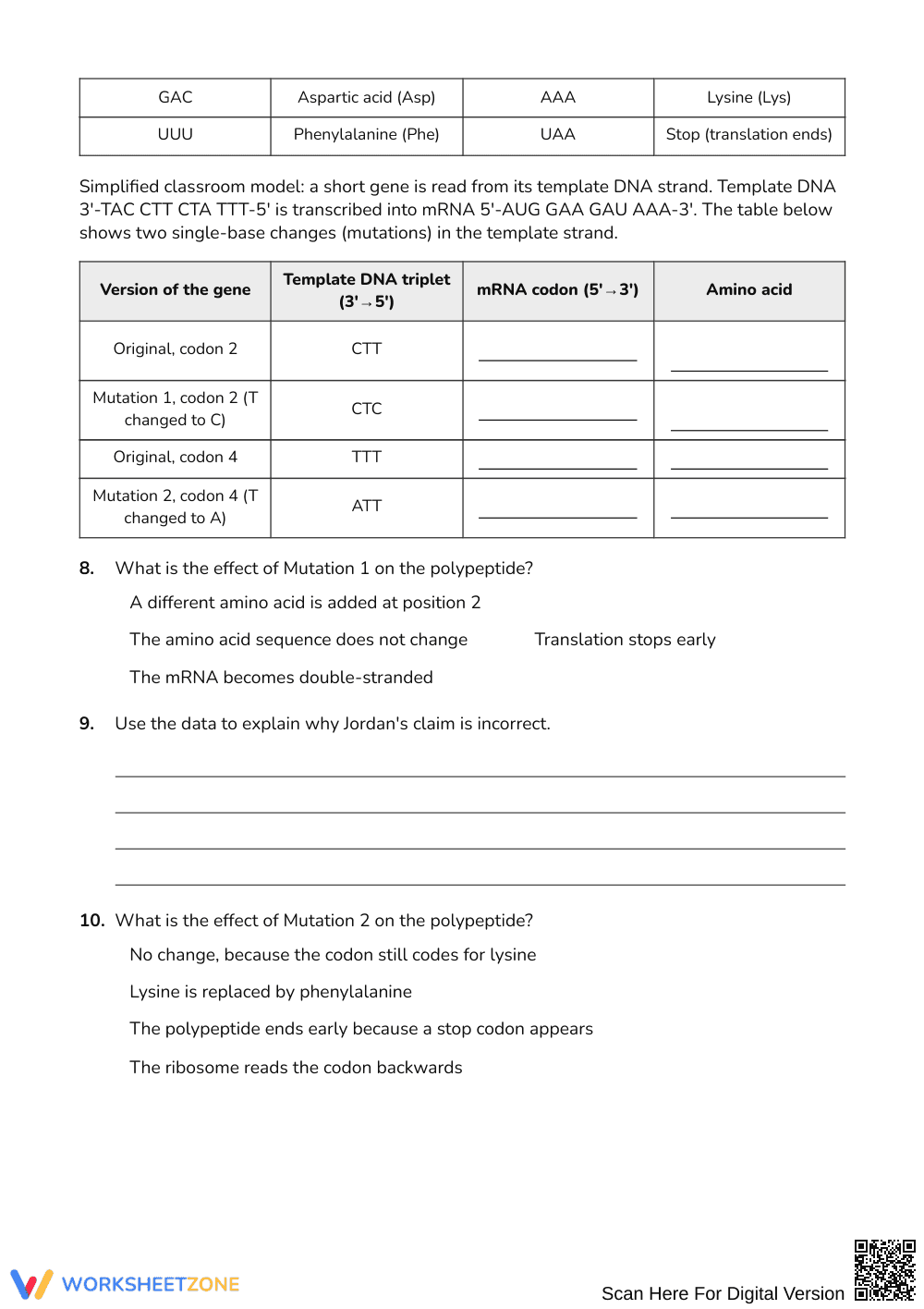
Across 4 structured pages, this resource features 31 targeted prompts organized into distinct analytical sections. Students interpret an annotated eukaryotic cell diagram, evaluate competing peer claims, analyze codon mutation charts, and trace transfer RNA mechanisms. A complete 4-page answer key provides full model explanations and sample justifications for straightforward grading.
Skill Progression
- Guided Practice (Part A): Students orient to core concepts by labeling cellular structures on a eukaryotic model and answering targeted multiple-choice identification questions with visible anatomical cues.
- Supported Practice (Parts B & C): Learners analyze conflicting student claims, detect biological errors, rewrite flawed statements, and consult codon reference tables to trace the physiological effects of specific point mutations.
- Independent Practice (Part D): Students independently explain ribosomal translation, base pairing, and the exact mechanism by which nucleotide triplets specify polypeptide sequences without visual scaffolds.
This deliberate sequence follows the gradual-release framework, moving students systematically from visual comprehension to autonomous scientific argumentation.
Standards Alignment
This resource aligns with high school life science standards that require students to construct evidence-based explanations for how DNA sequences specify proteins. Learners evaluate genetic models, examine synonymous mutations using mRNA tables, and differentiate transcription from translation. These standards-aligned objectives can be copied directly into lesson plans, IEP goals, or district curriculum mapping tools.
How to Use It
Implement this worksheet after direct instruction on protein synthesis. Use it during mid-unit formative assessment to pinpoint misunderstandings before cumulative exams, allowing 45 to 60 minutes for completion. During independent work, monitor student responses in Part B to confirm that students recognize that DNA stays protected within the nucleus rather than migrating to ribosomes.
Who It's For
This activity is designed for Grades 9–12 Biology and Advanced Life Science students developing scientific literacy. Built-in codon reference tables provide structured access for English language learners and students requiring instructional scaffolds. Pair this assignment with interactive protein synthesis simulations or hands-on molecular modeling kits to reinforce abstract cellular concepts.
According to research by Fisher & Frey (2014) on close reading and evidence evaluation, asking secondary students to detect and rectify common domain misconceptions significantly deepens conceptual retention compared to rote memorization. This 31-task science worksheet addresses this instructional need by engaging high school learners in rigorous error analysis across eukaryotic gene expression. Students systematically evaluate simulated student arguments, verify assertions against codon data tables, and construct written justifications detailing how mRNA transcripts direct ribosomal polypeptide assembly. By transforming common misunderstandings regarding nuclear transport and codon redundancy into concrete analytical tasks, the resource reinforces durable mental models of molecular inheritance.


