































Essential Central Dogma Worksheet | Grades 9–12 Science

Paste this activity's link or code into your existing LMS (Google Classroom, Canvas, Teams, Schoology, Moodle, etc.).
Students can open and work on the activity right away, with no student login required.
You'll still be able to track student progress and results from your teacher account.
Mastering protein synthesis requires students to trace genetic instructions from nuclear DNA to functional polypeptides. This 4-page worksheet guides high school biology students through comparing transcription and translation, mapping mutations to amino acid sequences, and contrasting eukaryotic and bacterial gene expression. Students analyze structural models and use comparison tables to explain cellular protein production.
At a Glance
- Grade: Grades 9–12 · Subject: Science
- Standard: High School Life Science — Explain how DNA directs the synthesis of proteins
- Skill Focus: Compare molecular processes and structures with comparison tables
- Format: 4 pages · 34 problems · Answer key included · PDF
- Best For: Post-instruction practice and unit review
- Time: 45–60 minutes
What's Inside
This 4-page packet features 34 targeted problems across four parts. Students analyze a eukaryotic cell diagram, complete comparison tables, decode point mutations using a codon chart, and evaluate prokaryotic versus eukaryotic transcription-translation timing. A full 4-page teacher answer key provides complete model responses.
Skill Progression
- Guided practice (Part A, 7 tasks): Students identify eukaryotic cell structures on a diagram and explain why mRNA carries genetic information to ribosomes.
- Supported practice (Parts B & C, 18 tasks): Learners complete comparative tables for transcription and translation, transcribe codon sequences, and compare mutation effects.
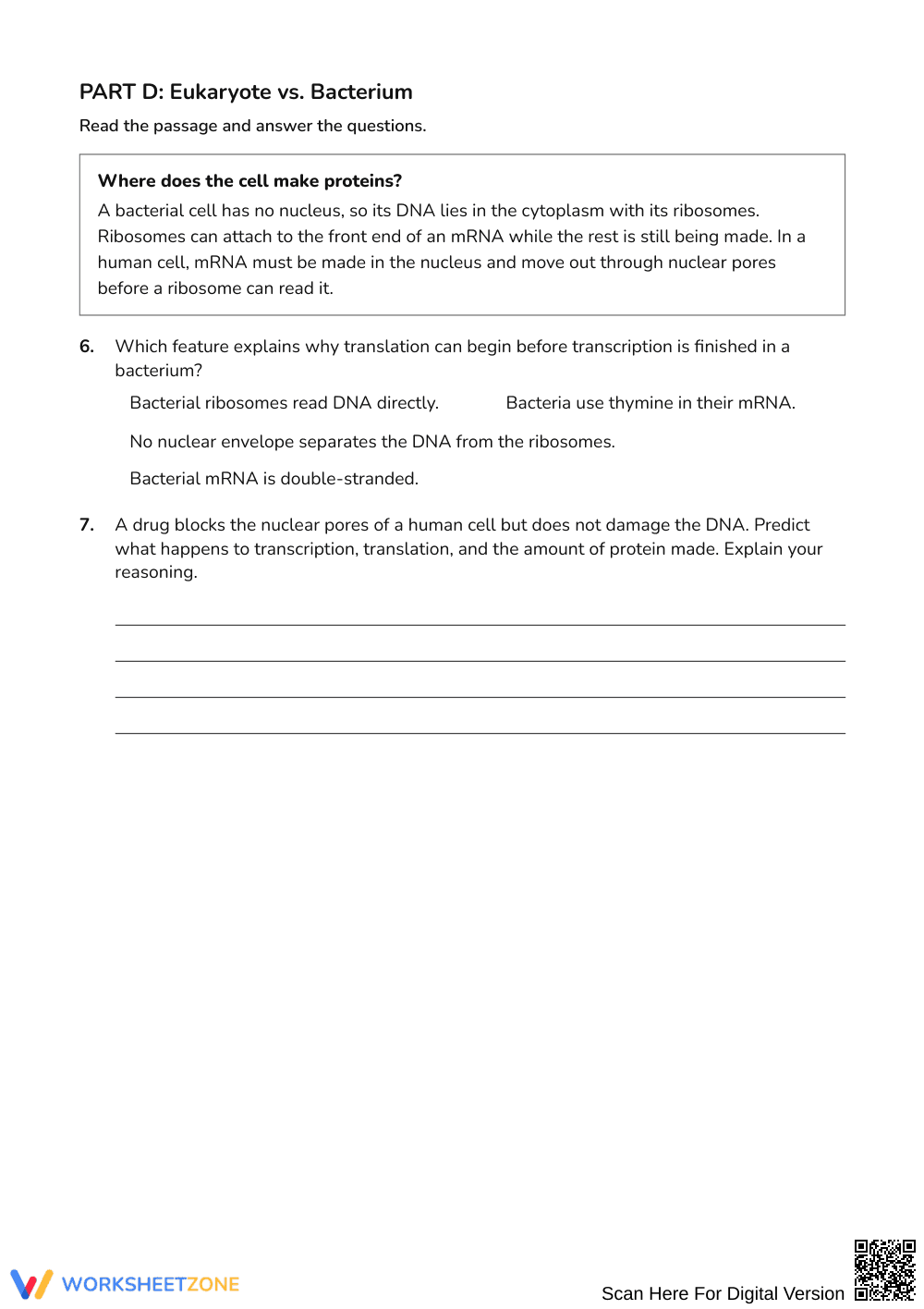
- Independent practice (Part D, 9 tasks): Students analyze bacterial gene expression and predict outcomes of blocking nuclear pore transport.
This gradual-release sequence guides students from structural recall to higher-level causal analysis.
Standards Alignment
This resource aligns with high school life science standards requiring students to explain how DNA sequences guide protein synthesis and cellular function. Students also practice interpreting informational diagrams and evaluating cause-and-effect relationships in cellular mechanisms. Both standard codes can be copied directly into lesson plans, IEP goals, or district curriculum mapping tools.
How to Use It
Assign this worksheet after direct instruction on protein synthesis. Use Parts A and B for paired class practice, followed by Parts C and D as independent formative assessment. Observe whether students notice how codon redundancy shields proteins from certain point mutations. Expected completion time is 45 to 60 minutes.
Who It's For
This resource supports general biology and introductory honors biology students. Teachers can provide an enlarged codon chart for learners needing visual scaffolding or use the nuclear pore inhibition scenario as an extension task. It pairs effectively with a dynamic cellular animation or direct instruction lecture.
According to Fisher & Frey (2014), structured comparative tasks and intentional scaffolding help secondary science students connect molecular vocabulary to complex biological models. This 34-task worksheet targets Central Dogma concepts by having students compare transcription and translation across eukaryotic and bacterial systems using tables, codon charts, and short-answer reasoning. Structured across four progressive sections, the activity guides learners from diagram identification to mutation analysis and physiological predictions. Students investigate why cells utilize messenger RNA rather than genomic DNA, decode codons, and evaluate how single nucleotide substitutions alter polypeptides. Featuring a complete 4-page answer key, this resource offers educators an effective tool that operationalizes deliberate practice and strengthens student understanding of protein synthesis pathways across high school life science curricula.


