




























Views
Downloads


Essential Budget Word Search | Grades 7–8 Social Studies

Paste this activity's link or code into your existing LMS (Google Classroom, Canvas, Teams, Schoology, Moodle, etc.).
Students can open and work on the activity right away, with no student login required.
You'll still be able to track student progress and results from your teacher account.
This Grades 7–8 economics word search reinforces key financial literacy concepts, helping middle school students master essential terminology related to budgeting, currency features, and saving targets. By pairing rigorous economic definitions with an engaging search activity, students connect core vocabulary—such as opportunity cost, discretionary spending, and security threads—to practical financial decision-making.
At a Glance
- Grade: Grades 7–8 · Subject: Social Studies
- Standard: Not standards-assessed — vocabulary enrichment
- Skill Focus: Planning purchases with a fixed budget, U.S. banknote vocabulary, and saving goals
- Format: 3 pages · 18 words · Answer key included · PDF
- Best For: Vocabulary review and financial literacy practice
- Time: 25–35 minutes
What's Inside
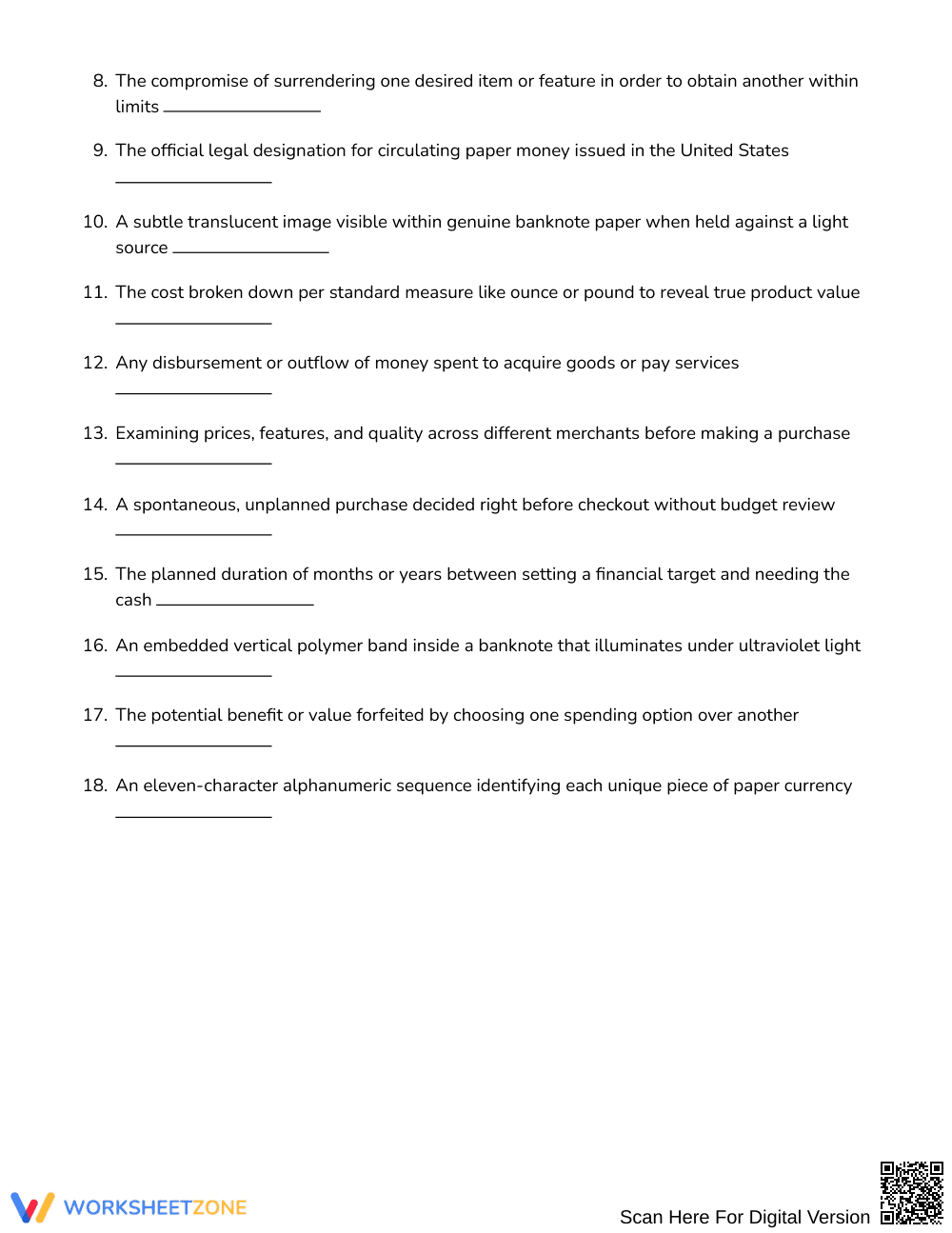
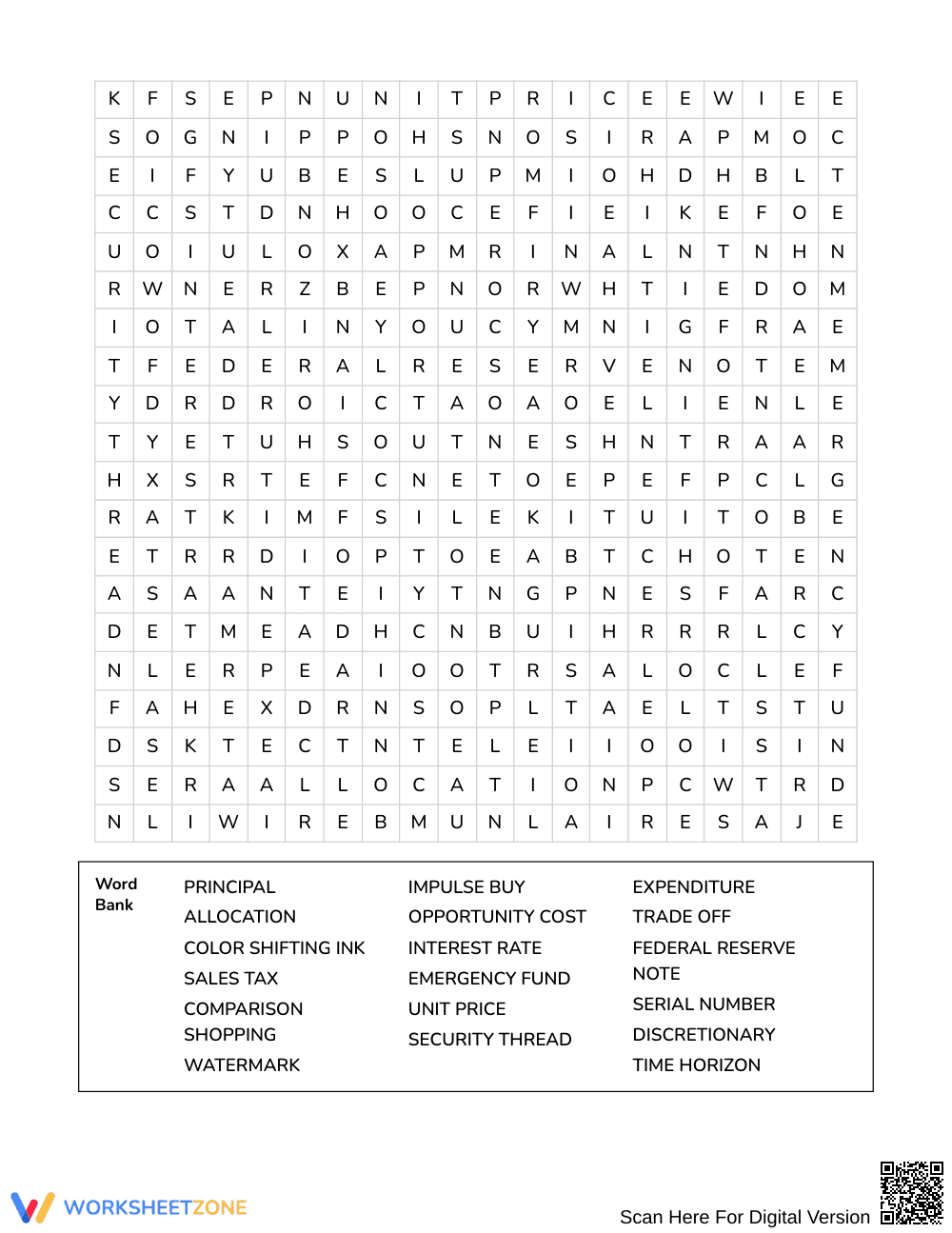
This 3-page printable resource includes an 18-word puzzle activity accompanied by a complete 4-page answer key. Students read detailed financial clues defining terms like comparison shopping, sales tax, and emergency fund, reference a shuffled word bank, and locate each corresponding term placed within the puzzle matrix.
Puzzle Mechanics
The word search is built on a 20 x 20 letter grid designed to engage middle school learners. The 18 hidden terms run in all eight compass directions: north, northeast, east, southeast, south, southwest, west, and northwest. Students read each definition clue, identify the matching financial term from the shuffled word bank, and search across horizontal, vertical, and diagonal orientations.
Standards Alignment
This activity serves strictly as vocabulary enrichment and is not aligned to a specific state or national standard. It supports foundational economic literacy by clarifying critical consumer terms and U.S. banknote anti-counterfeiting features.
How to Use It
Implement this puzzle as a post-instruction review activity following a direct lesson on personal budgeting, or incorporate it into an independent financial literacy station. Expected completion time spans 25 to 35 minutes. For formative assessment, circulate as students review the clues to confirm they accurately distinguish between opportunity cost and trade-offs before finding the terms.
Who It's For
This resource is designed for Grades 7–8 social studies and consumer economics classrooms. For students needing additional support, educators can highlight initial letters directly on the grid or pair peers for collaborative clue decoding. To extend the lesson, pair this activity with an interactive family budget simulation or a hands-on currency examination exercise.
Building domain-specific vocabulary is essential for middle school comprehension in economics and financial literacy. This Grades 7–8 vocabulary enrichment activity targets 18 core economic terms, guiding students to define and recognize critical concepts including fixed budgets, opportunity cost, unit pricing, and U.S. banknote security features. Rather than relying on passive memorization, the clue-driven format requires learners to actively process complex economic definitions before searching the 20 x 20 puzzle grid. According to Fisher & Frey (2014), intentional vocabulary instruction that integrates contextual definitions with deliberate retrieval practice significantly strengthens conceptual retention and reading comprehension across informational texts. By reinforcing specialized terms related to consumer choices, cash reserves, and banknote authentication, this resource equips middle school learners with the academic language necessary to analyze personal financial decisions and participate meaningfully in subsequent economic coursework.


