




























Views
Downloads




Essential Boundary Points Worksheet | Grade 9 Algebra I

Paste this activity's link or code into your existing LMS (Google Classroom, Canvas, Teams, Schoology, Moodle, etc.).
Students can open and work on the activity right away, with no student login required.
You'll still be able to track student progress and results from your teacher account.
This Grade 9 Algebra I worksheet trains students to justify boundary point inclusion in linear inequalities and systems. High school learners analyze boundary equations, evaluate mathematical claims using substitution, and explain why points on strict versus non-strict boundaries belong to solution sets. Students solidify the logical reasoning needed to master two-variable inequalities.
At a Glance
- Grade: 9 · Subject: High School Algebra I
- Standard:
HSA-REI.D.12— Graph solutions to linear inequalities in two variables as half-planes- Skill Focus: Justify Inclusion of Boundary Points in Solution Sets
- Format: 5 pages · 8 problems · Answer key included · PDF
- Best For: Conceptual understanding, error analysis, and partner discussion
- Time: 45–60 minutes
What's Inside
The 5-page student activity contains 8 rigorous, multi-step justification tasks supported by a Core Principles reference box. Students evaluate flawed student thinking in Part A, construct algebraic justifications across graphical and contextual scenarios in Part B, and build mathematical counterexamples in Part C. A complete 2-page answer key provides step-by-step substitution proofs and conceptual explanations.
Skill Progression
- Guided Practice (Part A, 2 tasks): Students evaluate pre-written claims, using algebraic substitution to test whether boundary points satisfy single inequalities or systems.
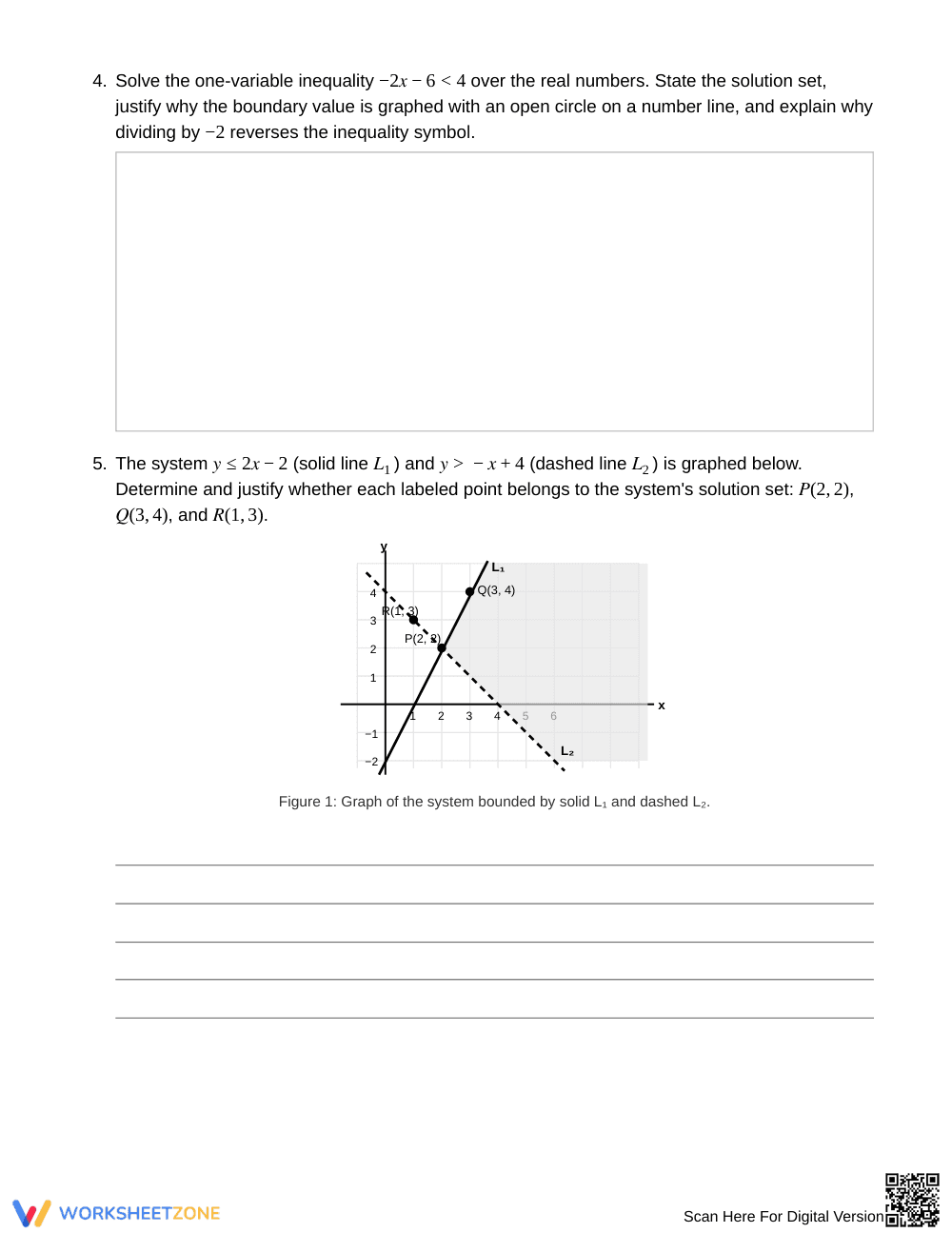
- Supported Practice (Part B, 4 tasks): Learners apply boundary rules to graphical models, number lines, and rover capacity constraints while justifying domain restrictions.
- Independent Practice (Part C, 2 tasks): Students formulate counterexamples disproving false claims and apply logic to analyze boundary intersections.
This structured progression follows the gradual-release framework, moving students from analyzing claims to constructing algebraic proofs.
Standards Alignment
This resource aligns directly with `HSA-REI.D.12`: Graph the solutions to a linear inequality in two variables as a half-plane, excluding the boundary for strict inequalities, and graph systems as intersecting half-planes. Supporting standard `HSA-CED.A.3` addresses representing constraints with systems. Both standard codes can be copied directly into lesson plans, IEP goals, or district curriculum mapping tools.
How to Use It
Deploy this worksheet after direct instruction on graphing half-planes and boundary lines. Use Part A as a collaborative mid-lesson checkpoint where student pairs discuss common misconceptions about strict inequalities. Formatively observe whether students substitute boundary values into strict inequalities or mistakenly assume boundary lines always belong to the solution set. The entire 8-task set completes in 45 to 60 minutes of focused instructional time.
Who It's For
This worksheet serves Grade 9 Algebra I students developing algebraic argumentation skills, including honors students preparing for advanced proof-based mathematics. For intervention groups, scaffold tasks by pairing Part B with a visual coordinate plane anchor chart showing dashed versus solid boundary conventions.
According to research by Fisher & Frey (2014), purposeful gradual-release instruction combined with structured error analysis significantly deepens conceptual mastery in secondary mathematics. Standard HSA-REI.D.12 requires ninth-grade algebra students to determine whether coordinate pairs along boundary lines belong to the solution sets of linear inequalities and systems of inequalities. Rather than relying on rote shading routines, students must coordinate algebraic substitution with geometric representations to defend why non-strict inequalities include their boundaries while strict inequalities exclude them. This 8-task worksheet directly addresses documented high school misconceptions by prompting students to critique mathematical claims, evaluate real-world rover capacity boundaries, and construct rigorous counterexamples. By requiring students to justify boundary conditions using formal logic, the resource reinforces the deductive reasoning habits emphasized across college- and career-ready mathematics curricula, establishing durable problem-solving frameworks for advanced algebra courses.


