































Essential Book Review Terms Word Search | Grades 6–7 ELA

Paste this activity's link or code into your existing LMS (Google Classroom, Canvas, Teams, Schoology, Moodle, etc.).
Students can open and work on the activity right away, with no student login required.
You'll still be able to track student progress and results from your teacher account.
This book reviewing vocabulary word search strengthens middle school literacy by challenging students to identify and locate 16 critical literary critique terms. Designed for Grades 6–7 English Language Arts, the activity reinforces essential terminology—including pacing, critique, perspective, and resolution—helping young readers articulate thoughtful, analytical evaluations of fiction and nonfiction texts.
At a Glance
- Grade: Grades 6–7 · Subject: English Language Arts (ELA)
- Standard: Not standards-assessed — vocabulary enrichment
- Skill Focus: Book reviewing vocabulary, literary critique terms, and narrative concepts
- Format: 3 pages · 16 words · Full answer key included · Printable PDF
- Best For: Book review writing units and independent reading response
- Time: 20–30 minutes
What's Inside
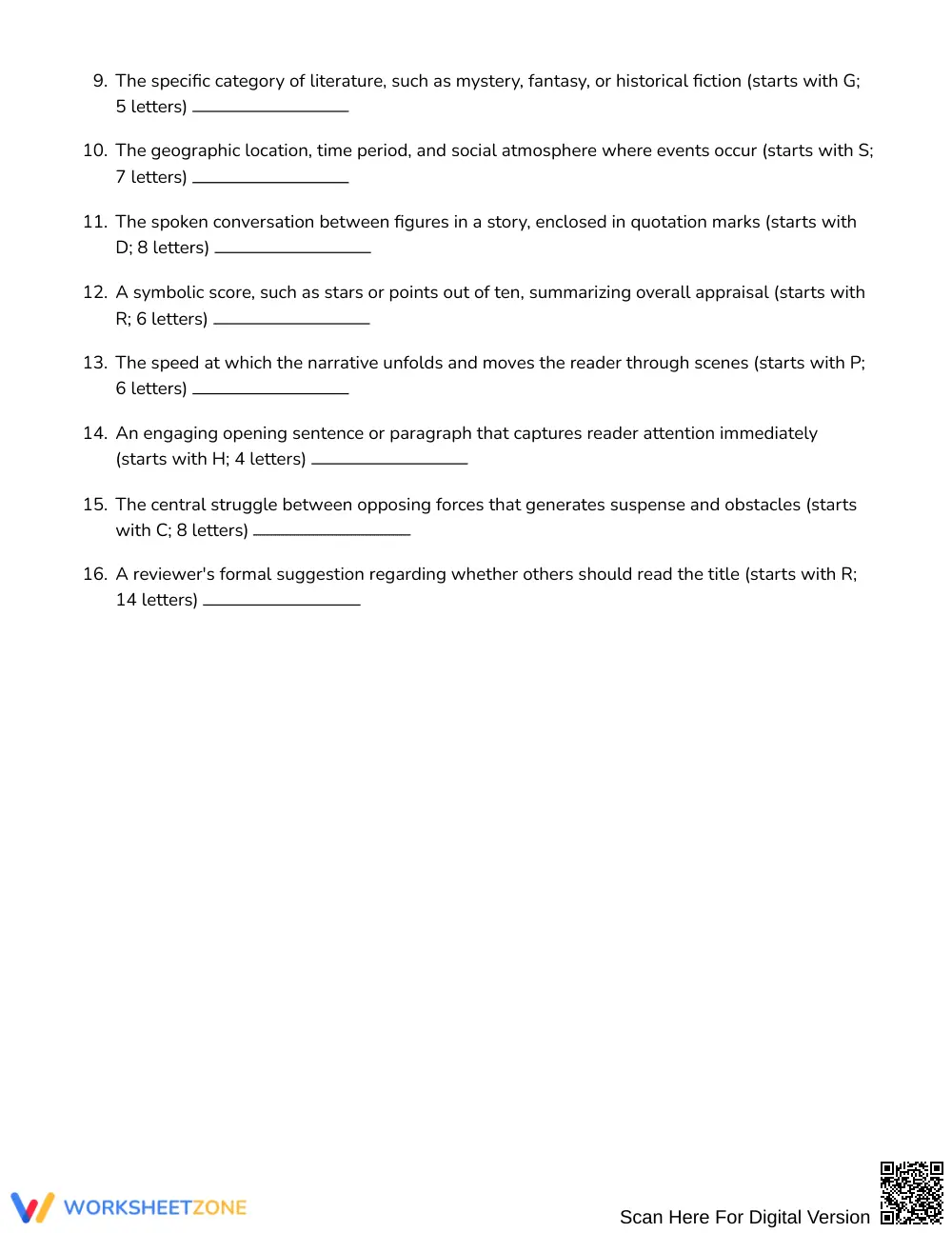
This 3-page printable PDF provides a clue-based word search targeting 16 essential book reviewing words. Instead of scanning a simple word bank, students read 16 definitions describing core literary elements, critical evaluation criteria, and narrative structures. Learners deduce each term—such as critique, dialogue, hook, and spoiler—before finding it within the puzzle. A 4-page answer key displays the full solution grid with every term highlighted.
Puzzle Mechanics and Structure
Designed as a no-bank challenge, this puzzle requires students to recall vocabulary rather than passively match letters. The activity features an 18 x 18 grid with 16 words hidden across eight directions: North, Northeast, East, Southeast, South, Southwest, West, and Northwest. Because words run forward, backward, horizontally, vertically, and diagonally, students build visual scanning skills. The absence of a word bank ensures learners read each clue closely to identify the target vocabulary before searching the grid.
Standards Alignment
This activity serves as vocabulary enrichment and is not aligned to a specific academic standard. It supports foundational English Language Arts proficiency by building domain-specific terminology that students need when analyzing literature, crafting written book critiques, and evaluating author craft across varied middle school reading genres.
How to Use It
Use this word search as a mid-unit transition or after direct instruction to reinforce concepts following a book review writing lesson. For formative assessment, observe which definitions students solve easily and which terms—such as perspective or pacing—require discussion. Most middle school learners will complete the clue-solving and puzzle search in 20 to 30 minutes.
Who It's For
This resource is designed for Grades 6–7 English Language Arts classrooms, reading workshops, and library programs. It offers built-in differentiation: clue-based searching challenges advanced learners to retrieve academic terms from memory, while supporting developing readers through clear definitions. Pair this puzzle with a mentor book review or an anchor chart outlining literary critique elements.
This Grades 6–7 English Language Arts vocabulary enrichment resource targets book reviewing vocabulary through an active retrieval word puzzle. Rather than relying on rote memorization or passive word search mechanics, students analyze 16 descriptive clues defining essential literary terms, including conflict, perspective, pacing, and theme. According to Fisher & Frey (2014), intentional academic vocabulary instruction that integrates definitional knowledge with meaningful retrieval practice significantly enhances reading comprehension and text-based writing proficiency in middle grade learners. By resolving clues before locating hidden words across an 18 x 18 grid, students strengthen orthographic mapping and domain-specific lexicon necessary for articulating structured book critiques. The included 4-page answer key provides immediate verification for teachers and students alike. This print-and-go activity bridges reading comprehension and written literary analysis, equipping intermediate readers with the precise terminology required to critique narrative pacing, characterization, and author perspective with academic precision.


