

































Essential Bisectors & Locus Worksheet | Grade 10 Geometry

Paste this activity's link or code into your existing LMS (Google Classroom, Canvas, Teams, Schoology, Moodle, etc.).
Students can open and work on the activity right away, with no student login required.
You'll still be able to track student progress and results from your teacher account.
This comprehensive Grade 10 geometry resource guides high school students through the formal logic and compass-and-straightedge procedures of geometric constructions. Learners analyze bisector theorems, evaluate multi-step construction algorithms, and solve intersection-of-loci problems to build rigorous geometric reasoning and spatial proof capabilities.
At a Glance
- Grade: 10 · Subject: Geometry
- Standard:
HSG-CO.D.12— Make formal geometric constructions with a variety of tools and methods- Skill Focus: Mix Bisectors, Perpendiculars, and Locus Reasoning
- Format: 5 pages · 16 problems · Answer key included · PDF
- Best For: High school geometry construction mastery
- Time: 45–60 minutes
What's Inside
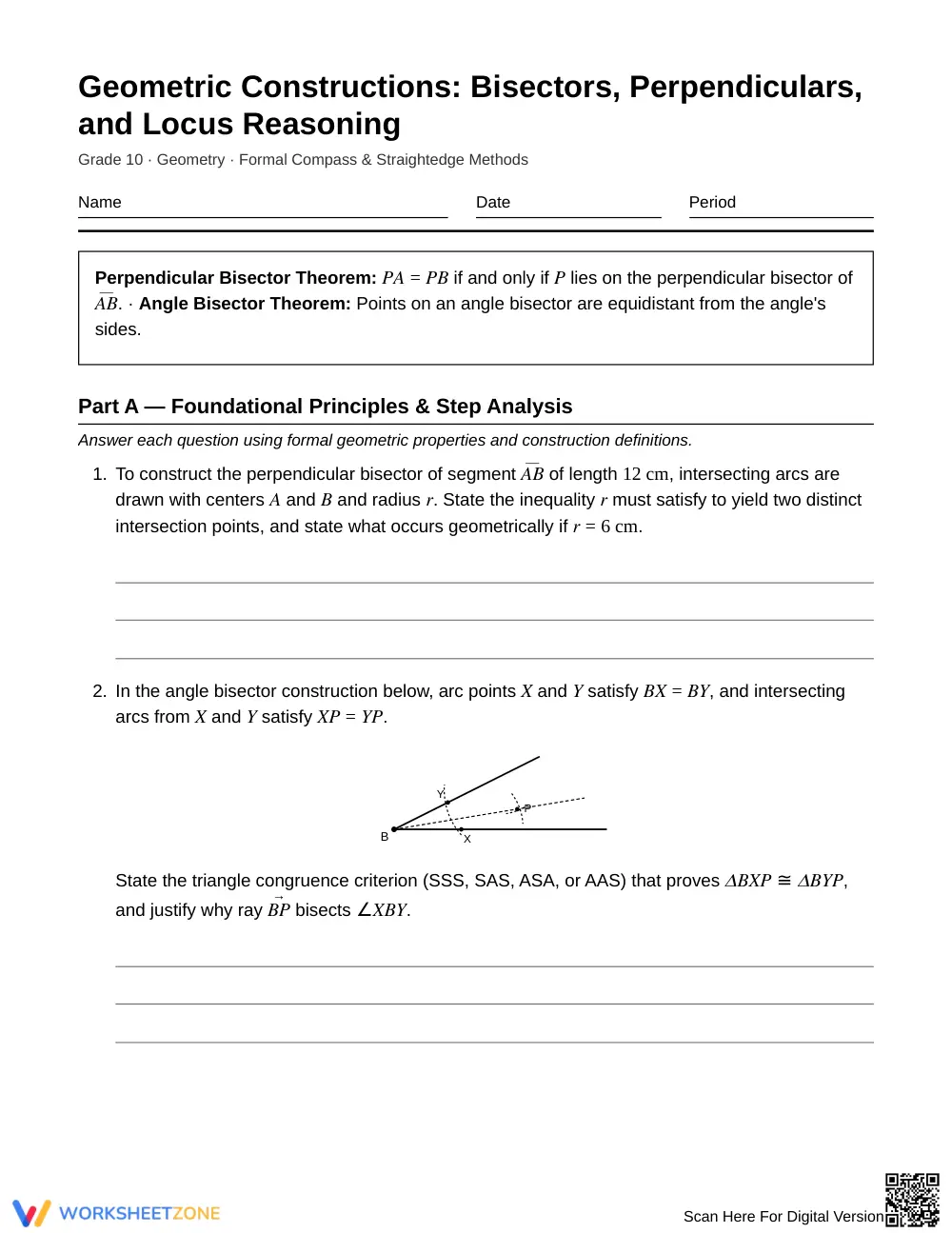
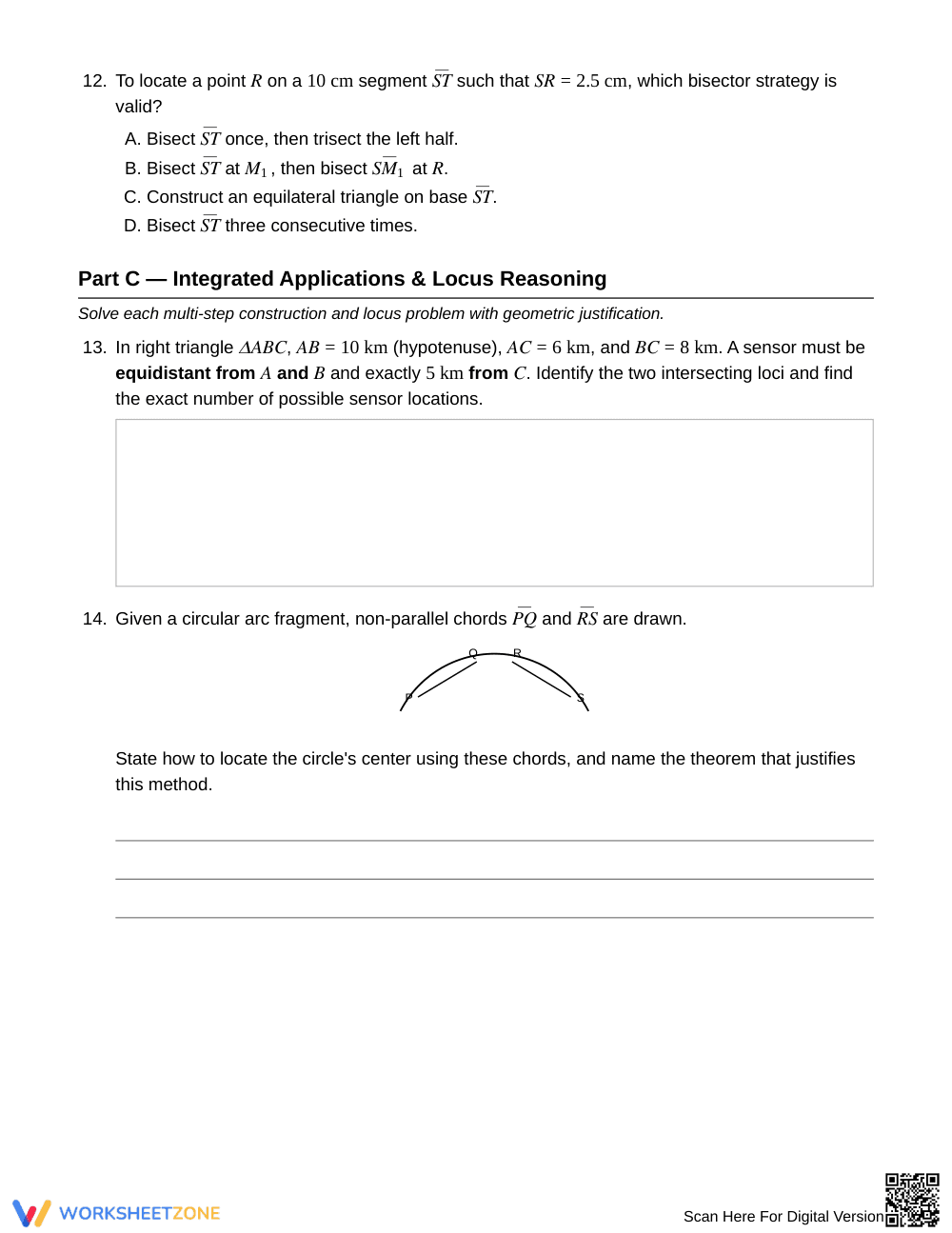
The 5-page student activity features 16 rigorous multi-part problems divided across three analytical sections. It includes geometric diagrams, theorem reference boxes covering the Perpendicular Bisector and Angle Bisector Theorems, conceptual analysis prompts, and an exhaustive 2-page step-by-step teacher answer key.
Skill Progression
- Guided practice (Part A, Problems 1–4): Foundational tasks prompt students to analyze step validity, arc radius inequalities, triangle congruence proofs, and single-condition locus sets.
- Supported practice (Part B, Problems 5–12): Students evaluate multi-step procedural choices, circumcenter and incenter properties, compound angle constructions, and segment bisection strategies.
- Independent practice (Part C, Problems 13–16): Open-ended complex application tasks require intersecting multiple loci, reconstructing circular centers from chord bisectors, and proving regular polygon inscriptions.
This structured progression moves students systematically from conceptual principles to autonomous multi-step locus modeling using the gradual-release framework.
Standards Alignment
This resource aligns directly to HSG-CO.D.12: Make formal geometric constructions with a variety of tools and methods such as copying a segment, bisecting a segment, bisecting an angle, constructing perpendicular lines, and inscribing regular polygons in circles. Supporting standard HSG-CO.C.9 reinforces underlying congruence theorems. Both standard codes can be copied directly into lesson plans, IEP goals, or district curriculum mapping tools.
How to Use It
Use this resource directly after direct instruction on compass constructions to bridge manual drawing skills with formal geometric proof. Alternatively, assign Parts B and C as collaborative small-group review before summative unit exams. During work time, formatively check whether students correctly distinguish between finding triangle incenters versus circumcenters. Expected completion time is 45 to 60 minutes.
Who It's For
This worksheet serves 10th-grade geometry students developing deductive proof skills and spatial visualization. Scaffolded prompts support struggling learners by identifying initial construction parameters, while advanced locus problems challenge honors students. Pair this activity with compass-and-straightedge tactile modeling kits or dynamic geometry software for hands-on verification.
According to research from Fisher & Frey (2014) on effective instruction, scaffolding geometric tasks from isolated procedural steps to integrated problem-solving significantly enhances student conceptual retention and deductive mastery. Under standard HSG-CO.D.12, tenth-grade geometry students must not merely memorize algorithmic drawing sequences but actively comprehend the spatial loci and congruence theorems that validate each stroke of the compass. This 16-task resource operationalizes this evidence-based model by demanding explicit geometric justifications for bisector spans, intersection properties, and multi-condition locus intersections. By pairing rigorous step analysis with compound locus challenges, the material reinforces the essential bridge between manual construction mechanics and formal deductive proof. Teachers can reliably utilize this structured sequence to diagnose procedural misconceptions and ensure all learners attain enduring mathematical proficiency across classical geometric construction standards.


