




























Views
Downloads


Essential Area of Composite Floors Worksheet | Grade 6 Math

Paste this activity's link or code into your existing LMS (Google Classroom, Canvas, Teams, Schoology, Moodle, etc.).
Students can open and work on the activity right away, with no student login required.
You'll still be able to track student progress and results from your teacher account.
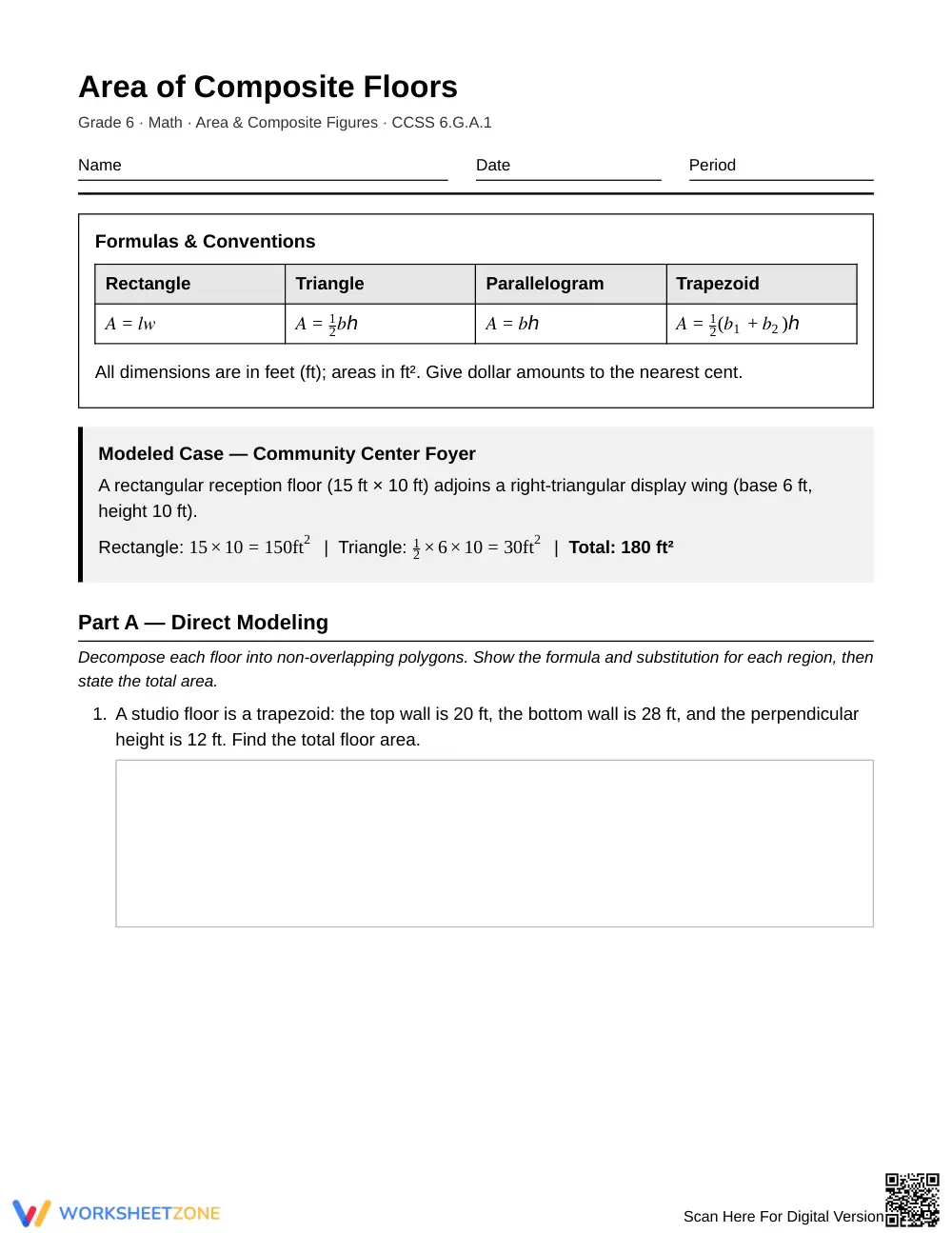
This Grade 6 math worksheet equips students to master finding composite floor area by decomposing shapes into triangles, rectangles, parallelograms, and trapezoids. Learners apply standard area formulas to real-world flooring projects, calculate installation costs, subtract cutout voids, and evaluate spatial constraints to build lasting geometric problem-solving fluency.
At a Glance
- Grade: 6 · Subject: Math
- Standard:
6.G.A.1— Decompose polygons into rectangles and triangles to solve real-world area problems- Skill Focus: Area of Composite Floors
- Format: 5 pages · 10 problems · Answer key included · PDF
- Best For: Real-world composite area practice
- Time: 45–60 minutes
What's Inside
This 5-page printable packet includes 10 structured problems, a formula reference header, and a complete modeled example. Students encounter additive layouts, subtractive cutouts, and real-world cost conversions. A full 2-page step-by-step answer key is provided to ensure easy grading and self-assessment.
Skill Progression
- Guided Practice (Part A, 2 problems): Direct geometric modeling where students decompose studio and gallery floors into rectangles and triangles.
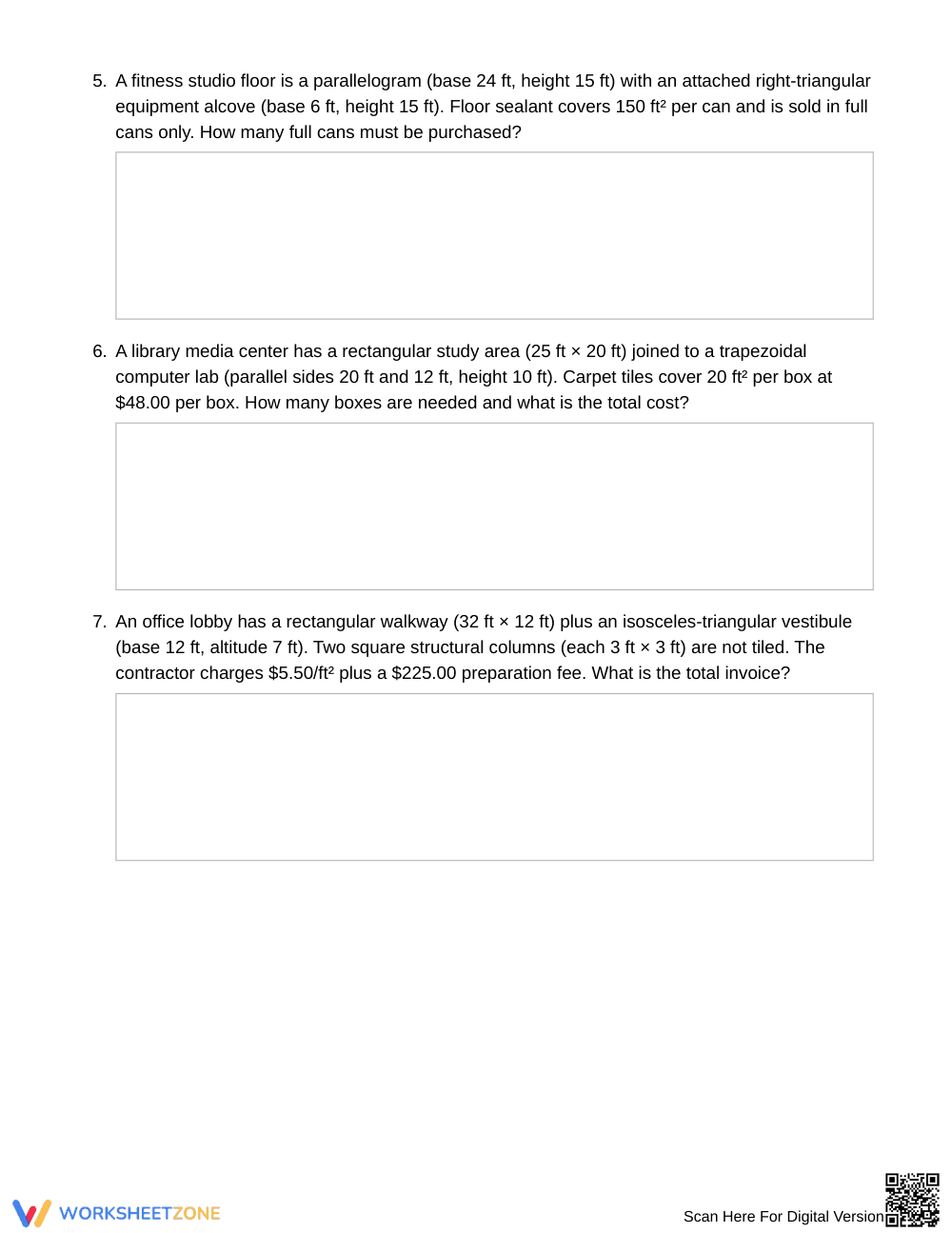
- Supported Practice (Part B, 6 problems): Multi-step applications involving material unit costs, subtractive column cutouts, and supply coverage limits.
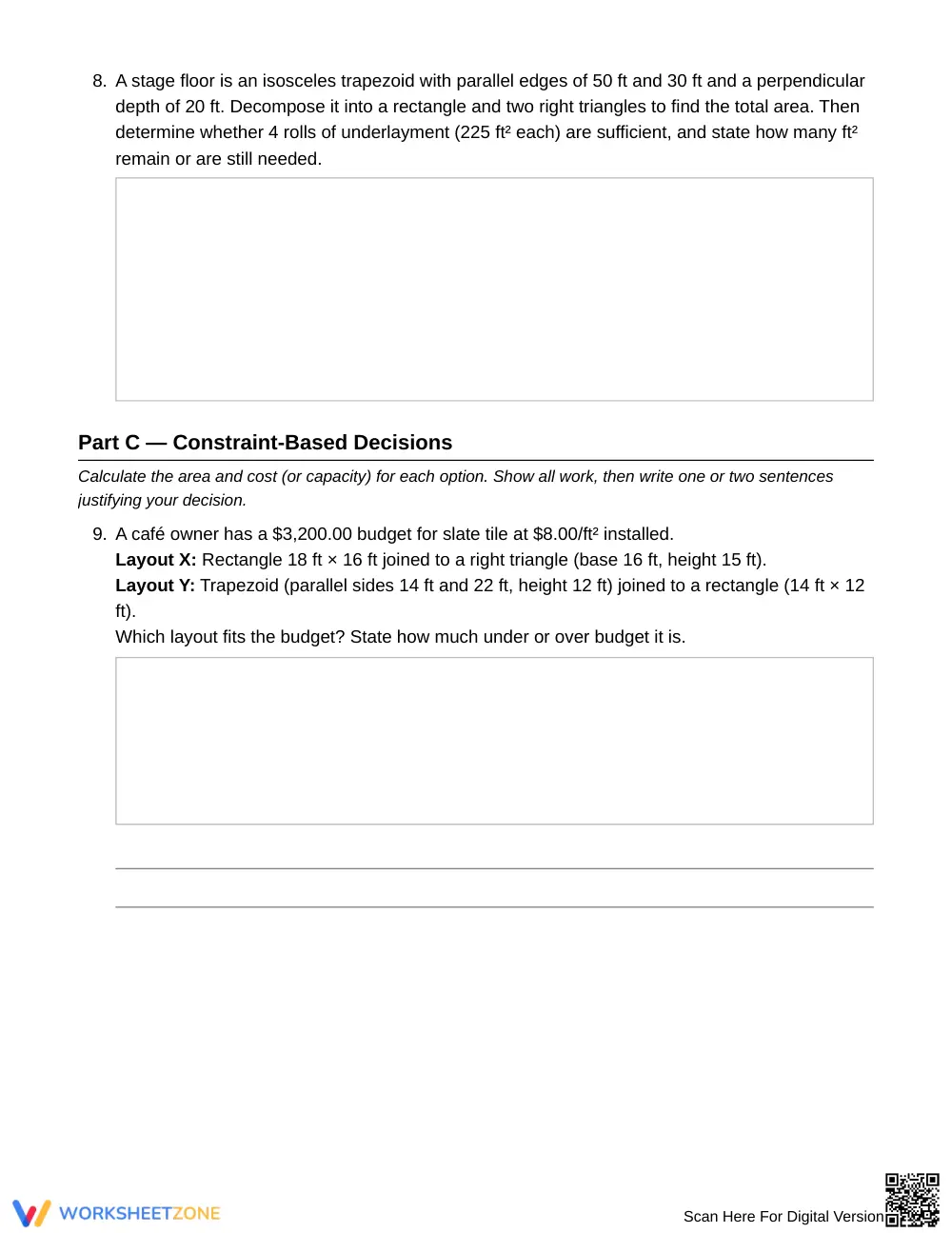
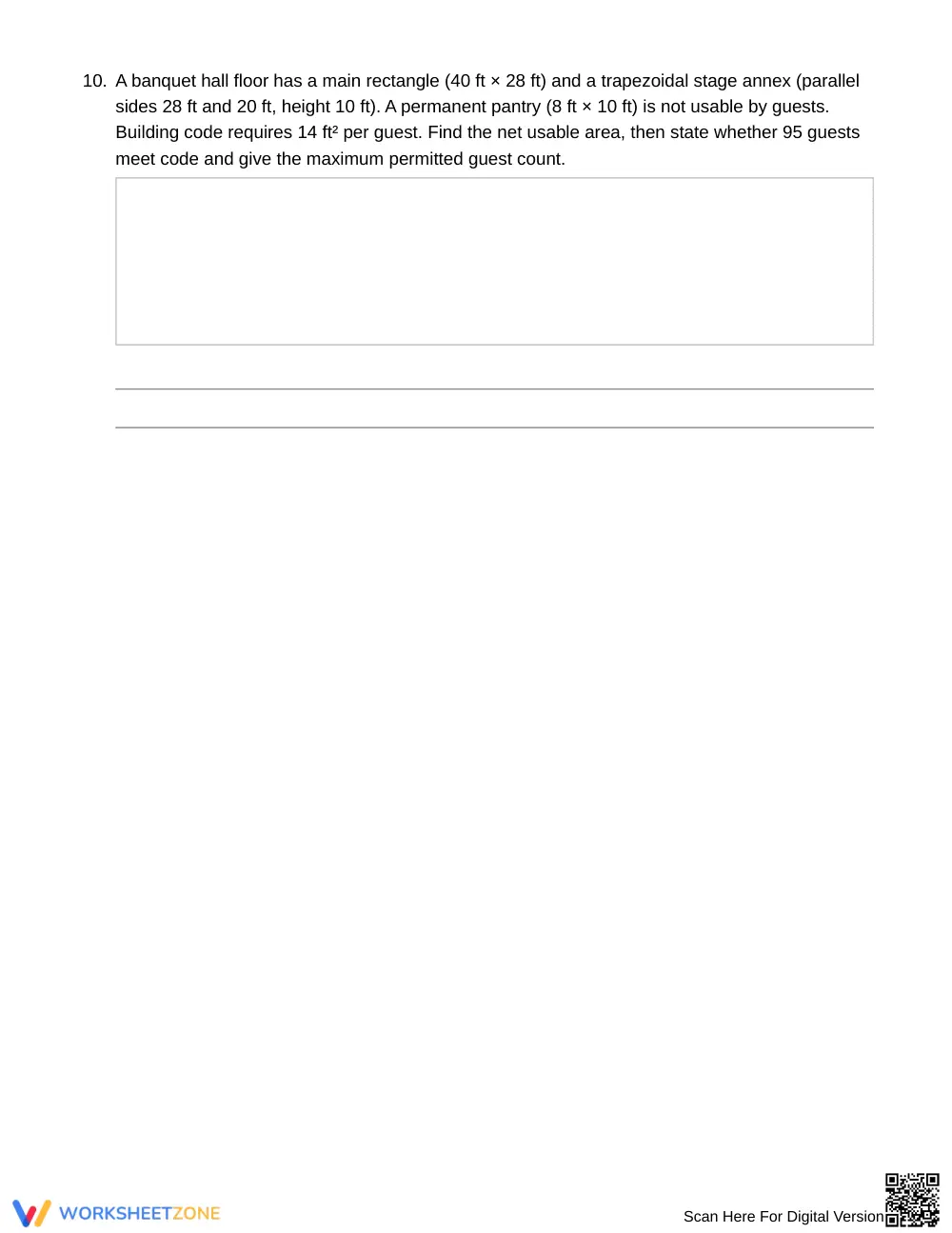
- Independent Practice (Part C, 2 problems): Constraint-based decision tasks evaluating flooring budgets and municipal room occupancy codes.
This sequence follows a gradual-release model, advancing learners from basic decomposition to higher-order quantitative analysis.
Standards Alignment
This resource aligns directly to 6.G.A.1: Find the area of right triangles, other triangles, special quadrilaterals, and polygons by composing or decomposing into basic geometric shapes. Additionally, it supports 6.EE.A.2 by having students evaluate multi-step algebraic formulas in real-world contexts. Both standard codes can be copied directly into lesson plans, IEP goals, or district curriculum mapping tools.
How to Use It
Use this worksheet for targeted independent practice or collaborative math stations following direct instruction on polygon area. During work time, check that students correctly identify shared dimensions when decomposing figures. Expect completion in 45 to 60 minutes, using Part C as an enrichment challenge for early finishers.
Who It's For
Designed for Grade 6 math students, this resource also supports advanced fifth graders and Grade 7 intervention groups. Differentiate by encouraging students to color-code sub-regions, and pair this packet with visual anchor charts detailing geometric area formulas.
Mastering standard 6.G.A.1 enables sixth-grade students to transition from basic formula memorization to deep spatial reasoning, establishing essential foundations for coordinate plane geometry and three-dimensional surface area calculations. When learners solve composite floor area problems situated within authentic real-world contexts like tile installation and material budgeting, conceptual retention improves markedly. According to foundational research on mathematics instruction by Fisher & Frey (2014), scaffolding tasks through an explicit gradual release framework—moving systematically from teacher-modeled practice to independent multi-step applications and complex constraint-based evaluations—generates measurable gains in student problem-solving accuracy, spatial reasoning, and knowledge transfer. This 10-problem geometry packet reinforces standards-based proficiency by requiring middle school learners to decompose compound layouts into basic polygons, subtract interior architectural voids, calculate unit material pricing, and justify building code compliance using clear mathematical evidence and step-by-step arithmetic.


