




























Views
Downloads

Printable Enzyme Classification Worksheet | Grades 9-12

Paste this activity's link or code into your existing LMS (Google Classroom, Canvas, Teams, Schoology, Moodle, etc.).
Students can open and work on the activity right away, with no student login required.
You'll still be able to track student progress and results from your teacher account.
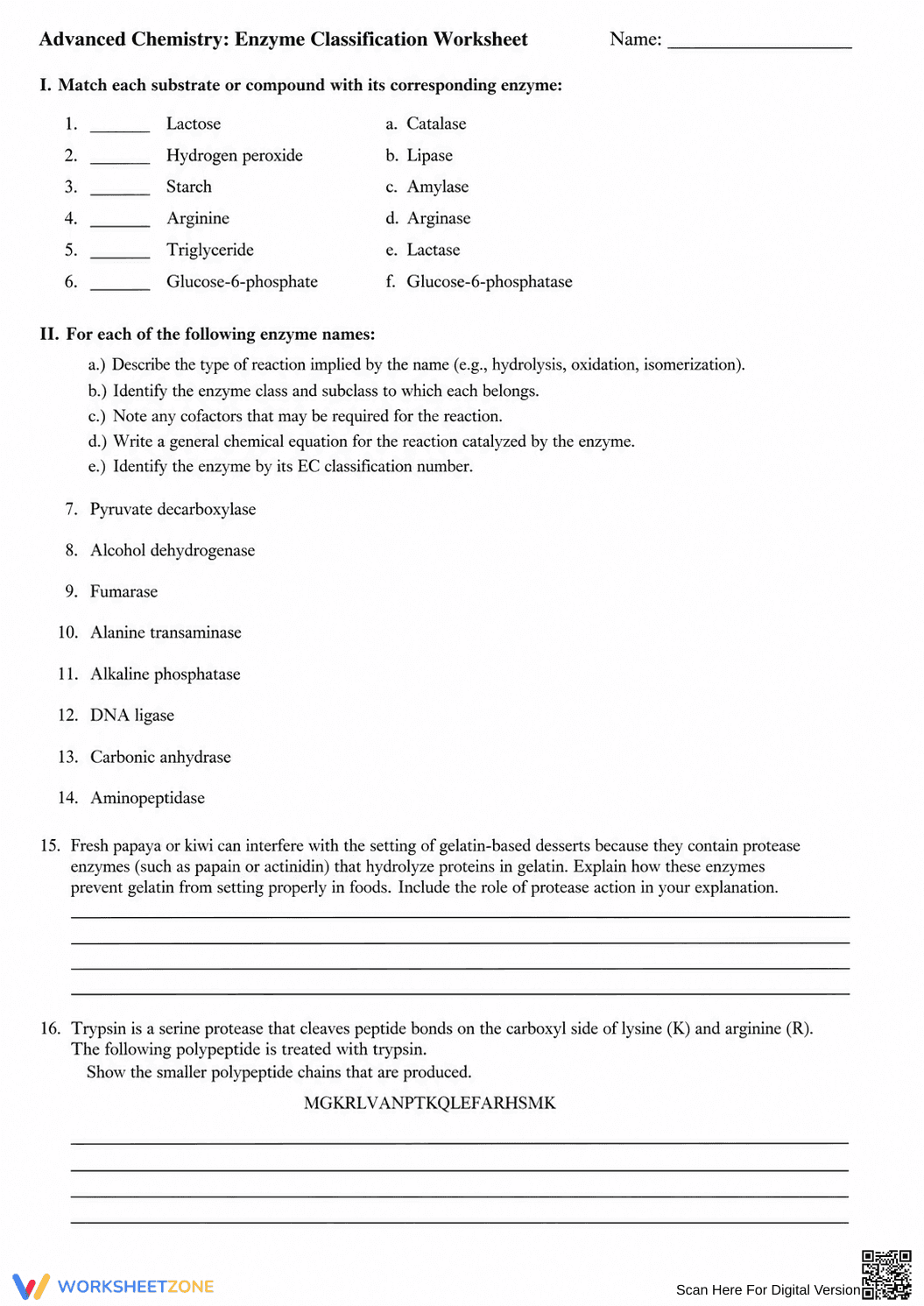
This high school science worksheet provides students with targeted practice on enzyme classification and reaction mechanisms. By completing these structured problems, learners will solidify their understanding of substrate specificity, enzyme nomenclature, and real-world biochemical applications to master essential protein functions and their role in biological systems.
At a Glance
- Grade: 9-12 · Subject: Science
- Standard:
HS-LS1-1— Explain how protein structures carry out essential life functions- Skill Focus: Enzyme classification and reactions
- Format: 1 page · 16 problems · Answer key included · PDF
- Best For: Independent practice or homework
- Time: 25–35 minutes
Inside this single-page resource, educators will find 16 multi-part questions designed for advanced science students. The worksheet begins with a matching section linking substrates to their corresponding enzymes. The second section requires students to analyze eight specific enzyme names, detailing the reaction type, classification, cofactors, and chemical equations. Finally, two application questions challenge students with real-world scenarios, such as the effect of fruit proteases on gelatin and trypsin hydrolysis on a polypeptide chain. A complete answer key is included for easy grading.
This resource is designed for immediate classroom implementation:
- Print (1 minute): Download the PDF and print copies. The single-page layout minimizes paper waste.
- Distribute (1 minute): Hand out at the beginning of independent work time or assign as homework.
- Review (3 minutes): Use the provided answer key to quickly check responses.
With under two minutes of total teacher prep time, this worksheet is an excellent addition to any lesson plan and serves as a highly effective sub plan.
This worksheet aligns with HS-LS1-1: Construct an explanation based on evidence for how the structure of DNA determines the structure of proteins which carry out the essential functions of life. By analyzing enzymes, students demonstrate how specialized proteins facilitate biochemical reactions. Both standard codes can be copied directly into lesson plans, IEP goals, or district curriculum mapping tools.
Teachers can utilize this worksheet during independent practice, immediately following direct instruction on enzyme kinetics. It also functions perfectly as a summative homework assignment. As a formative assessment tip, observe students tackling the polypeptide hydrolysis question to see if they correctly identify cleavage sites based on the provided amino acid sequence. Expect completion in 25 to 35 minutes.
This resource is designed for high school students in advanced biology or chemistry courses. To support learners who might need additional scaffolding, teachers can provide an enzyme classification chart or a list of common cofactors. This worksheet pairs exceptionally well with a laboratory investigation on catalase activity or a direct instruction lesson on protein folding.
Mastering enzyme classification and reaction mechanisms is a critical component of advanced secondary science curricula. According to a recent ScienceDirect TpT Analysis, providing students with structured, multi-layered problem sets significantly improves their ability to synthesize complex biochemical information. When learners actively engage with standard HS-LS1-1 to explain how protein structures carry out essential life functions, they transition from rote memorization to deep conceptual understanding. This worksheet facilitates that transition by requiring students to articulate specific reaction mechanisms and real-world applications, such as the hydrolysis of gelatin by bromelain. By integrating these rigorous application questions, educators ensure that students are adequately prepared for college-level biochemistry coursework and standardized science assessments. Consistent practice with these specialized protein systems builds the analytical skills necessary for long-term academic success in STEM fields.


