


























Views
Downloads

Name Tracing Worksheet | Kindergarten Printable
Paste this activity's link or code into your existing LMS (Google Classroom, Canvas, Teams, Schoology, Moodle, etc.).
Students can open and work on the activity right away, with no student login required.
You'll still be able to track student progress and results from your teacher account.
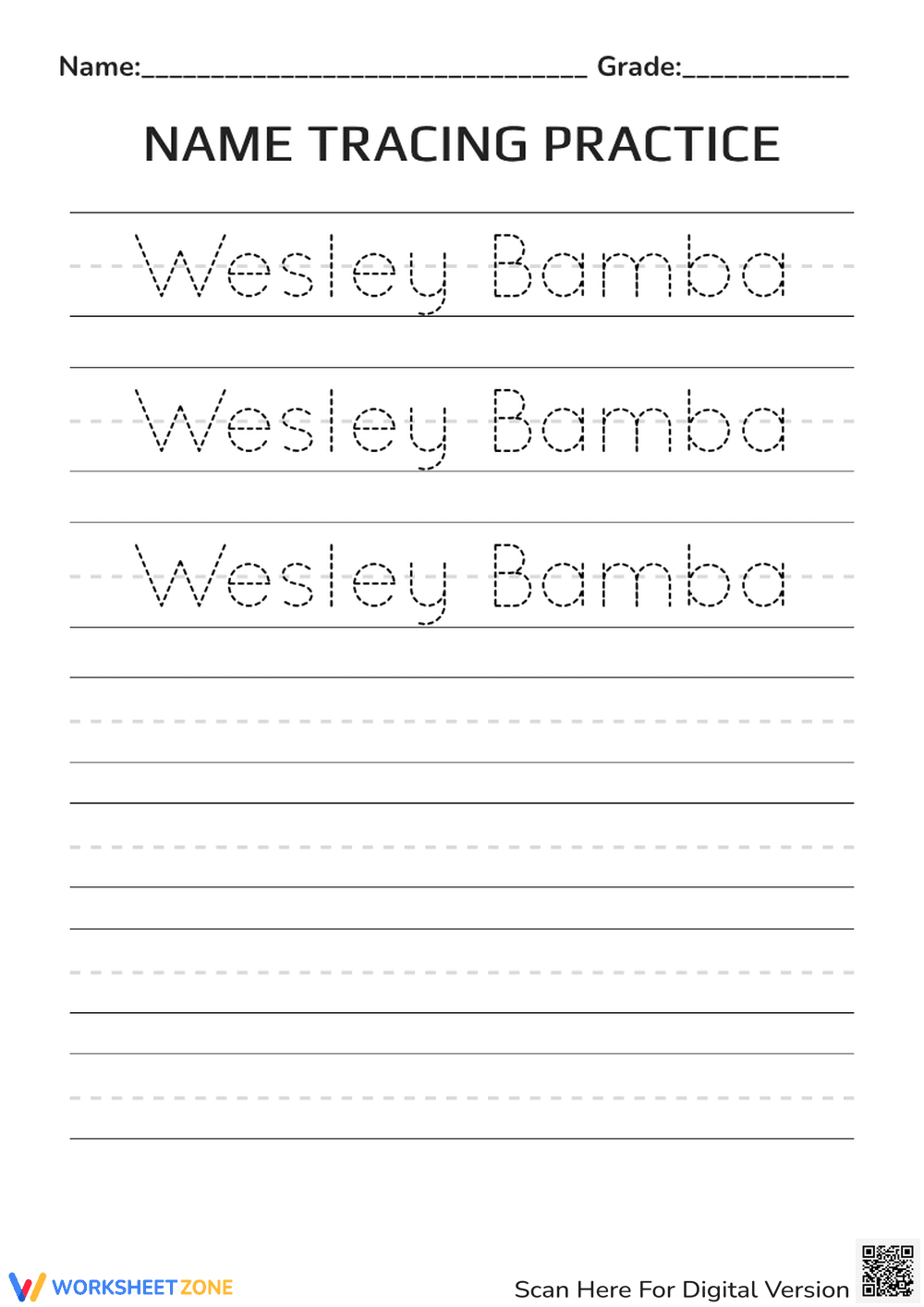
This printable handwriting worksheet helps early learners master letter formation through focused name tracing practice. Students develop fine motor control and muscle memory by tracing the name "Wesley Bamba" before transitioning to independent writing. This resource builds essential foundational literacy skills for kindergarten and first-grade students.
At a Glance
- Grade: Kindergarten · Subject: Handwriting
- Standard:
CCSS.ELA-LITERACY.L.K.1.A— Print upper- and lowercase letters- Skill Focus: Name tracing and letter formation
- Format: 2 pages · 3 guided tasks · No answer key · PDF
- Best For: Morning work or literacy centers
- Time: 10–15 minutes
This two-page resource features a structured layout designed for early writers. The first page includes three guided tracing lines with dashed letters for the specific name, followed by five blank primary-lined spaces for independent practice. The second page provides an additional blank primary line with ample white space for drawing or extending the activity. The clear, distraction-free design ensures students remain focused on their penmanship.
This resource is designed for immediate classroom implementation with a zero-prep workflow.
- Print (1 minute): Simply download the PDF and print the required number of copies. The black-and-white design saves ink.
- Distribute (1 minute): Hand out the worksheets during morning routines or center rotations. No additional materials are needed beyond a pencil.
- Review (1 minute): Quickly check student work for proper letter sizing and spacing on the primary lines.
Total teacher preparation time is under two minutes, making this an excellent option for emergency sub plans or quick skill reinforcement.
This worksheet is aligned to primary standard CCSS.ELA-LITERACY.L.K.1.A, requiring students to print many upper- and lowercase letters. By practicing specific name tracing, students apply these foundational printing skills in a highly relevant context. Both standard codes can be copied directly into lesson plans, IEP goals, or district curriculum mapping tools.
Teachers can utilize this worksheet as a daily morning work activity to establish a consistent routine as students enter the classroom. It also serves as an effective independent station during literacy block rotations. While students are working, teachers should observe their pencil grip and stroke direction, providing immediate corrective feedback if letters are formed from the bottom up rather than top to bottom. Expected completion time ranges from 10 to 15 minutes depending on the student's fine motor development.
This resource is primarily designed for kindergarten and first-grade students who are developing basic handwriting skills. It is highly beneficial for occupational therapy sessions focusing on fine motor control and spatial awareness on primary lines. For differentiation, teachers can highlight the bottom baseline to help struggling writers anchor their letters. This worksheet pairs perfectly with alphabet anchor charts or direct instruction on proper letter formation techniques.
Mastering foundational handwriting skills is a critical component of early literacy development. This worksheet targets CCSS.ELA-LITERACY.L.K.1.A, helping students print upper- and lowercase letters accurately. According to Fisher & Frey (2014), explicit instruction and repeated practice in letter formation significantly improve both writing fluency and reading recognition in early elementary students. When children do not have to expend excessive cognitive energy on the physical act of writing, they can dedicate more working memory to sentence composition and phonics application. By providing a structured progression from guided tracing to independent practice, this resource supports the automaticity required for future academic success. The clear primary lines ensure young learners build the necessary muscle memory to form letters correctly.


