




























Views
Downloads
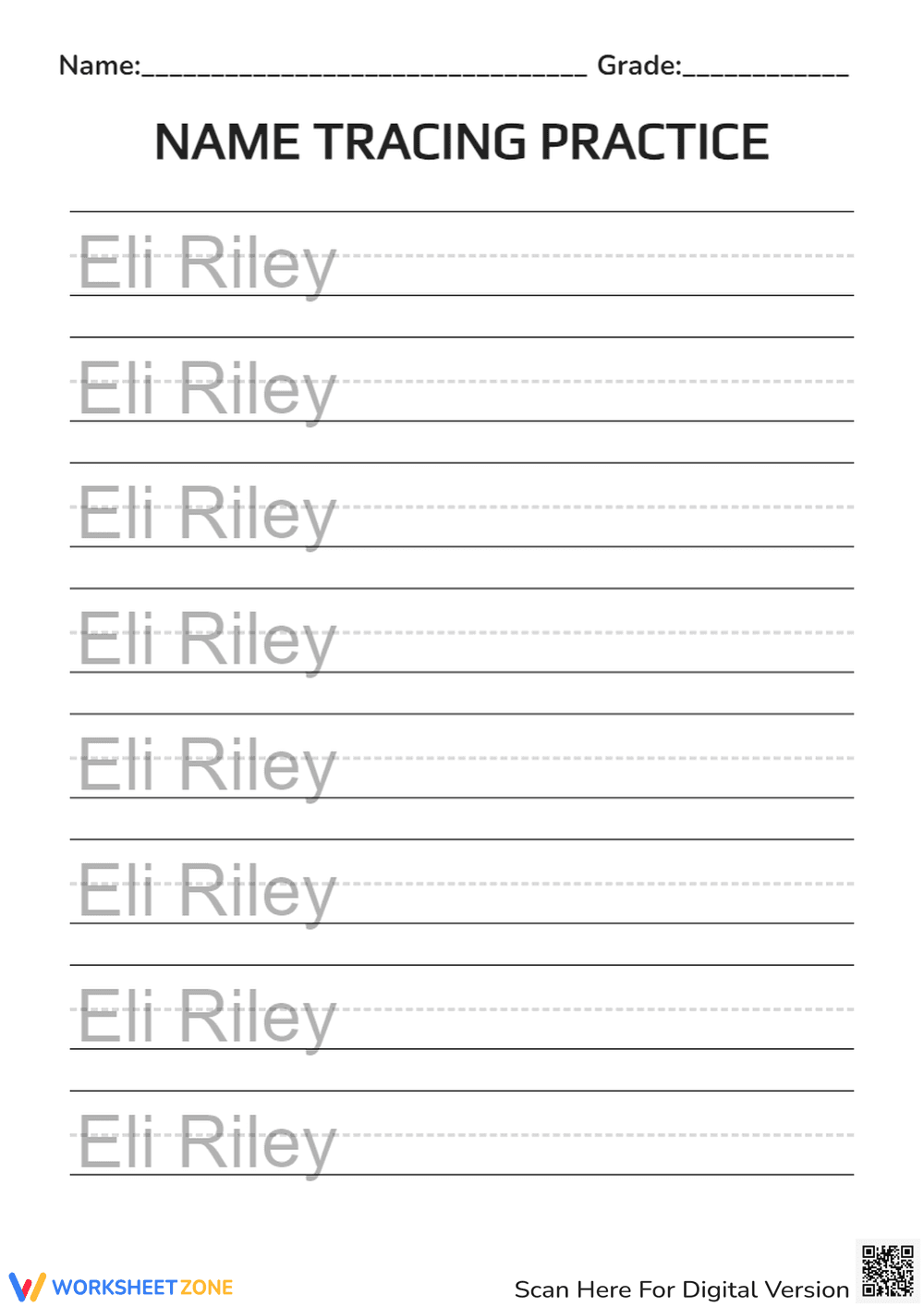

Printable Name Tracing Worksheet | Grades K-1

Paste this activity's link or code into your existing LMS (Google Classroom, Canvas, Teams, Schoology, Moodle, etc.).
Students can open and work on the activity right away, with no student login required.
You'll still be able to track student progress and results from your teacher account.
This foundational handwriting worksheet provides early learners with targeted practice in writing their names. By tracing the letters repeatedly on primary dashed lines, students develop essential fine motor control and letter formation habits. This resource ensures young writers build confidence and muscle memory for everyday classroom tasks.
At a Glance
- Grade: K-1 · Subject: Handwriting
- Standard:
CCSS.ELA-LITERACY.L.K.1.A— Print upper- and lowercase letters- Skill Focus: Name Tracing
- Format: 1 page · 7 problems · No answer key · PDF
- Best For: Morning work or centers
- Time: 5–10 minutes
This single-page printable features seven structured rows of tracing practice for the name "Eli Riley." Each row utilizes standard primary writing lines, complete with a dashed midline, to guide proper letter height and placement. The clear, legible font provides an ideal model for early writers, while the repetitive format encourages consistent practice without overwhelming the student. No answer key is required for this straightforward fine motor activity.
Zero-Prep Workflow
This resource is designed for immediate classroom implementation with a simple three-step process:
- Print (1 minute): Generate the PDF and print the required number of copies for your roster.
- Distribute (1 minute): Hand out the sheets during morning arrival or transition times.
- Review (1 minute): Briefly demonstrate how to start at the top line and follow the dashed midline.
Total teacher preparation time is under two minutes. The self-explanatory nature of the tracing task makes it highly suitable for substitute teacher plans or independent literacy centers.
Standards Alignment
This activity aligns directly with CCSS.ELA-LITERACY.L.K.1.A: Print many upper- and lowercase letters. By focusing on the specific letters within a name, students practice the foundational strokes required for broader alphabet mastery. Both standard codes can be copied directly into lesson plans, IEP goals, or district curriculum mapping tools.
How to Use It
Deploy this worksheet as a morning bell-ringer activity to establish a calm, focused routine at the start of the school day. It also functions perfectly as an independent station during literacy centers while the teacher conducts small group instruction. For formative assessment, observe students as they trace to ensure they are gripping the pencil correctly and forming letters from top to bottom, rather than bottom to top. Expected completion time ranges from five to ten minutes depending on the student's fine motor development.
Who It's For
This resource is primarily designed for Kindergarten and first-grade students who are mastering basic handwriting skills. It serves as an excellent intervention tool for older students requiring occupational therapy support or fine motor remediation. To differentiate, teachers can pair this worksheet with a tactile activity, such as tracing letters in sand or using playdough mats, before moving to pencil and paper.
Research underscores the critical importance of explicit handwriting instruction in early childhood education. According to a recent EdReports 2024 analysis, foundational skills practice, including targeted letter formation, significantly impacts later reading and writing fluency. When students practice printing upper- and lowercase letters, as outlined in CCSS.ELA-LITERACY.L.K.1.A, they reduce the cognitive load required for basic transcription. This automaticity allows young learners to dedicate more mental resources to idea generation and complex composition as they progress through elementary school. Structured tracing activities provide the necessary scaffolding to build this muscle memory efficiently. By integrating consistent, brief handwriting exercises into daily routines, educators can effectively support both fine motor development and broader literacy goals, ensuring students have the mechanical skills necessary to express their thoughts clearly on paper.


