


























Views
Plays


Sentence Structure Worksheet | Grade 5 Essential Practice
Paste this activity's link or code into your existing LMS (Google Classroom, Canvas, Teams, Schoology, Moodle, etc.).
Students can open and work on the activity right away, with no student login required.
You'll still be able to track student progress and results from your teacher account.
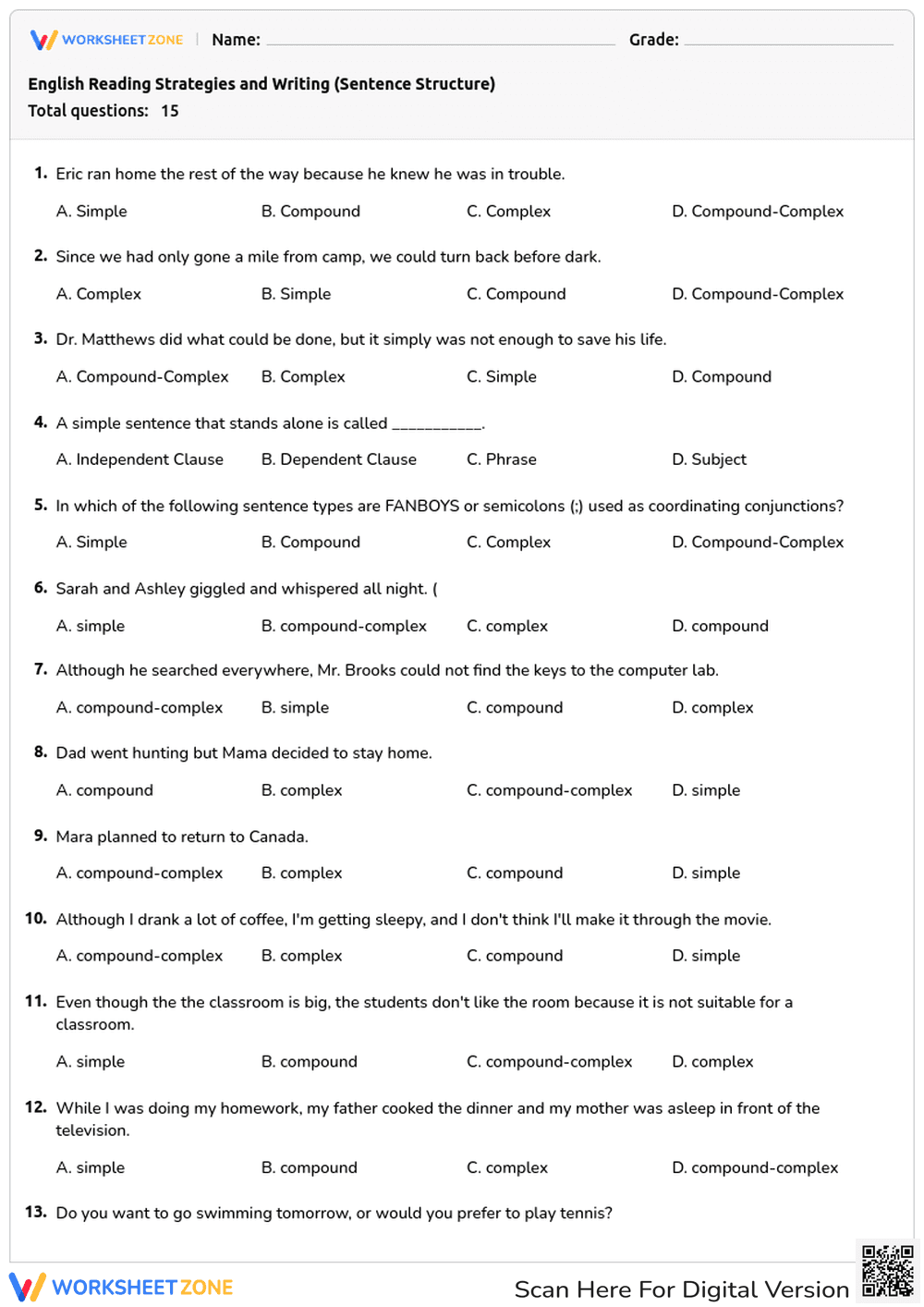
This Grade 5 sentence structure worksheet provides students with 15 targeted multiple-choice questions to master the identification of simple, compound, complex, and compound-complex sentences. By analyzing sentence architecture and conjunction usage, learners develop the grammatical precision necessary for sophisticated writing and reading comprehension.
At a Glance
- Grade: 5 · Subject: ELA
- Standard:
CCSS.ELA-LITERACY.L.3.1.I— Produce simple, compound, and complex sentences to express ideas clearly- Skill Focus: Sentence Type Identification
- Format: 2 pages · 15 problems · Answer key included · PDF
- Best For: Grammar Review and Formative Assessment
- Time: 15–20 minutes
This comprehensive 2-page PDF features 15 multiple-choice items designed to test a student's ability to categorize sentences based on their clauses. The worksheet includes specific questions on grammatical terminology, such as independent clauses and the use of FANBOYS (coordinating conjunctions). A clear layout ensures students can focus on the linguistic patterns without visual distraction.
Skill Progression
- Guided practice: The initial items focus on basic sentence identification, allowing students to apply definitions of simple and compound structures.
- Supported practice: Middle questions introduce subordinating conjunctions and complex structures, requiring students to distinguish between dependent and independent clauses.
- Independent practice: The final set of problems challenges students with compound-complex sentences, testing their ability to recognize multiple clause types within a single sentence.
This gradual-release approach moves from foundational recognition to high-level analysis using the I Do, We Do, You Do model.
Standards Alignment
The primary focus is `CCSS.ELA-LITERACY.L.3.1.I`, which requires students to produce and identify simple, compound, and complex sentences. Additionally, it supports L.4.1.F by helping students recognize how proper sentence structure prevents fragments and run-ons. Both standard codes can be copied directly into lesson plans, IEP goals, or district curriculum mapping tools.
How to Use It
Use this worksheet as a mid-unit formative assessment to gauge student understanding of conjunctions and clause relationships. It also serves as an excellent bell-ringer activity to reinforce grammar mechanics before a writing workshop. Teachers should observe if students struggle specifically with the "complex" vs "compound-complex" distinction to provide targeted small-group intervention. Completion typically takes 15 to 20 minutes.
Who It's For
This resource is ideal for Grade 3, 4, and 5 students who are transitioning from basic sentence construction to more varied writing styles. It is particularly helpful for English Language Learners (ELLs) who need explicit practice with English syntax. Pair this worksheet with a coordinating conjunctions anchor chart or a direct instruction lesson on sentence variety.
According to the RAND AIRS 2024 report on instructional materials, explicit grammar instruction that focuses on sentence-level mechanics significantly improves overall writing quality in upper elementary students. This worksheet addresses the core requirements of CCSS.ELA-LITERACY.L.3.1.I by requiring students to differentiate between simple, compound, and complex sentences through 15 rigorous multiple-choice tasks. Research from Fisher & Frey (2014) emphasizes that identifying sentence types is a prerequisite for mastering complex text structures and improving reading fluency. By isolating the skill of clause identification, this resource provides the necessary scaffolding for students to move toward independent mastery of sophisticated syntax. The inclusion of terminology like "independent clause" and "FANBOYS" ensures that students acquire the academic vocabulary needed for standardized testing and middle-school readiness. This structured approach to grammar allows for data-driven instruction and targeted intervention in the ELA classroom.


