


























Views
Plays
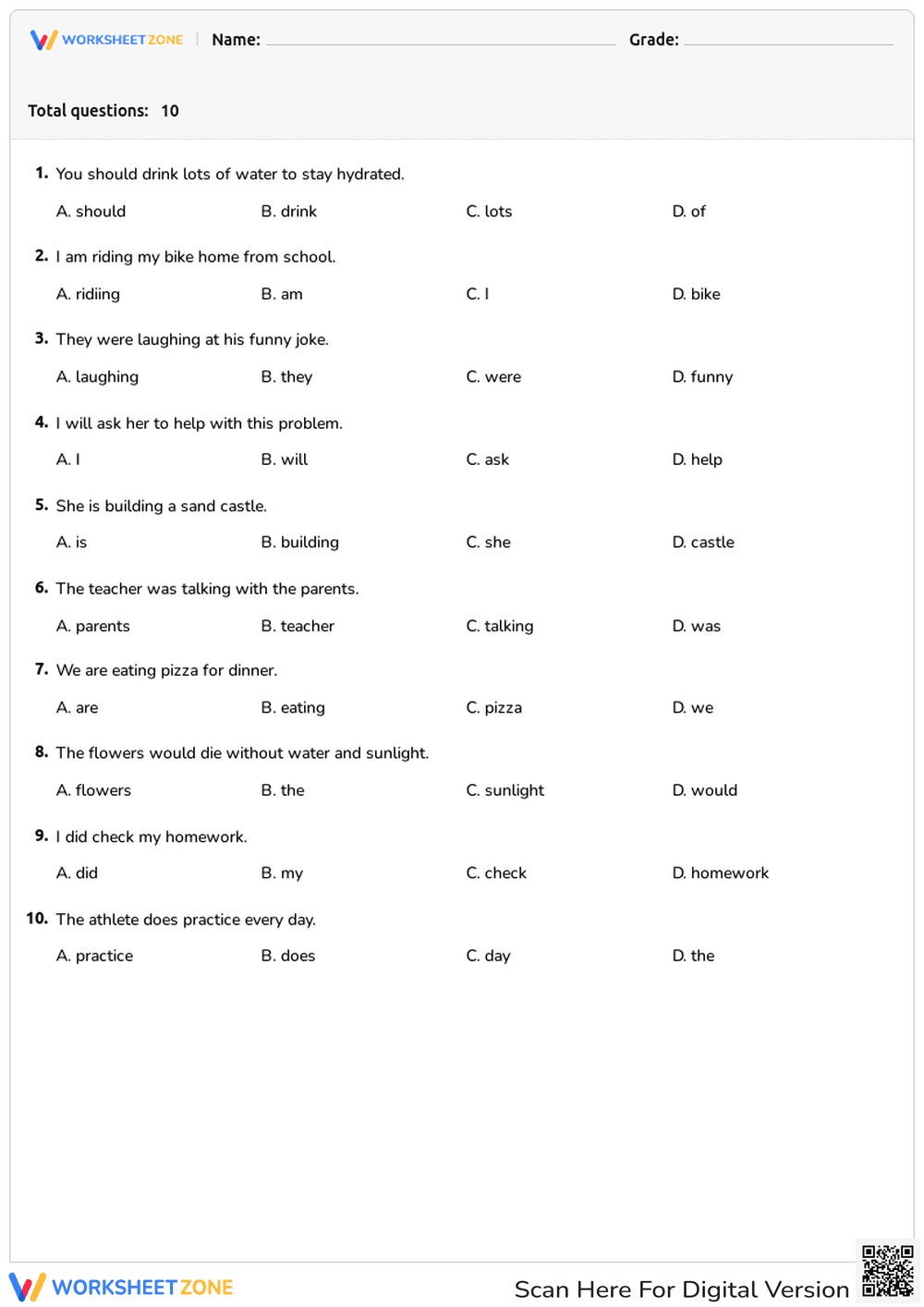

Helping Verbs Worksheet | Grade 6-7 Essential
Paste this activity's link or code into your existing LMS (Google Classroom, Canvas, Teams, Schoology, Moodle, etc.).
Students can open and work on the activity right away, with no student login required.
You'll still be able to track student progress and results from your teacher account.
This Grade 6 and 7 grammar worksheet provides targeted practice for identifying helping verbs within complex sentences. By isolating auxiliary verbs from main verbs, students strengthen their understanding of verb phrases and sentence structure. This resource ensures learners can distinguish between action and support in standard English usage.
At a Glance
- Grade: 6-7 · Subject: ELA Grammar
- Standard:
CCSS.ELA-LITERACY.L.6.1— Demonstrate command of standard English grammar and usage when writing- Skill Focus: Helping Verb Identification
- Format: 1 page · 10 problems · Answer key included · PDF
- Best For: Grammar review and formative assessment
- Time: 10–15 minutes
Inside this single-page PDF, you will find 10 carefully crafted multiple-choice questions. Each item presents a complete sentence and asks the student to select the correct helping verb from four options. The layout is clean and distraction-free, featuring a clear header for student names and grades, making it ideal for quick classroom distribution.
Skill Progression
- Guided practice: The first three items use common auxiliary verbs like "should" and "am" in simple contexts to build initial confidence.
- Supported practice: Items 4 through 7 introduce varied sentence lengths, requiring students to differentiate between the subject, the helping verb, and the main action.
- Independent practice: The final three problems challenge students to identify "did," "does," and "would" in more nuanced sentence constructions.
This structure supports a gradual-release model, moving from high-frequency verbs to more complex auxiliary usage.
Standards Alignment
This resource is aligned with `CCSS.ELA-LITERACY.L.6.1`, which requires students to demonstrate command of the conventions of standard English grammar and usage. It specifically targets the identification of verb phrases. Both standard codes can be copied directly into lesson plans, IEP goals, or district curriculum mapping tools.
How to Use It
Use this worksheet as a "bell-ringer" activity at the start of a grammar unit or as a quick exit ticket to gauge understanding after a lesson on verb types. For a formative assessment, observe if students confuse the main verb with the helping verb. Completion typically takes 10 to 15 minutes.
Who It's For
This practice is designed for middle school students in grades 6 and 7, including English Language Learners who need focused work on sentence mechanics. It pairs naturally with an anchor chart on common auxiliary verbs or a direct instruction lesson on the "Helping Verb Song."
According to the RAND AIRS 2024 report on instructional materials, targeted grammar practice that isolates specific parts of speech is highly effective for long-term retention in middle school learners. This worksheet addresses the core requirements of CCSS.ELA-LITERACY.L.6.1 by providing 10 distinct opportunities for students to identify helping verbs in context. By focusing on auxiliary verbs—such as "should," "were," and "does"—students develop the linguistic precision necessary for advanced writing and speaking tasks. Research from Fisher & Frey (2014) emphasizes that scaffolded identification tasks serve as a bridge to independent application in student compositions. This resource provides the necessary repetition to move students toward mastery of standard English conventions. Educators can utilize this tool to provide immediate feedback, ensuring that foundational grammar gaps are addressed before moving into complex tense shifts or mood variations in later grades.


