


























Views
Downloads
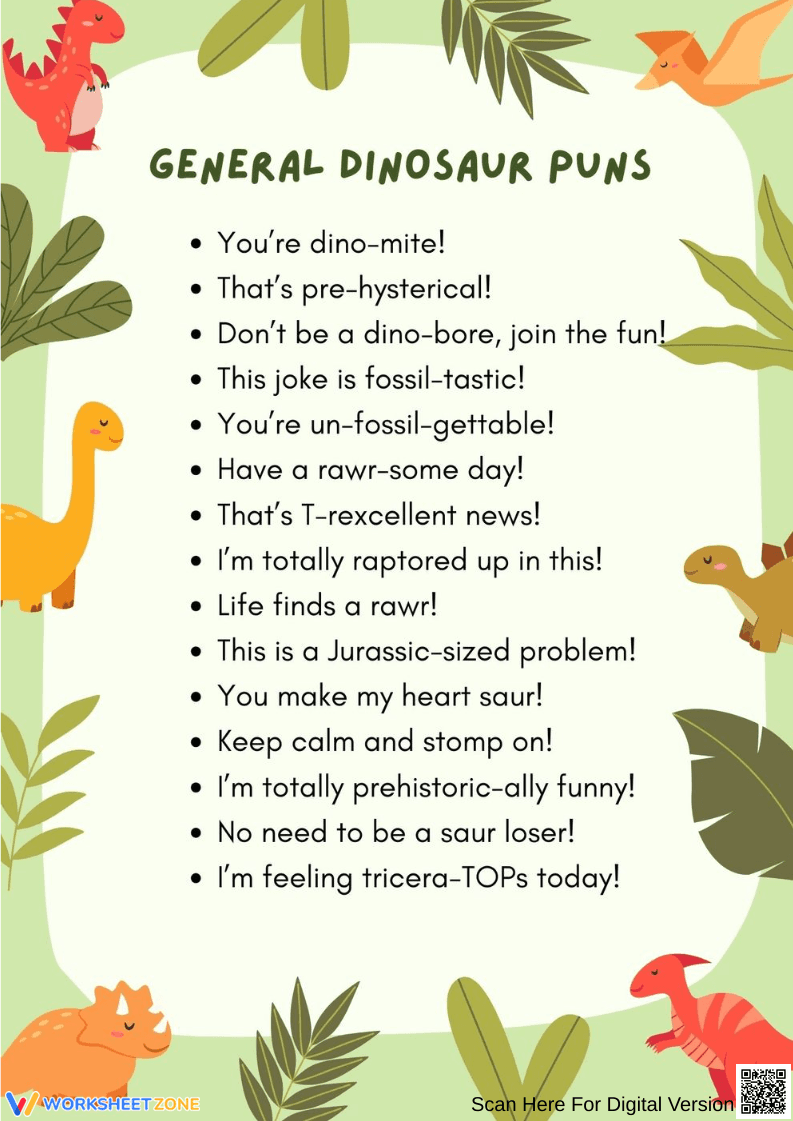

Grade 1 Dinosaur Puns — Printable No-Prep Worksheet
Paste this activity's link or code into your existing LMS (Google Classroom, Canvas, Teams, Schoology, Moodle, etc.).
Students can open and work on the activity right away, with no student login required.
You'll still be able to track student progress and results from your teacher account.
This Grade 1 ELA resource introduces young learners to wordplay through fifteen humorous dinosaur puns. Students build vocabulary and phonological awareness by identifying double meanings in context. This printable sheet supports early reading comprehension and language development by making figurative language accessible and engaging for beginning readers.
At a Glance
- Grade: Grade 1 · Subject: ELA
- Standard:
CCSS.ELA-LITERACY.L.1.5— Sort words into categories and define key word relationships and nuances- Skill Focus: Figurative language, puns, and wordplay
- Format: 1 page · 15 dinosaur puns · Reference sheet · PDF
- Best For: Whole-class ELA warm-ups and early finisher activities
- Time: 10–15 minutes
This single-page PDF features fifteen carefully selected dinosaur puns designed for early elementary students. The layout includes clear bullet points and colorful dinosaur illustrations that maintain student interest. Each pun highlights a specific phonetic spelling or double meaning, such as combining "dinosaur" and "dynamite" to create "dino-mite," providing a concrete model of wordplay.
Zero-Prep Classroom Workflow
Incorporate this resource into your daily routine with minimal effort:
- Print (1 minute): Print copies for your class or project the sheet onto your whiteboard.
- Distribute (1 minute): Hand out the sheets during transitions or place them in your writing center.
- Review (10 minutes): Read the puns aloud, prompting students to identify the combined words.
With under two minutes of prep, this resource serves as an excellent transition activity.
Standards Alignment
This activity aligns directly with the Common Core State Standard `CCSS.ELA-LITERACY.L.1.5`, which requires students to demonstrate understanding of word relationships and nuances in word meanings with guidance and support. Additionally, it supports `CCSS.ELA-LITERACY.L.1.6` by encouraging students to use words and phrases acquired through reading and responding to texts. Both standard codes can be copied directly into lesson plans, IEP goals, or district curriculum mapping tools.
How to Use It
Use this reference sheet during your morning meeting as a warm-up activity before direct instruction in phonics. Read one pun daily and ask students to explain the humor. Alternatively, use it after a lesson on compound words or syllables to show how writers manipulate sounds. For formative assessment, observe whether students can identify the root words within the puns during group discussion. The activity typically takes 10 to 15 minutes to complete.
Who It's For
This resource is designed for Grade 1 students learning basic word structures and figurative language. It also benefits English language learners who are developing vocabulary and understanding idioms. Pair this sheet with a read-aloud book about dinosaurs or a simple matching worksheet where students connect the pun to its literal meaning.
This educational resource supports the development of early figurative language skills aligned with `CCSS.ELA-LITERACY.L.1.5`. By presenting fifteen dinosaur-themed puns, the worksheet helps first-grade students recognize word relationships and phonetic nuances in a structured format. Research by Fisher & Frey (2014) emphasizes that exposure to wordplay and intentional vocabulary instruction builds metalinguistic awareness, which is critical for reading comprehension. Using humor in the classroom lowers the affective filter, allowing young readers to engage more deeply with complex language structures. Teachers can utilize this print-ready tool to introduce double meanings and homophones, providing a foundation for advanced decoding and comprehension skills. The clear layout and contextual clues assist diverse learners in identifying how words can be manipulated to create humor, reinforcing vocabulary acquisition in an accessible manner. This resource serves as a valuable addition to any early literacy curriculum.


