


























Views
Downloads
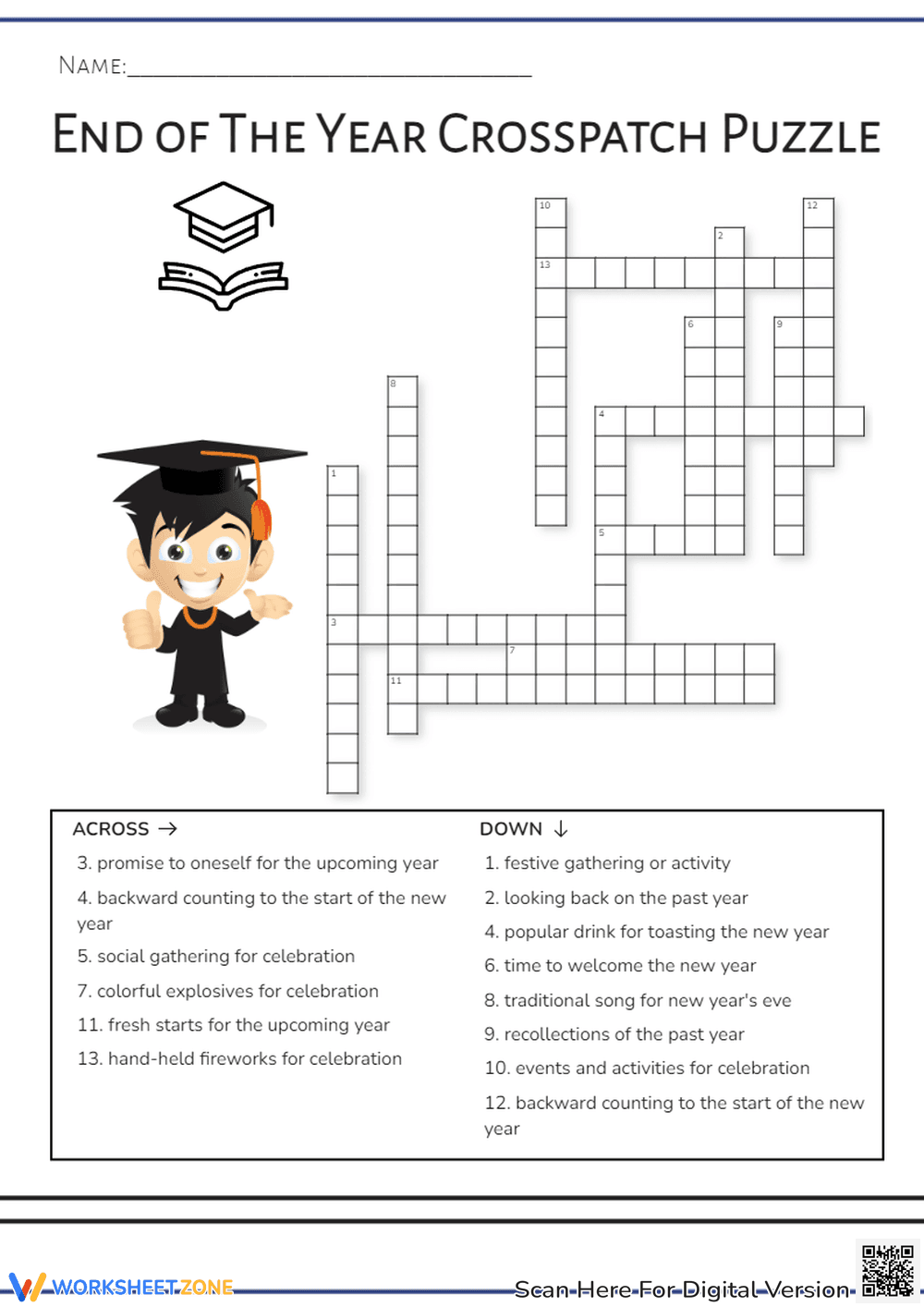

End of The Year Crosspatch Puzzle | Grade 4 Essential
Paste this activity's link or code into your existing LMS (Google Classroom, Canvas, Teams, Schoology, Moodle, etc.).
Students can open and work on the activity right away, with no student login required.
You'll still be able to track student progress and results from your teacher account.
This Grade 4 vocabulary worksheet provides a structured way for students to review seasonal terminology through a 13-clue crosspatch puzzle. By matching descriptive definitions to specific year-end concepts, learners strengthen their semantic networks and word retrieval skills. It is an ideal resource for maintaining academic focus during the final week of school.
At a Glance
- Grade: 4 · Subject: ELA
- Standard:
CCSS.ELA-LITERACY.L.4.6— Acquire and use accurately grade-appropriate general academic and domain-specific words- Skill Focus: Vocabulary Acquisition
- Format: 1 page · 13 problems · Answer key included · PDF
- Best For: End-of-year review or early finishers
- Time: 15–20 minutes
The worksheet features a single-page layout containing a 13-word crosspatch grid and a comprehensive list of clues divided into "Across" and "Down" categories. Students encounter definitions for terms like "resolution," "countdown," and "celebration." The visual layout includes festive graphics to maintain engagement, and the PDF format ensures high-quality printing for whole-class distribution. A complete answer key is provided for rapid grading.
The zero-prep workflow for this resource is designed for maximum efficiency during busy seasonal transitions. First, print the single-page PDF (30 seconds). Second, distribute the sheets to students as they enter the classroom or finish a primary assessment (1 minute). Third, review the completed grids using the provided answer key or by projecting the puzzle for a collective class check (5 minutes). Total teacher preparation time is under 2 minutes, making it an excellent choice for sub plans.
This resource is primarily aligned with `CCSS.ELA-LITERACY.L.4.6`, which requires students to acquire and use accurately grade-appropriate general academic and domain-specific words and phrases. By engaging with definitions that require inferential thinking, students demonstrate mastery of vocabulary in context. Both standard codes can be copied directly into lesson plans, IEP goals, or district curriculum mapping tools.
Use this worksheet as a formative assessment during the final week of the semester to gauge student grasp of seasonal and academic vocabulary. It serves as an excellent "early finisher" activity for students who complete their final exams ahead of schedule. Expected completion time ranges from 15 to 20 minutes, depending on the student's familiarity with the specific year-end traditions described in the clues.
This puzzle is designed for students in Grades 3, 4, and 5 who are transitioning between grade levels. It is particularly effective for English Language Learners (ELLs) who benefit from the concrete definitions and the structural support of the crosspatch grid. Pair this resource with a seasonal writing prompt or a year-in-review anchor chart to create a comprehensive literacy block.
Research from Fisher & Frey (2014) emphasizes that word-solving tasks, such as crosswords and crosspatch puzzles, are effective tools for reinforcing vocabulary because they require students to engage in active retrieval and orthographic processing. This worksheet targets CCSS.ELA-LITERACY.L.4.6 by challenging students to map 13 specific definitions to their corresponding terms within a constrained spatial grid. Such activities support the development of "word consciousness," where students become more aware of how words are constructed and used within specific thematic contexts. According to the NAEP framework, frequent exposure to domain-specific vocabulary in varied formats—including puzzles—correlates with higher reading comprehension scores in upper elementary grades. By providing a low-stakes, high-engagement format, this resource ensures that students remain academically active during seasonal transitions while reinforcing the linguistic foundations necessary for the upcoming academic year.


