


























Views
Downloads

Printable End of School Year Tracing | Grade K-1
Paste this activity's link or code into your existing LMS (Google Classroom, Canvas, Teams, Schoology, Moodle, etc.).
Students can open and work on the activity right away, with no student login required.
You'll still be able to track student progress and results from your teacher account.
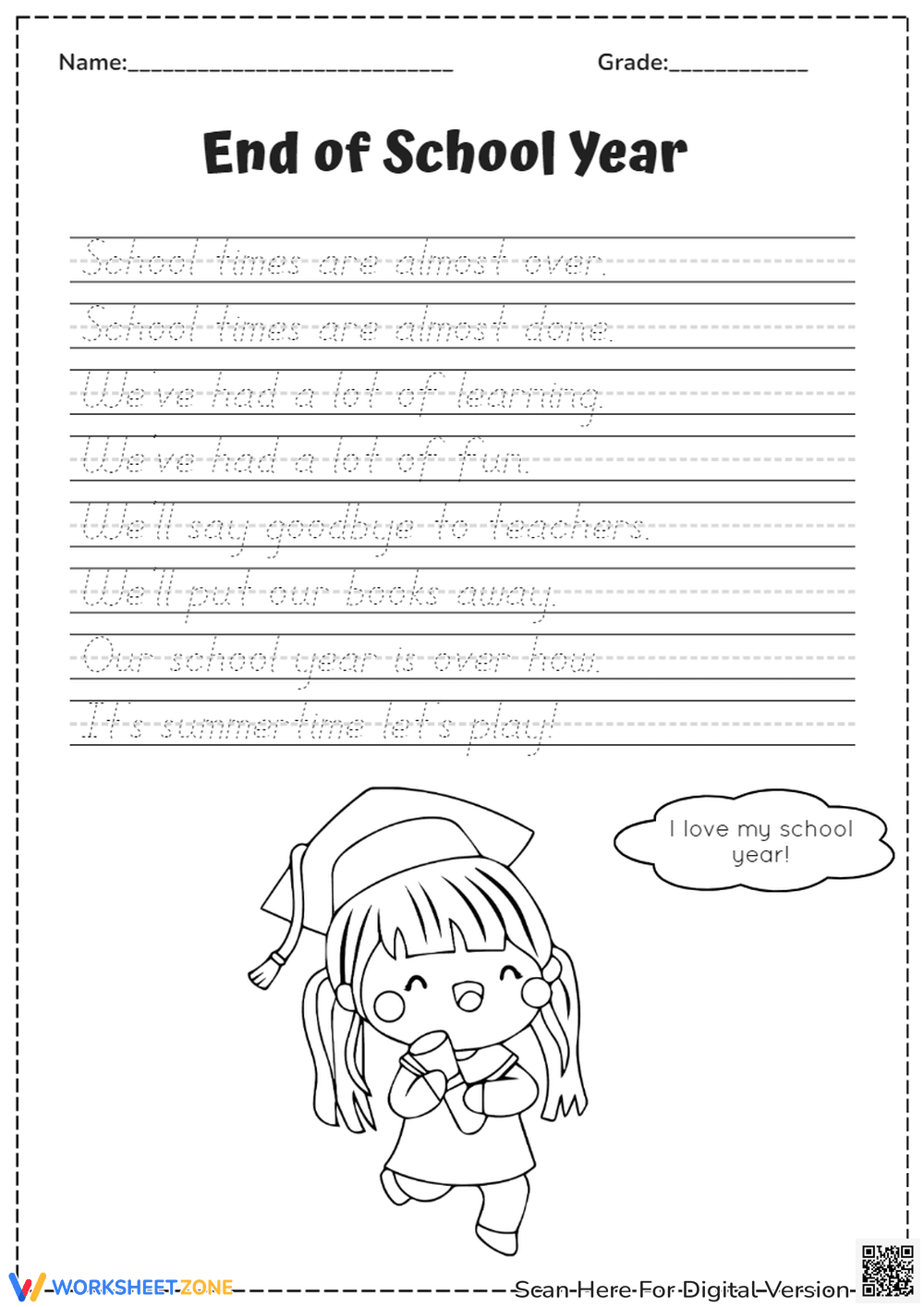
This printable handwriting worksheet helps early childhood students master fine motor control and letter formation through seasonal sentence tracing. Students trace eight thematic sentences celebrating the end of the school year and color a graduation illustration. This activity reinforces print conventions while providing a reflective, engaging wrap-up task.
At a Glance
- Grade: Kindergarten · Subject: English Language Arts
- Standard:
CCSS.ELA-LITERACY.L.K.1.A— Print lowercase and uppercase letters during writing activities- Skill Focus: Handwriting, letter formation, and sentence tracing
- Format: 1 page · 8 sentences · Coloring activity · PDF
- Best For: End-of-year morning work or independent handwriting practice
- Time: 15–20 minutes
This single-page resource features eight dotted-line sentences designed for tracing, followed by a cute graduation-themed coloring graphic. The structured layout provides wide primary lines with dotted midlines to guide letter height and spacing. The vocabulary focuses on simple, high-frequency words that describe common school experiences, ensuring students can read what they trace.
Zero-Prep Workflow
This resource requires under two minutes of total teacher preparation. Follow these three simple steps to integrate it into your classroom routine:
- Print (1 minute): Select the single-page PDF and print the exact number of copies needed for your class. No collating or stapling required.
- Distribute (30 seconds): Hand out the sheets along with pencils and crayons. The intuitive layout allows students to begin immediately without complex directions.
- Review (30 seconds): Walk the room to check pencil grip and letter alignment. This self-explanatory structure makes it an ideal option for emergency sub plans.
Standards Alignment
This activity aligns directly with the Common Core State Standard `CCSS.ELA-LITERACY.L.K.1.A`, which requires students to print many lowercase and uppercase letters. Additionally, it supports `CCSS.ELA-LITERACY.RF.K.1.A` by reinforcing the concept that print is read from left to right and top to bottom. Both standard codes can be copied directly into lesson plans, IEP goals, or district curriculum mapping tools.
How to Use It
Use this worksheet as a quiet morning work activity during the final week of school to keep students focused during transition times. Alternatively, assign it as a center activity during your writing block. As students work, observe their pencil grip and stroke direction, noting who still struggles with top-to-bottom letter formation. The activity typically takes 15 to 20 minutes to complete.
Who It's For
This worksheet is designed for kindergarteners and early first-grade students developing fine motor control. For students needing extra support, highlight the starting points of each letter with a yellow marker. Pair this worksheet with a read-aloud of a classic end-of-year picture book to build thematic context before students begin writing.
This instructional resource targets the foundational literacy standard `CCSS.ELA-LITERACY.L.K.1.A` by focusing on the plain-English skill of printing lowercase and uppercase letters legibly. According to research by Fisher & Frey (2014) on gradual release of responsibility, structured tracing exercises provide the necessary scaffolding for early writers to transition from guided imitation to independent letter production. By combining motor skill practice with contextualized sentences, this worksheet reinforces print awareness and spatial orientation on the page. The inclusion of a coloring task serves as a motivating reward that further develops the hand muscles required for sustained writing endurance. Educators can confidently integrate this tool into their early childhood curriculum, knowing that repetitive tracing of complete sentences builds the muscle memory essential for fluent handwriting development in subsequent primary grades.


