


























Views
Downloads

Grade 3 Election Day Vocabulary — Printable Worksheet
Paste this activity's link or code into your existing LMS (Google Classroom, Canvas, Teams, Schoology, Moodle, etc.).
Students can open and work on the activity right away, with no student login required.
You'll still be able to track student progress and results from your teacher account.
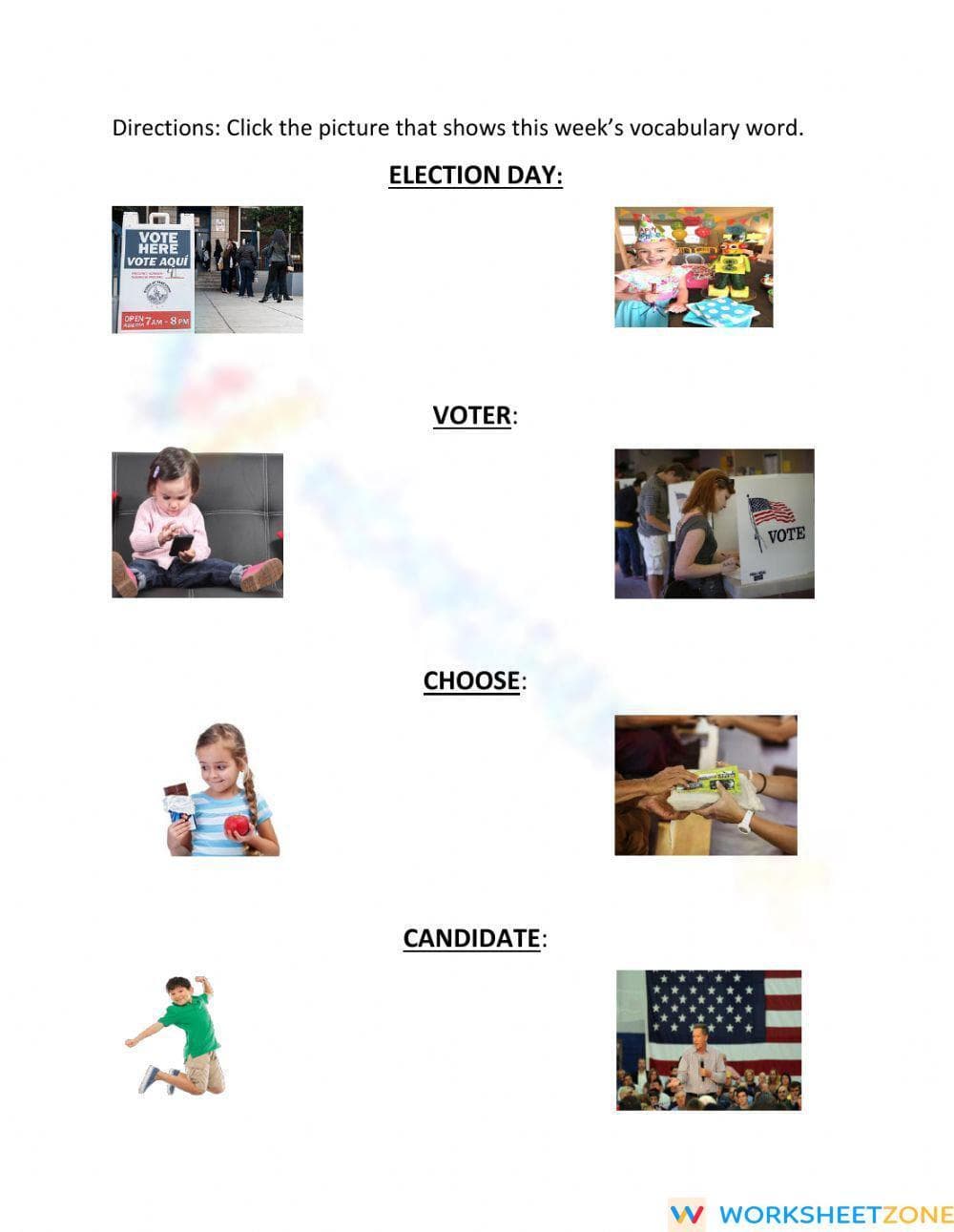
This worksheet helps students identify and master essential Election Day vocabulary through visual matching tasks. By distinguishing between examples and non-examples of key civic terms, learners build domain-specific language skills. It is an ideal resource for early elementary students or special education classrooms focusing on functional literacy and social studies concepts.
At a Glance
- Grade: 3 · Subject: ELA / Civics
- Standard:
CCSS.ELA-LITERACY.L.3.6— Acquire and use domain-specific words and phrases accurately- Skill Focus: Election Vocabulary Identification
- Format: 1 page · 4 problems · Answer key included · PDF
- Best For: Special education or early elementary civics
- Time: 10–15 minutes
What's Inside
The worksheet features a clean, high-contrast layout containing four vocabulary words: Election Day, Voter, Choose, and Candidate. Students must identify the photograph illustrating each term from a choice of two realistic images. This one-page PDF includes clear directions and a full answer key for rapid grading or self-correction.
Zero-Prep Workflow
This resource is designed for a frictionless classroom experience. The workflow is simple: Print the single-page document (30 seconds), distribute to students as a bell-ringer or independent center task (30 seconds), and review the answers using the provided key (1 minute). The total teacher preparation time is under two minutes, making it an excellent candidate for emergency sub plans or quick formative assessments during a civics unit.
Standards Alignment
The primary focus is CCSS.ELA-LITERACY.L.3.6, which requires students to acquire and use accurately grade-appropriate conversational, general academic, and domain-specific words and phrases. By connecting visual representations to specific terms like "candidate" and "voter," students demonstrate conceptual understanding. This standard code can be copied directly into lesson plans, IEP goals, or district curriculum mapping tools to ensure compliance with state and national ELA frameworks.
How to Use It
Use this worksheet as an introductory "hook" before a direct instruction lesson on how elections work. It serves as a baseline to see which students can already identify key roles and events. Alternatively, assign it as a post-instruction exit ticket to verify that learners have internalized the definitions. During completion, observe if students hesitate on abstract terms like "choose" to identify needed scaffolds. Expected completion time is 10 to 15 minutes.
Who It's For
This is optimized for Grade 2-5 students and special education (n2y) populations who benefit from clear visual supports. It is also highly suitable for English Language Learners (ELL) who are building foundational social studies vocabulary. It pairs naturally with an Election Day anchor chart or a short informational passage about the voting process to provide a comprehensive, multi-modal learning experience.
Research by Fisher & Frey (2014) highlights that visual supports and example/non-example comparisons are critical for students with diverse learning needs to acquire domain-specific vocabulary. This worksheet implements these evidence-based strategies by asking students to distinguish between correct and incorrect representations of "voter," "candidate," and "election day." By focusing on four high-frequency civic terms, the activity ensures that cognitive load remains manageable while still meeting the rigorous demands of CCSS.ELA-LITERACY.L.3.6. The inclusion of real-world photography instead of stylized clip art further aids in generalizing these concepts to authentic civic contexts. Educators can rely on this structured approach to provide the guided practice necessary for transition into independent reading of social studies texts. This method aligns with the RAND AIRS 2024 recommendations for high-leverage practices in inclusive literacy instruction, providing a measurable way to track vocabulary mastery for IEP progress monitoring.


