


























Views
Plays



Sentence Types & Punctuation Worksheet | Grade 5 Printable
Paste this activity's link or code into your existing LMS (Google Classroom, Canvas, Teams, Schoology, Moodle, etc.).
Students can open and work on the activity right away, with no student login required.
You'll still be able to track student progress and results from your teacher account.
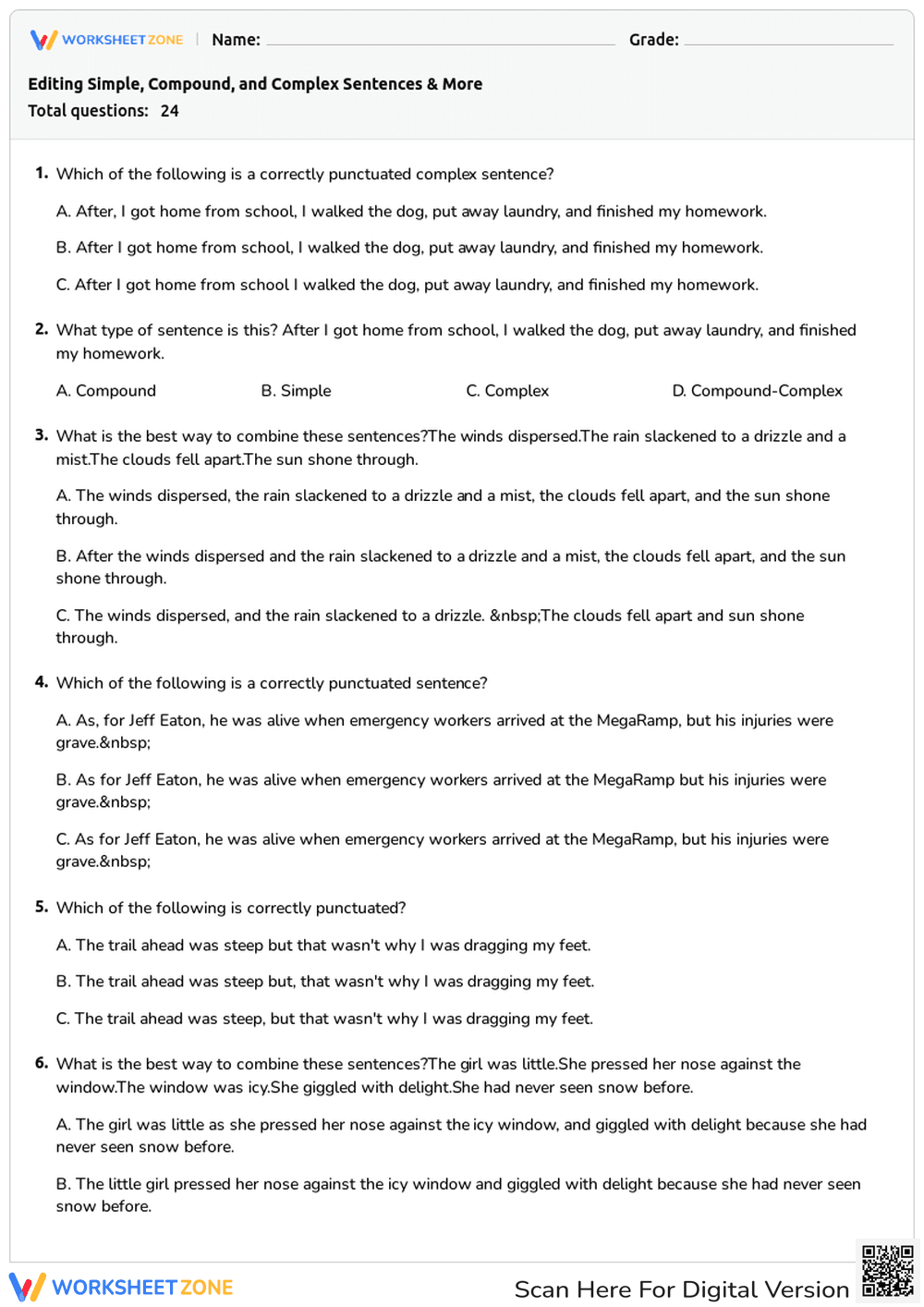
This comprehensive grammar worksheet helps students master the mechanics of simple, compound, and complex sentences. By working through targeted multiple-choice questions, learners will practice combining sentences, identifying correct punctuation, and understanding the function of conjunctions to improve their overall writing clarity and structural variety.
At a Glance
- Grade: 5 · Subject: ELA
- Standard:
CCSS.ELA-LITERACY.L.5.3.A— Expand, combine, and reduce sentences for meaning- Skill Focus: Sentence types and punctuation
- Format: 4 pages · 24 problems · Answer key included · PDF
- Best For: Independent practice or assessment
- Time: 25–35 minutes
Inside this resource, educators will find a robust 24-question practice set spanning four pages. The tasks include multiple-choice questions and true-or-false statements that challenge students to identify correctly punctuated sentences, choose the best way to combine clauses, and define grammatical terms like appositives and conjunctions. A complete answer key is included to streamline the grading process and provide immediate feedback.
The problem set is designed to build student confidence through a logical progression of grammar skills:
- Guided practice: The initial questions focus on identifying correctly punctuated complex and compound sentences, allowing students to recognize proper structures.
- Supported practice: Mid-level tasks require students to evaluate true-or-false statements about grammar rules, reinforcing their understanding of dependent clauses, independent clauses, and conjunctions (FANBOYS and AAAWWUBBIS).
- Independent practice: The final section challenges learners to apply their knowledge by combining sentences and correctly placing commas and semicolons in complex scenarios.
This gradual-release approach ensures students internalize the rules before applying them independently.
This material is directly aligned with CCSS.ELA-LITERACY.L.5.3.A, requiring students to expand, combine, and reduce sentences for meaning, reader/listener interest, and style. It also supports foundational punctuation skills by reinforcing the correct use of commas and semicolons in complex sentence structures. Both standard codes can be copied directly into lesson plans, IEP goals, or district curriculum mapping tools.
Teachers can deploy this worksheet as a summative assessment after a unit on sentence structures or as a comprehensive review activity before standardized testing. During independent work time, educators can use the true-or-false section as a formative assessment, observing which specific grammar rules (such as comma placement with appositives) require reteaching. Students should be able to complete the entire packet within 25 to 35 minutes.
This resource is ideal for fifth-grade students, though it serves as an excellent review for sixth graders or a challenge for advanced fourth graders. For students requiring accommodations, teachers can assign specific pages rather than the entire packet to reduce cognitive load. It pairs perfectly with anchor charts detailing coordinating and subordinating conjunctions or a direct instruction lesson on sentence combining.
Mastering sentence variety is a critical component of developing mature, effective writing skills in upper elementary students. By aligning instruction to CCSS.ELA-LITERACY.L.5.3.A, educators ensure students can expand, combine, and reduce sentences for meaning. According to a recent EdReports 2024 analysis, students who engage in explicit grammar practice, particularly focusing on the mechanics of compound and complex sentences, demonstrate significant improvements in their reading comprehension and written expression. Structured exercises that require learners to manipulate clauses and apply precise punctuation rules help bridge the gap between isolated grammar knowledge and authentic writing application. Providing targeted, multiple-choice practice allows teachers to quickly identify misconceptions regarding conjunctions and comma usage, enabling timely interventions that support long-term literacy development and academic success across all subject areas.


