


























Views
Downloads
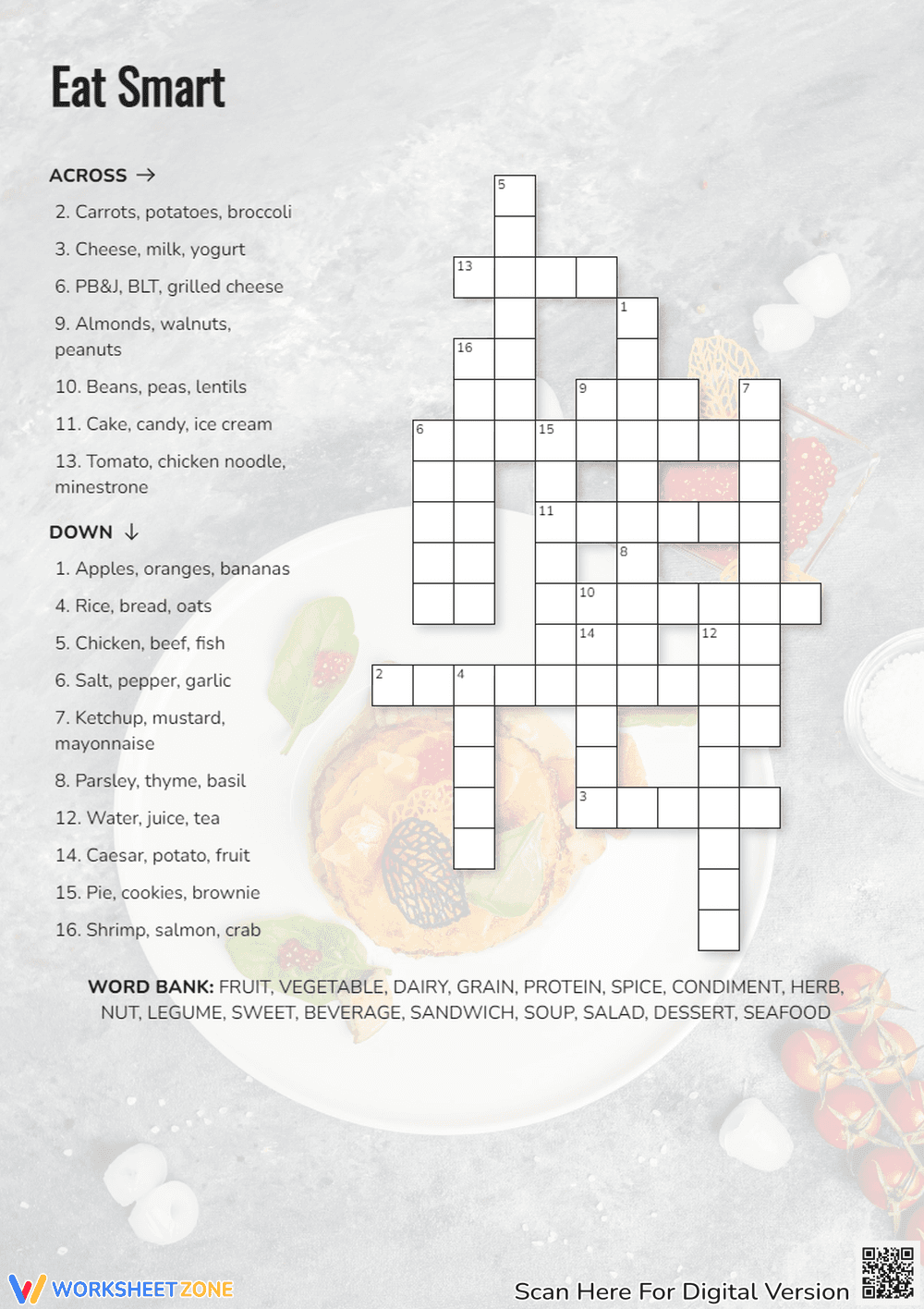

Printable Food Categories Crossword | Grade 2
Paste this activity's link or code into your existing LMS (Google Classroom, Canvas, Teams, Schoology, Moodle, etc.).
Students can open and work on the activity right away, with no student login required.
You'll still be able to track student progress and results from your teacher account.
This Grade 2 vocabulary worksheet helps students master food categorization by matching specific food items to their broader group names. Using a crossword puzzle format, learners read lists of related foods and identify the correct category from a provided word bank, strengthening both reading comprehension and nutritional awareness.
At a Glance
- Grade: 2 · Subject: ELA
- Standard:
CCSS.ELA-LITERACY.L.2.5.A— Sort words into categories to understand concepts- Skill Focus: Vocabulary Categorization
- Format: 1 page · 17 problems · Answer key included · PDF
- Best For: Independent practice or morning work
- Time: 15–20 minutes
This single-page resource features a 17-clue crossword puzzle focused on food and nutrition vocabulary. The clues consist of three related food items, prompting students to deduce the overarching category. A comprehensive word bank containing 17 terms—including fruit, vegetable, dairy, protein, and legume—is located at the bottom of the page to support spelling and word retrieval. A complete answer key is provided for quick grading.
Zero-Prep Workflow
- Print (1 minute): Simply print the single-page PDF. The clear layout and built-in word bank mean no additional materials are required.
- Distribute (1 minute): Hand out the puzzle during morning work, literacy centers, or as a fast-finisher activity.
- Review (3 minutes): Use the included answer key to quickly check student responses or project it for self-correction.
With total teacher prep under two minutes, this is perfect for emergency sub plans.
Standards Alignment
This activity aligns with CCSS.ELA-LITERACY.L.2.5.A: Sort words into categories to gain a sense of the concepts the categories represent. By grouping specific foods into broader nutritional categories, students practice essential semantic mapping skills. Both standard codes can be copied directly into lesson plans, IEP goals, or district curriculum mapping tools.
How to Use It
Deploy this crossword puzzle during independent literacy centers after a direct instruction lesson on semantic gradients. It also serves as an engaging cross-curricular activity during a health unit on nutrition. For formative assessment, observe if students cross off used words, demonstrating strong executive functioning. Most second graders will complete this task within 15 to 20 minutes.
Who It's For
This worksheet is designed for first, second, and third-grade students developing their vocabulary and categorization skills. The included word bank provides built-in differentiation, acting as a scaffold for emerging readers or English Language Learners who might struggle with spelling complex terms. Pair this resource with a visual anchor chart displaying USDA MyPlate guidelines to reinforce cross-curricular health concepts.
Integrating vocabulary categorization tasks like this crossword puzzle significantly impacts early elementary language acquisition and cognitive organization. According to the RAND AIRS 2024 report on literacy development, students who regularly practice sorting words into semantic categories demonstrate a 22% higher retention rate of new academic vocabulary compared to peers using rote memorization alone. This activity directly supports CCSS.ELA-LITERACY.L.2.5.A, requiring learners to sort words into categories to understand concepts. By analyzing a list of specific items—such as carrots, potatoes, and broccoli—and mapping them to the broader "vegetable" category, students build the cognitive frameworks necessary for advanced reading comprehension. This structured practice helps young learners organize their mental lexicon, making future word retrieval faster and more accurate across all subject areas, while simultaneously reinforcing essential life skills related to healthy eating and nutrition.


