


























Views
Downloads

Easter Eggs Coloring Worksheet | Printable Holiday Fun
Paste this activity's link or code into your existing LMS (Google Classroom, Canvas, Teams, Schoology, Moodle, etc.).
Students can open and work on the activity right away, with no student login required.
You'll still be able to track student progress and results from your teacher account.
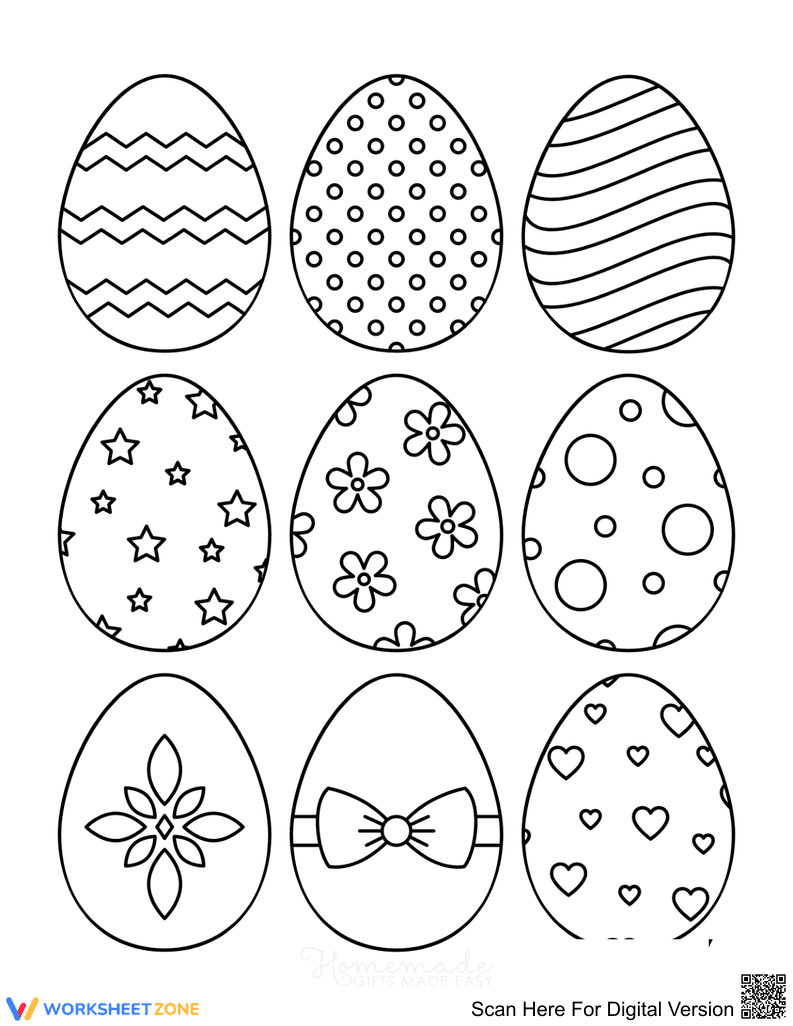
This Easter Eggs coloring worksheet provides young learners with 9 distinct patterns to explore, fostering essential fine motor development and artistic expression. By engaging with varied shapes like stars, hearts, and zig-zags, students practice the precision required for early writing tasks. It is a functional, holiday-themed resource designed for immediate classroom implementation.
At a Glance
- Grade: Kindergarten · Subject: Arts & English
- Standard:
CCSS.ELA-LITERACY.L.K.1— Demonstrate command of the conventions of standard English grammar and usage when writing- Skill Focus: Fine motor control and pattern recognition
- Format: 1 page · 9 problems · Answer key included · PDF
- Best For: Holiday morning work or art centers
- Time: 15–20 minutes
This single-page PDF features 9 individual Easter egg illustrations, each containing a unique geometric or organic pattern. Students will find eggs decorated with polka dots, stripes, floral motifs, stars, and hearts. The clean black-and-white line art ensures high-quality printing, while the variety of designs allows for multiple coloring techniques, from solid fills to gradient shading.
The zero-prep workflow for this resource is designed for maximum efficiency in a busy classroom. First, print the required number of copies (30 seconds). Second, distribute the sheets along with crayons, markers, or colored pencils (1 minute). Third, review the completed work to observe student grip and stroke control (30 seconds). Total teacher preparation time is under 2 minutes, making it an ideal choice for emergency sub plans or transition periods.
The primary alignment is CCSS.ELA-LITERACY.L.K.1, which focuses on the command of conventions and the physical act of writing. While primarily an artistic activity, the grip strength and spatial awareness developed here are direct prerequisites for letter formation. This standard code can be copied directly into lesson plans, IEP goals, or district curriculum mapping tools.
Use this worksheet as a calming morning work activity during the week leading up to the spring break. It serves as an excellent formative assessment tool for observing pencil grasp and boundary awareness in early childhood settings. Alternatively, place it in a holiday-themed art station to encourage independent creative choices. Expected completion time ranges from 15 to 20 minutes depending on the medium used.
This resource is tailored for Kindergarten and First Grade students, though it remains accessible for preschool learners developing foundational motor skills. It is particularly beneficial for students receiving Occupational Therapy (OT) support who need engaging ways to practice hand-eye coordination. Pair this with a seasonal read-aloud or a lesson on symmetry and patterns.
Research from Fisher & Frey (2014) emphasizes the importance of scaffolded fine motor activities in the early years to support later literacy outcomes. This Easter Eggs worksheet aligns with these findings by providing structured boundaries that require precise motor control. By engaging with 9 different patterns, students build the muscular endurance necessary for sustained writing tasks. The use of seasonal themes increases student engagement, which is a key factor in retention and skill mastery according to NAEP data. This resource provides a practical application of CCSS.ELA-LITERACY.L.K.1 by bridging the gap between creative play and academic readiness. Educators can utilize this tool to document progress in manual dexterity, ensuring that students meet the physical demands of the primary curriculum while enjoying a culturally relevant holiday activity.


