


























Views
Downloads
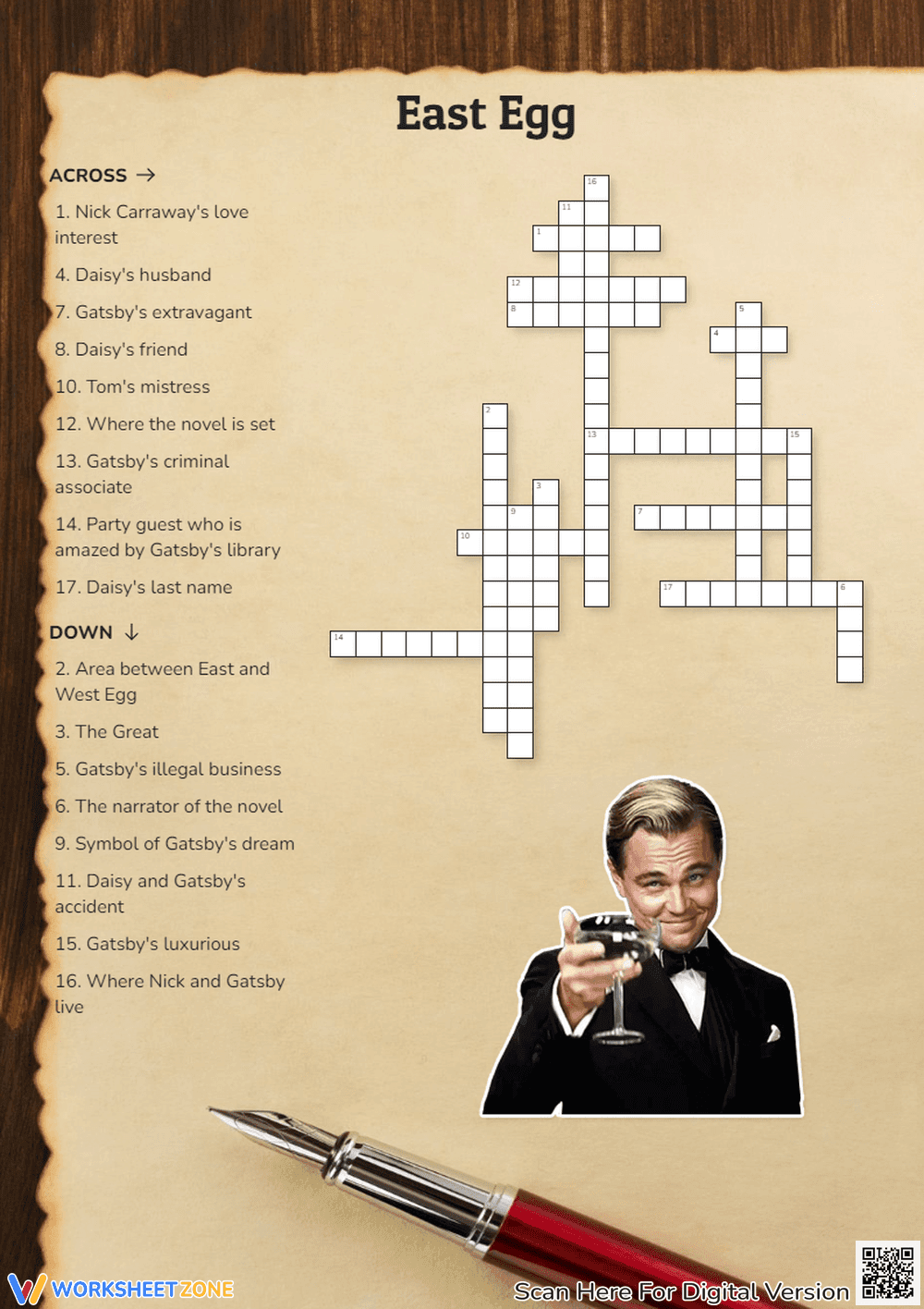

East Egg Crossword Puzzle | Essential Grade 5 ELA
Paste this activity's link or code into your existing LMS (Google Classroom, Canvas, Teams, Schoology, Moodle, etc.).
Students can open and work on the activity right away, with no student login required.
You'll still be able to track student progress and results from your teacher account.
This Grade 5 literary crossword provides a structured way for students to recall key details from the classic setting of East Egg. By identifying 16 specific characters, relationships, and plot points, learners demonstrate their comprehension of text-based evidence. It serves as a high-interest review tool that reinforces vocabulary and narrative structure without requiring extensive teacher preparation.
At a Glance
- Grade: 5 · Subject: ELA
- Standard:
CCSS.ELA-LITERACY.RL.5.3— Compare and contrast two or more characters, settings, or events in a story- Skill Focus: Character and setting recall
- Format: 1 page · 16 problems · Answer key included · PDF
- Best For: Post-reading review and vocabulary reinforcement
- Time: 15–20 minutes
The worksheet features a single-page layout containing a 16-clue crossword grid. Clues are divided into "Across" and "Down" categories, targeting specific details such as Nick Carraway’s love interest, Gatsby’s criminal associates, and the symbolic geography of the novel. The visual design includes a thematic background and character imagery to maintain student engagement during independent work or small-group rotations.
The zero-prep workflow is designed for maximum efficiency in busy classrooms. Teachers can print the PDF in under 30 seconds, distribute it to the class in 1 minute, and conduct a whole-group review of the 16 answers in approximately 5 minutes. This makes the resource an ideal choice for emergency sub plans or as a transition activity between reading blocks.
This resource aligns with CCSS.ELA-LITERACY.RL.5.3, which requires students to describe in depth a character, setting, or event in a story or drama, drawing on specific details in the text. By correctly identifying figures like Tom, Daisy, and Jordan, students prove their ability to track character interactions across chapters. Both standard codes can be copied directly into lesson plans, IEP goals, or district curriculum mapping tools.
Use this crossword as a formative assessment after completing the initial chapters of the text. Observe which students struggle with specific character names versus setting descriptions to identify gaps in literal comprehension. It also works well as a quiet-time activity for early finishers, typically requiring 15 to 20 minutes for completion depending on the student's familiarity with the source material.
This activity is tailored for Grade 5 students engaging with introductory literary analysis. It provides necessary support for visual learners through the crossword format while challenging advanced readers to recall nuanced plot details. It pairs naturally with a character anchor chart or a map of East and West Egg to provide additional scaffolding for students who need visual cues.
Research by Fisher & Frey (2014) emphasizes that structured review activities, such as crosswords, help solidify the retrieval of domain-specific vocabulary and character relationships in complex narratives. This worksheet specifically targets CCSS.ELA-LITERACY.RL.5.3 by requiring students to identify 16 distinct elements of the setting and cast. By engaging in this retrieval practice, students move beyond passive reading toward active recall, which is a critical component of long-term retention in ELA instruction. According to the RAND AIRS 2024 report, high-quality supplemental materials that focus on specific standard-aligned skills significantly improve student performance on standardized assessments. This resource provides a focused, 20-minute intervention that bridges the gap between initial reading and deep literary analysis, ensuring that every student has a firm grasp of the foundational facts before moving into higher-order thematic discussions or essay writing.


